 Add to Chrome
 Add to Firefox
 Add to Edge
ELLIPSE: Evidential Learning for Robust Waypoints and Uncertainties
Mar 04, 2026
Robust waypoint prediction is crucial for mobile robots operating in open-world, safety-critical settings. While Imitation Learning (IL) methods have demonstrated great success in practice, they are susceptible to distribution shifts: the policy can become dangerously overconfident in unfamiliar states. In this paper, we present \textit{ELLIPSE}, a method building on multivariate deep evidential regression to output waypoints and multivariate Student-t predictive distributions in a single forward pass. To reduce covariate-shift-induced overconfidence under viewpoint and pose perturbations near expert trajectories, we introduce a lightweight domain augmentation procedure that synthesizes plausible viewpoint/pose variations without collecting additional demonstrations. To improve uncertainty reliability under environment/domain shift (e.g., unseen staircases), we apply a post-hoc isotonic recalibration on probability integral transform (PIT) values so that prediction sets remain plausible during deployment. We ground the discussion and experiments in staircase waypoint prediction, where obtaining robust waypoint and uncertainty is pivotal. Extensive real world evaluations show that \textit{ELLIPSE} improves both task success rate and uncertainty coverage compared to baselines.

Learning-on-the-Drive: Self-supervised Adaptation of Visual Offroad Traversability Models
Jun 27, 2023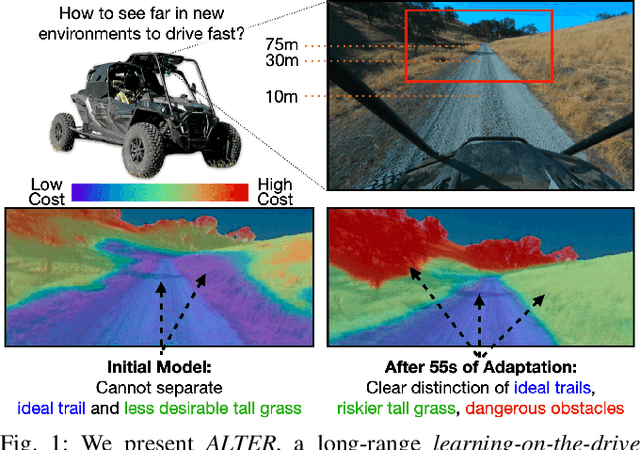
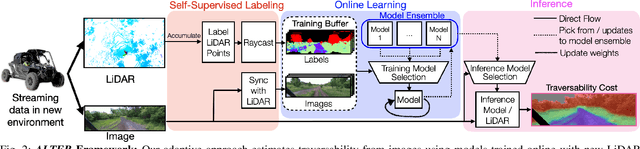

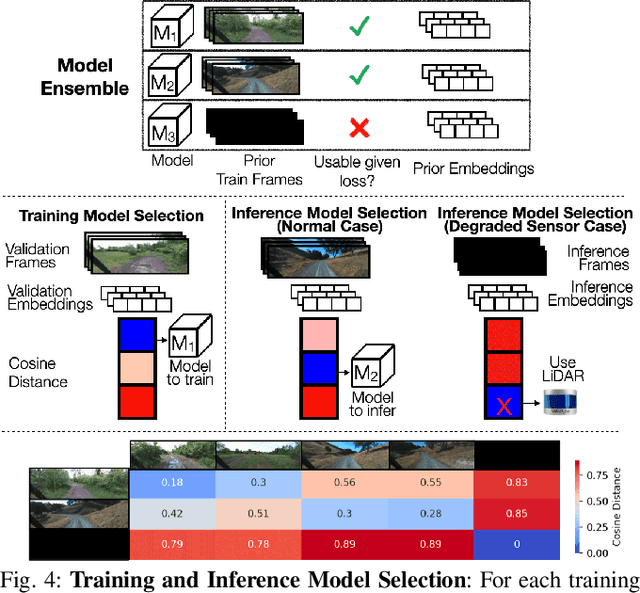
Autonomous off-road driving requires understanding traversability, which refers to the suitability of a given terrain to drive over. When offroad vehicles travel at high speed ($>10m/s$), they need to reason at long-range ($50m$-$100m$) for safe and deliberate navigation. Moreover, vehicles often operate in new environments and under different weather conditions. LiDAR provides accurate estimates robust to visual appearances, however, it is often too noisy beyond 30m for fine-grained estimates due to sparse measurements. Conversely, visual-based models give dense predictions at further distances but perform poorly at all ranges when out of training distribution. To address these challenges, we present ALTER, an offroad perception module that adapts-on-the-drive to combine the best of both sensors. Our visual model continuously learns from new near-range LiDAR measurements. This self-supervised approach enables accurate long-range traversability prediction in novel environments without hand-labeling. Results on two distinct real-world offroad environments show up to 52.5% improvement in traversability estimation over LiDAR-only estimates and 38.1% improvement over non-adaptive visual baseline.