 Add to Chrome
 Add to Firefox
 Add to Edge
Through the PRISM: Principle-Aware, Interpretable, and Multi-Scale Evaluation of Visual Designs
May 30, 2026
Effective visual communication stems from the harmony of multiple design principles, such as readability, contrast, alignment, overlap, and coherence, which collectively govern clarity and intent of the communicator. While human designers reason holistically over these principles, machine agents typically condense them into a single heuristic score, offering limited interpretability and diagnostic precision. To address this gap, we introduce PRISM (PRinciple-aware, Interpretable, and Structure-guided Design Modifications), a benchmark that systematically perturbs professional layouts from the Crello dataset along measurable design principles. The benchmark comprises 100K perturbed training samples and 10K perturbed validation designs, each isolating a specific principle violation for controlled analysis of multimodal reasoning about design quality. We show that models like Qwen-2.5-VL and GPT-4o-mini are largely insensitive to targeted principle degradations, whereas GPT-4o exhibits global awareness without fine-grained disentanglement. Building on these insights, we propose a multi-scale evaluation framework that integrates lightweight scorers for quantitative assessment, instruction-tuned vision-language models for localised feedback, and prompt-based methods for global reasoning. Our framework provides interpretable explanations of design failures. Using these localised insights, we show targeted refinements that improve layout quality. Together, PRISM and our framework lay the foundation for interpretable design-literate multimodal reasoning systems.

$\textrm{D}^3\textrm{Former}$: Debiased Dual Distilled Transformer for Incremental Learning
Jul 25, 2022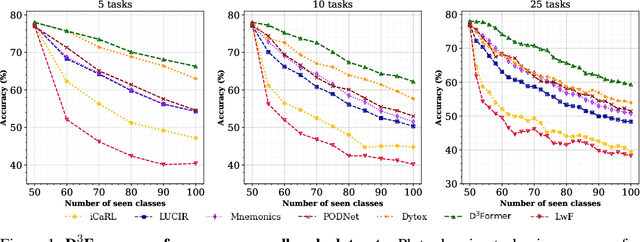
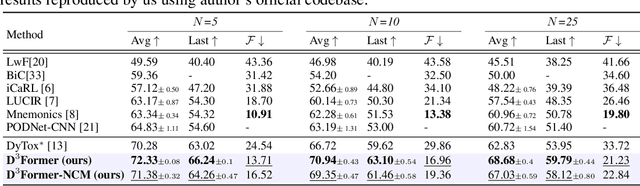
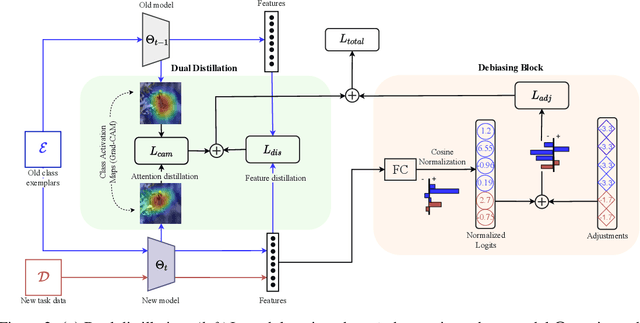
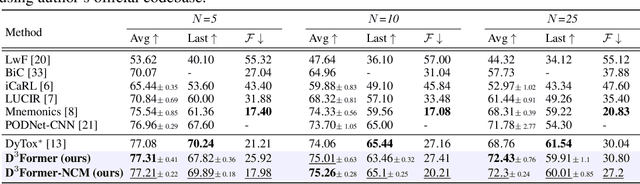
Class incremental learning (CIL) involves learning a classification model where groups of new classes are encountered in every learning phase. The goal is to learn a unified model performant on all the classes observed so far. Given the recent popularity of Vision Transformers (ViTs) in conventional classification settings, an interesting question is to study their continual learning behaviour. In this work, we develop a Debiased Dual Distilled Transformer for CIL dubbed $\textrm{D}^3\textrm{Former}$. The proposed model leverages a hybrid nested ViT design to ensure data efficiency and scalability to small as well as large datasets. In contrast to a recent ViT based CIL approach, our $\textrm{D}^3\textrm{Former}$ does not dynamically expand its architecture when new tasks are learned and remains suitable for a large number of incremental tasks. The improved CIL behaviour of $\textrm{D}^3\textrm{Former}$ owes to two fundamental changes to the ViT design. First, we treat the incremental learning as a long-tail classification problem where the majority samples from new classes vastly outnumber the limited exemplars available for old classes. To avoid biasness against the minority old classes, we propose to dynamically adjust logits to emphasize on retaining the representations relevant to old tasks. Second, we propose to preserve the configuration of spatial attention maps as the learning progresses across tasks. This helps in reducing catastrophic forgetting via constraining the model to retain the attention on the most discriminative regions. $\textrm{D}^3\textrm{Former}$ obtains favorable results on incremental versions of CIFAR-100, MNIST, SVHN, and ImageNet datasets.