 Add to Chrome
 Add to Firefox
 Add to Edge
Learning Modal-Mixed Chain-of-Thought Reasoning with Latent Embeddings
Jan 31, 2026
We study how to extend chain-of-thought (CoT) beyond language to better handle multimodal reasoning. While CoT helps LLMs and VLMs articulate intermediate steps, its text-only form often fails on vision-intensive problems where key intermediate states are inherently visual. We introduce modal-mixed CoT, which interleaves textual tokens with compact visual sketches represented as latent embeddings. To bridge the modality gap without eroding the original knowledge and capability of the VLM, we use the VLM itself as an encoder and train the language backbone to reconstruct its own intermediate vision embeddings, to guarantee the semantic alignment of the visual latent space. We further attach a diffusion-based latent decoder, invoked by a special control token and conditioned on hidden states from the VLM. In this way, the diffusion head carries fine-grained perceptual details while the VLM specifies high-level intent, which cleanly disentangles roles and reduces the optimization pressure of the VLM. Training proceeds in two stages: supervised fine-tuning on traces that interleave text and latents with a joint next-token and latent-reconstruction objective, followed by reinforcement learning that teaches when to switch modalities and how to compose long reasoning chains. Extensive experiments across 11 diverse multimodal reasoning tasks, demonstrate that our method yields better performance than language-only and other CoT methods. Our code will be publicly released.

Logit-Entropy Adaptive Stopping Heuristic for Efficient Chain-of-Thought Reasoning
Nov 06, 2025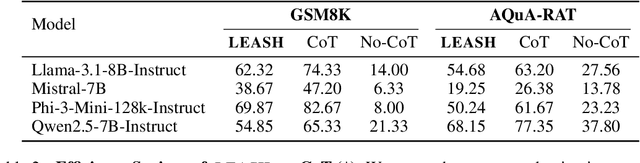
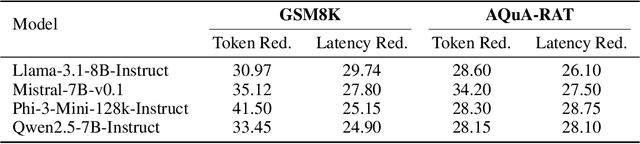
Chain-of-Thought (CoT) prompting is a key technique for enabling complex reasoning in large language models. However, generating full, fixed-length rationales is computationally wasteful, inflating both token usage and latency. We introduce LEASH: Logit-Entropy Adaptive Stopping Heuristic, a training-free decoding algorithm that adaptively halts rationale generation. LEASH monitors two intrinsic signals: the slope of token-level entropy and the improvement in the top-logit margin. It terminates the generation once both signals plateau, indicating the model has reached a stable reasoning state. Across four instruction-tuned models on the GSM8K and AQuA-RAT benchmarks, LEASH reduces average token generation by 30--35% and latency by 27%, while incurring a 10 p.p. accuracy drop relative to CoT. LEASH is model-agnostic and requires no additional training or supervision, offering a simple and efficient alternative to CoT decoding.
STARS: Segment-level Token Alignment with Rejection Sampling in Large Language Models
Nov 05, 2025Aligning large language models with human values is crucial for their safe deployment; however, existing methods, such as fine-tuning, are computationally expensive and suboptimal. In contrast, inference-time approaches like Best-of-N sampling require practically infeasible computation to achieve optimal alignment. We propose STARS: Segment-level Token Alignment with Rejection Sampling, a decoding-time algorithm that steers model generation by iteratively sampling, scoring, and rejecting/accepting short, fixed-size token segments. This allows for early correction of the generation path, significantly improving computational efficiency and boosting alignment quality. Across a suite of six LLMs, we show that STARS outperforms Supervised Fine-Tuning (SFT) by up to 14.9 percentage points and Direct Preference Optimization (DPO) by up to 4.3 percentage points on win-rates, while remaining highly competitive with strong Best-of-N baselines. Our work establishes granular, reward-guided sampling as a generalizable, robust, and efficient alternative to traditional fine-tuning and full-sequence ranking methods for aligning LLMs.