 Add to Chrome
 Add to Firefox
 Add to Edge
Logit-Entropy Adaptive Stopping Heuristic for Efficient Chain-of-Thought Reasoning
Nov 06, 2025
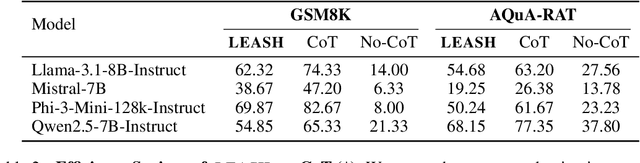
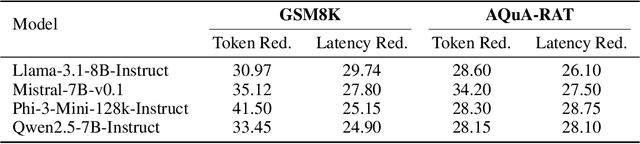
Chain-of-Thought (CoT) prompting is a key technique for enabling complex reasoning in large language models. However, generating full, fixed-length rationales is computationally wasteful, inflating both token usage and latency. We introduce LEASH: Logit-Entropy Adaptive Stopping Heuristic, a training-free decoding algorithm that adaptively halts rationale generation. LEASH monitors two intrinsic signals: the slope of token-level entropy and the improvement in the top-logit margin. It terminates the generation once both signals plateau, indicating the model has reached a stable reasoning state. Across four instruction-tuned models on the GSM8K and AQuA-RAT benchmarks, LEASH reduces average token generation by 30--35% and latency by 27%, while incurring a 10 p.p. accuracy drop relative to CoT. LEASH is model-agnostic and requires no additional training or supervision, offering a simple and efficient alternative to CoT decoding.

STARS: Segment-level Token Alignment with Rejection Sampling in Large Language Models
Nov 05, 2025Aligning large language models with human values is crucial for their safe deployment; however, existing methods, such as fine-tuning, are computationally expensive and suboptimal. In contrast, inference-time approaches like Best-of-N sampling require practically infeasible computation to achieve optimal alignment. We propose STARS: Segment-level Token Alignment with Rejection Sampling, a decoding-time algorithm that steers model generation by iteratively sampling, scoring, and rejecting/accepting short, fixed-size token segments. This allows for early correction of the generation path, significantly improving computational efficiency and boosting alignment quality. Across a suite of six LLMs, we show that STARS outperforms Supervised Fine-Tuning (SFT) by up to 14.9 percentage points and Direct Preference Optimization (DPO) by up to 4.3 percentage points on win-rates, while remaining highly competitive with strong Best-of-N baselines. Our work establishes granular, reward-guided sampling as a generalizable, robust, and efficient alternative to traditional fine-tuning and full-sequence ranking methods for aligning LLMs.