 Add to Chrome
 Add to Firefox
 Add to Edge
Gemini Embedding 2: A Native Multimodal Embedding Model from Gemini
May 26, 2026
We introduce Gemini Embedding 2, a native multimodal embedding model that allows embedding video, audio, image, and text modalities in a unified representation space. We leverage the multimodal capabilities of Gemini to produce embeddings for arbitrary combinations of interleaved inputs across all these modalities that generalize well across a wide variety of tasks. Applying large-scale contrastive learning in a multi-task multi-stage training setup, we achieve state-of-the-art performance on key embedding benchmarks including unimodal, cross-modal, and multimodal retrieval spanning a diverse set of tasks. We show that our embedding model demonstrates strong performance (with a score of 62.9 R@1 on MSCOCO, 68.8 NDCG@10 on Vatex, 69.9 on MTEB multilingual and 84.0 on MTEB Code) across a variety of tasks surpassing the performance of specialized models. These unified capabilities make Gemini Embedding 2 a promising candidate for downstream use cases such as RAG, recommendation and search. Furthermore, its robust zero-shot performance across distinct fields - from astronomy and bioscience to fine arts and the culinary arts - establishes it as a highly reliable, out-of-the-box representation even for specialized domains.

TIPSv2: Advancing Vision-Language Pretraining with Enhanced Patch-Text Alignment
Apr 13, 2026Recent progress in vision-language pretraining has enabled significant improvements to many downstream computer vision applications, such as classification, retrieval, segmentation and depth prediction. However, a fundamental capability that these models still struggle with is aligning dense patch representations with text embeddings of corresponding concepts. In this work, we investigate this critical issue and propose novel techniques to enhance this capability in foundational vision-language models. First, we reveal that a patch-level distillation procedure significantly boosts dense patch-text alignment -- surprisingly, the patch-text alignment of the distilled student model strongly surpasses that of the teacher model. This observation inspires us to consider modifications to pretraining recipes, leading us to propose iBOT++, an upgrade to the commonly-used iBOT masked image objective, where unmasked tokens also contribute directly to the loss. This dramatically enhances patch-text alignment of pretrained models. Additionally, to improve vision-language pretraining efficiency and effectiveness, we modify the exponential moving average setup in the learning recipe, and introduce a caption sampling strategy to benefit from synthetic captions at different granularities. Combining these components, we develop TIPSv2, a new family of image-text encoder models suitable for a wide range of downstream applications. Through comprehensive experiments on 9 tasks and 20 datasets, we demonstrate strong performance, generally on par with or better than recent vision encoder models. Code and models are released via our project page at https://gdm-tipsv2.github.io/ .
Non-Intrusive Adaptation: Input-Centric Parameter-efficient Fine-Tuning for Versatile Multimodal Modeling
Oct 18, 2023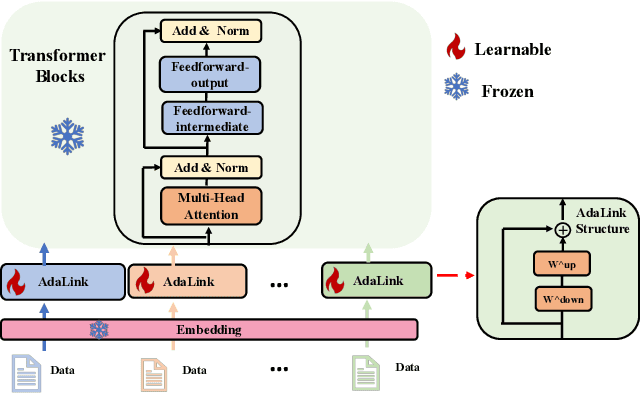


Large language models (LLMs) and vision language models (VLMs) demonstrate excellent performance on a wide range of tasks by scaling up parameter counts from O(10^9) to O(10^{12}) levels and further beyond. These large scales make it impossible to adapt and deploy fully specialized models given a task of interest. Parameter-efficient fine-tuning (PEFT) emerges as a promising direction to tackle the adaptation and serving challenges for such large models. We categorize PEFT techniques into two types: intrusive and non-intrusive. Intrusive PEFT techniques directly change a model's internal architecture. Though more flexible, they introduce significant complexities for training and serving. Non-intrusive PEFT techniques leave the internal architecture unchanged and only adapt model-external parameters, such as embeddings for input. In this work, we describe AdaLink as a non-intrusive PEFT technique that achieves competitive performance compared to SoTA intrusive PEFT (LoRA) and full model fine-tuning (FT) on various tasks. We evaluate using both text-only and multimodal tasks, with experiments that account for both parameter-count scaling and training regime (with and without instruction tuning).