 Add to Chrome
 Add to Firefox
 Add to Edge
Distilling Self-Supervised Vision Transformers for Weakly-Supervised Few-Shot Classification & Segmentation
Jul 07, 2023
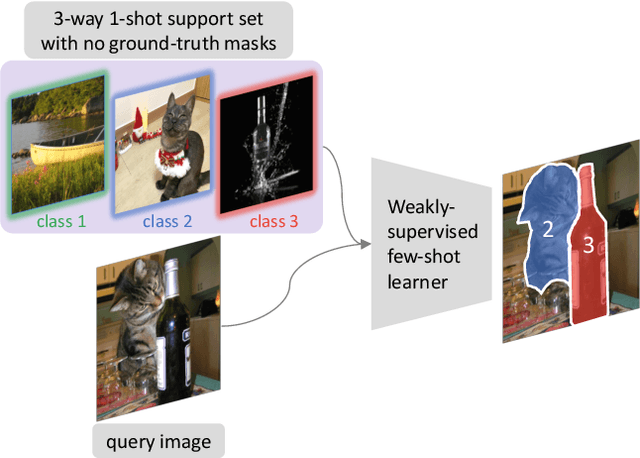

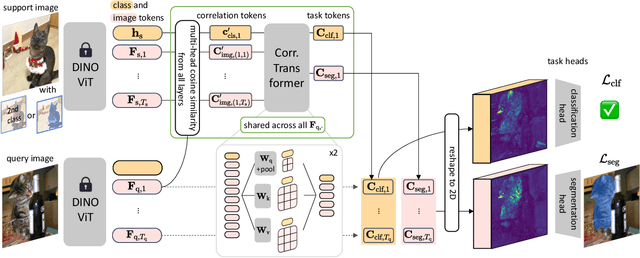
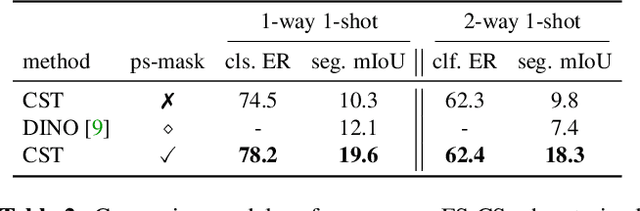
We address the task of weakly-supervised few-shot image classification and segmentation, by leveraging a Vision Transformer (ViT) pretrained with self-supervision. Our proposed method takes token representations from the self-supervised ViT and leverages their correlations, via self-attention, to produce classification and segmentation predictions through separate task heads. Our model is able to effectively learn to perform classification and segmentation in the absence of pixel-level labels during training, using only image-level labels. To do this it uses attention maps, created from tokens generated by the self-supervised ViT backbone, as pixel-level pseudo-labels. We also explore a practical setup with ``mixed" supervision, where a small number of training images contains ground-truth pixel-level labels and the remaining images have only image-level labels. For this mixed setup, we propose to improve the pseudo-labels using a pseudo-label enhancer that was trained using the available ground-truth pixel-level labels. Experiments on Pascal-5i and COCO-20i demonstrate significant performance gains in a variety of supervision settings, and in particular when little-to-no pixel-level labels are available.
* Accepted at CVPR 2023

Stable and Consistent Prediction of 3D Characteristic Orientation via Invariant Residual Learning
Jun 20, 2023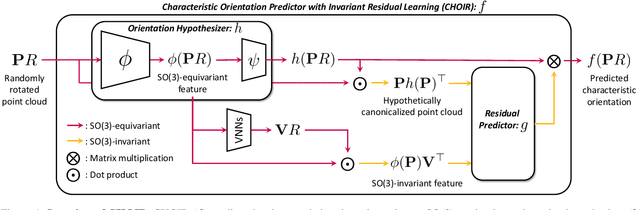

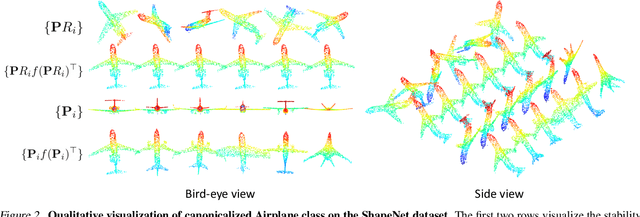

Learning to predict reliable characteristic orientations of 3D point clouds is an important yet challenging problem, as different point clouds of the same class may have largely varying appearances. In this work, we introduce a novel method to decouple the shape geometry and semantics of the input point cloud to achieve both stability and consistency. The proposed method integrates shape-geometry-based SO(3)-equivariant learning and shape-semantics-based SO(3)-invariant residual learning, where a final characteristic orientation is obtained by calibrating an SO(3)-equivariant orientation hypothesis using an SO(3)-invariant residual rotation. In experiments, the proposed method not only demonstrates superior stability and consistency but also exhibits state-of-the-art performances when applied to point cloud part segmentation, given randomly rotated inputs.
Relational Context Learning for Human-Object Interaction Detection
Apr 11, 2023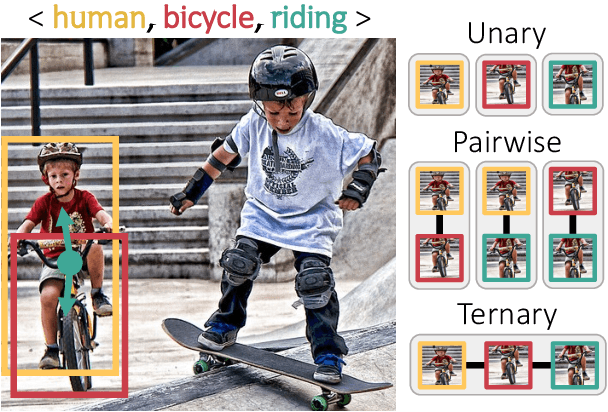
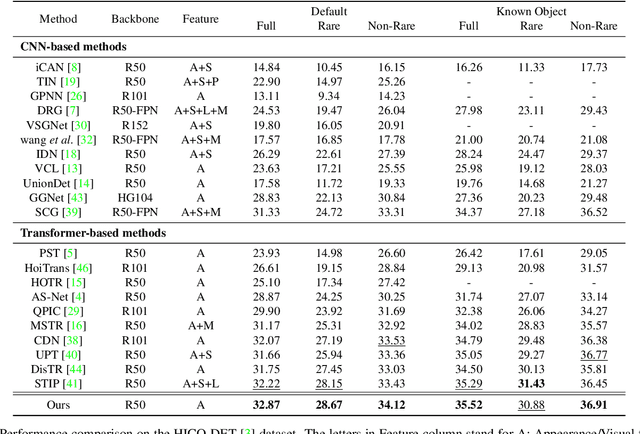
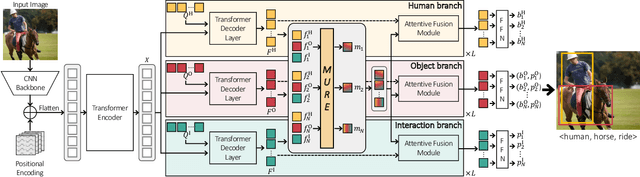
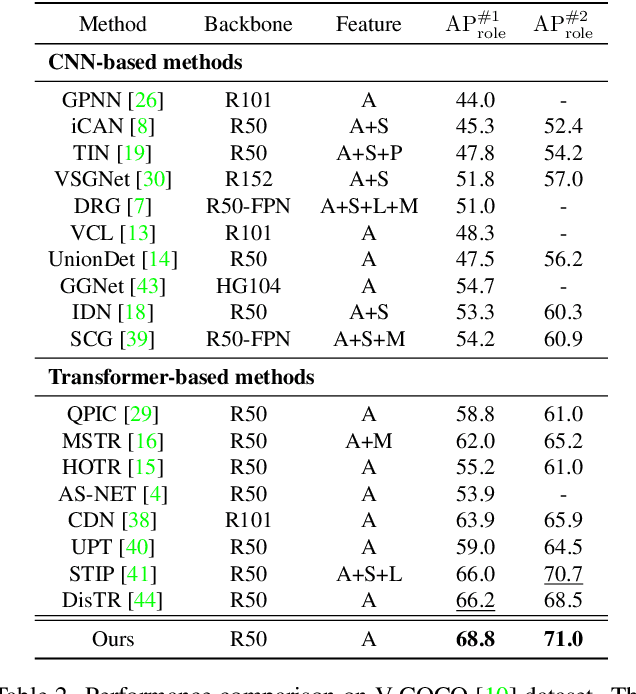
Recent state-of-the-art methods for HOI detection typically build on transformer architectures with two decoder branches, one for human-object pair detection and the other for interaction classification. Such disentangled transformers, however, may suffer from insufficient context exchange between the branches and lead to a lack of context information for relational reasoning, which is critical in discovering HOI instances. In this work, we propose the multiplex relation network (MUREN) that performs rich context exchange between three decoder branches using unary, pairwise, and ternary relations of human, object, and interaction tokens. The proposed method learns comprehensive relational contexts for discovering HOI instances, achieving state-of-the-art performance on two standard benchmarks for HOI detection, HICO-DET and V-COCO.
Devil's on the Edges: Selective Quad Attention for Scene Graph Generation
Apr 07, 2023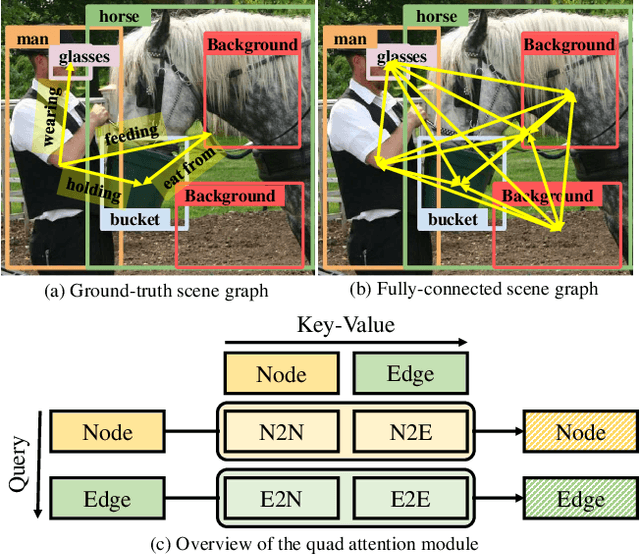
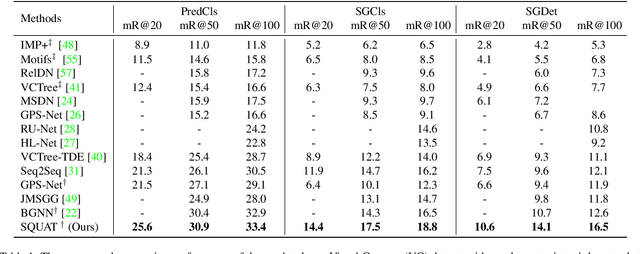
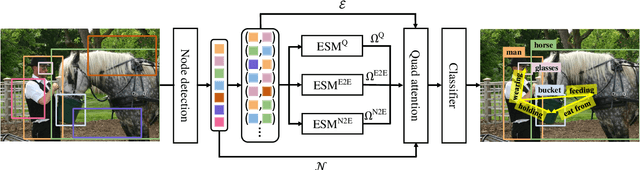
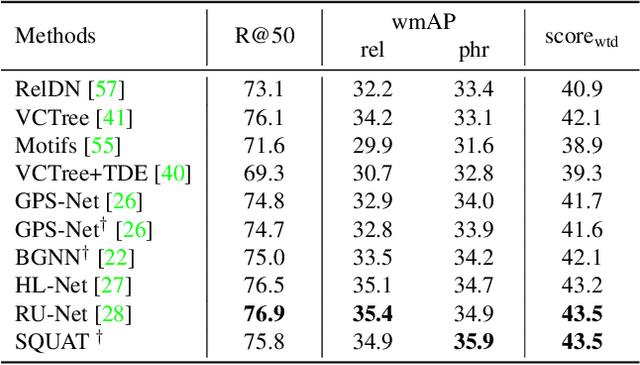
Scene graph generation aims to construct a semantic graph structure from an image such that its nodes and edges respectively represent objects and their relationships. One of the major challenges for the task lies in the presence of distracting objects and relationships in images; contextual reasoning is strongly distracted by irrelevant objects or backgrounds and, more importantly, a vast number of irrelevant candidate relations. To tackle the issue, we propose the Selective Quad Attention Network (SQUAT) that learns to select relevant object pairs and disambiguate them via diverse contextual interactions. SQUAT consists of two main components: edge selection and quad attention. The edge selection module selects relevant object pairs, i.e., edges in the scene graph, which helps contextual reasoning, and the quad attention module then updates the edge features using both edge-to-node and edge-to-edge cross-attentions to capture contextual information between objects and object pairs. Experiments demonstrate the strong performance and robustness of SQUAT, achieving the state of the art on the Visual Genome and Open Images v6 benchmarks.
Learning Rotation-Equivariant Features for Visual Correspondence
Mar 25, 2023Extracting discriminative local features that are invariant to imaging variations is an integral part of establishing correspondences between images. In this work, we introduce a self-supervised learning framework to extract discriminative rotation-invariant descriptors using group-equivariant CNNs. Thanks to employing group-equivariant CNNs, our method effectively learns to obtain rotation-equivariant features and their orientations explicitly, without having to perform sophisticated data augmentations. The resultant features and their orientations are further processed by group aligning, a novel invariant mapping technique that shifts the group-equivariant features by their orientations along the group dimension. Our group aligning technique achieves rotation-invariance without any collapse of the group dimension and thus eschews loss of discriminability. The proposed method is trained end-to-end in a self-supervised manner, where we use an orientation alignment loss for the orientation estimation and a contrastive descriptor loss for robust local descriptors to geometric/photometric variations. Our method demonstrates state-of-the-art matching accuracy among existing rotation-invariant descriptors under varying rotation and also shows competitive results when transferred to the task of keypoint matching and camera pose estimation.
Generalizable Implicit Neural Representations via Instance Pattern Composers
Nov 23, 2022
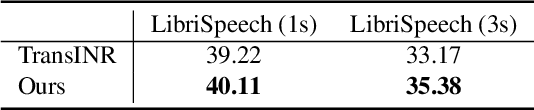


Despite recent advances in implicit neural representations (INRs), it remains challenging for a coordinate-based multi-layer perceptron (MLP) of INRs to learn a common representation across data instances and generalize it for unseen instances. In this work, we introduce a simple yet effective framework for generalizable INRs that enables a coordinate-based MLP to represent complex data instances by modulating only a small set of weights in an early MLP layer as an instance pattern composer; the remaining MLP weights learn pattern composition rules for common representations across instances. Our generalizable INR framework is fully compatible with existing meta-learning and hypernetworks in learning to predict the modulated weight for unseen instances. Extensive experiments demonstrate that our method achieves high performance on a wide range of domains such as an audio, image, and 3D object, while the ablation study validates our weight modulation.
Few-shot Metric Learning: Online Adaptation of Embedding for Retrieval
Nov 14, 2022Metric learning aims to build a distance metric typically by learning an effective embedding function that maps similar objects into nearby points in its embedding space. Despite recent advances in deep metric learning, it remains challenging for the learned metric to generalize to unseen classes with a substantial domain gap. To tackle the issue, we explore a new problem of few-shot metric learning that aims to adapt the embedding function to the target domain with only a few annotated data. We introduce three few-shot metric learning baselines and propose the Channel-Rectifier Meta-Learning (CRML), which effectively adapts the metric space online by adjusting channels of intermediate layers. Experimental analyses on miniImageNet, CUB-200-2011, MPII, as well as a new dataset, miniDeepFashion, demonstrate that our method consistently improves the learned metric by adapting it to target classes and achieves a greater gain in image retrieval when the domain gap from the source classes is larger.
Soft-Landing Strategy for Alleviating the Task Discrepancy Problem in Temporal Action Localization Tasks
Nov 11, 2022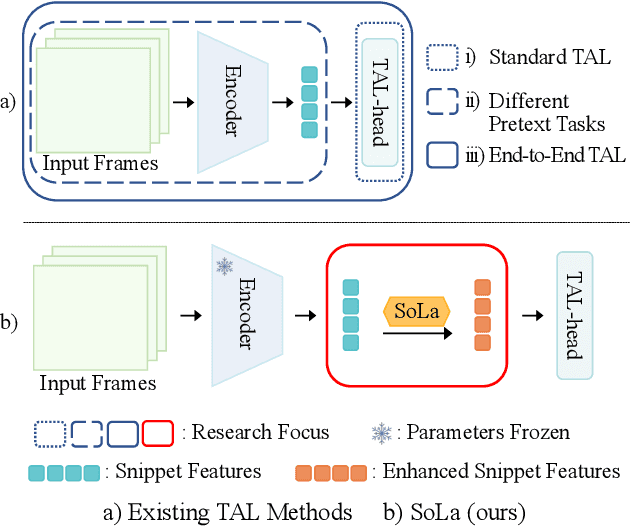
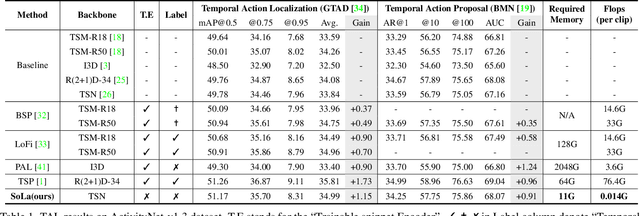
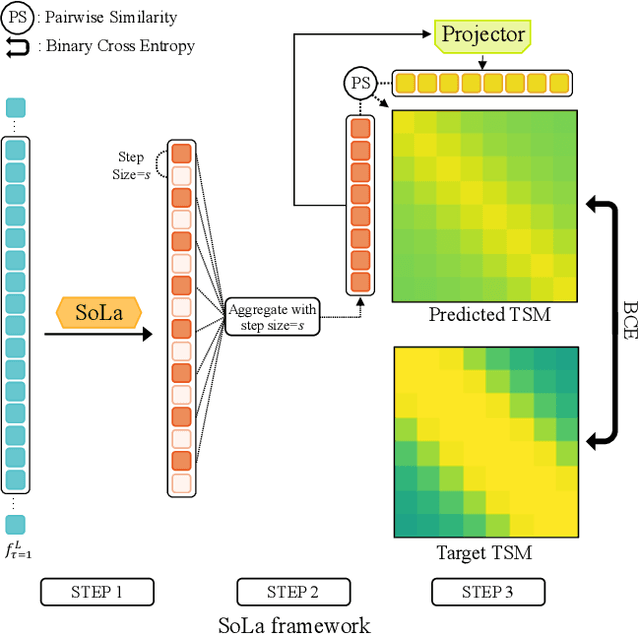
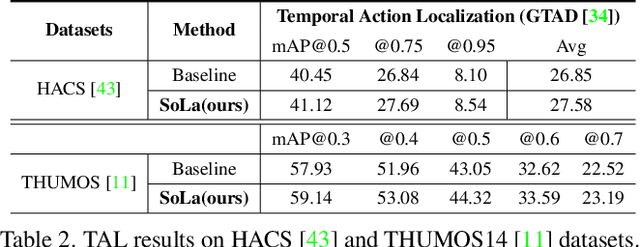
Temporal Action Localization (TAL) methods typically operate on top of feature sequences from a frozen snippet encoder that is pretrained with the Trimmed Action Classification (TAC) tasks, resulting in a task discrepancy problem. While existing TAL methods mitigate this issue either by retraining the encoder with a pretext task or by end-to-end fine-tuning, they commonly require an overload of high memory and computation. In this work, we introduce Soft-Landing (SoLa) strategy, an efficient yet effective framework to bridge the transferability gap between the pretrained encoder and the downstream tasks by incorporating a light-weight neural network, i.e., a SoLa module, on top of the frozen encoder. We also propose an unsupervised training scheme for the SoLa module; it learns with inter-frame Similarity Matching that uses the frame interval as its supervisory signal, eliminating the need for temporal annotations. Experimental evaluation on various benchmarks for downstream TAL tasks shows that our method effectively alleviates the task discrepancy problem with remarkable computational efficiency.
Sequential Brick Assembly with Efficient Constraint Satisfaction
Oct 03, 2022
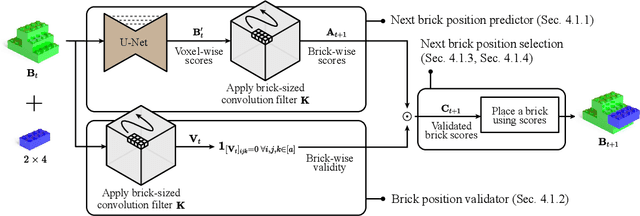
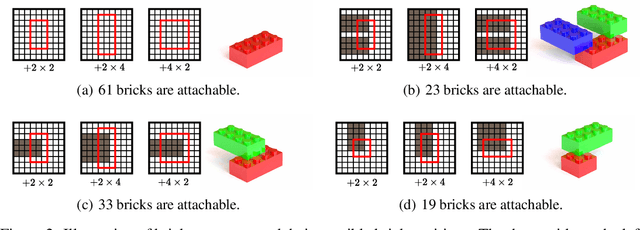
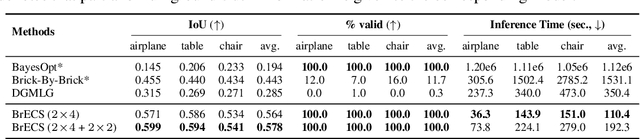
We address the problem of generating a sequence of LEGO brick assembly with high-fidelity structures, satisfying physical constraints between bricks. The assembly problem is challenging since the number of possible structures increases exponentially with the number of available bricks, complicating the physical constraints to satisfy across bricks. To tackle this problem, our method performs a brick structure assessment to predict the next brick position and its confidence by employing a U-shaped sparse 3D convolutional network. The convolution filter efficiently validates physical constraints in a parallelizable and scalable manner, allowing to process of different brick types. To generate a novel structure, we devise a sampling strategy to determine the next brick position by considering attachable positions under physical constraints. Instead of using handcrafted brick assembly datasets, our model is trained with a large number of 3D objects that allow to create a new high-fidelity structure. We demonstrate that our method successfully generates diverse brick structures while handling two different brick types and outperforms existing methods based on Bayesian optimization, graph generative model, and reinforcement learning, all of which are limited to a single brick type.
PeRFception: Perception using Radiance Fields
Aug 24, 2022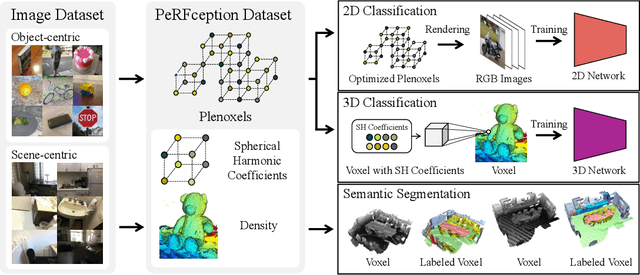
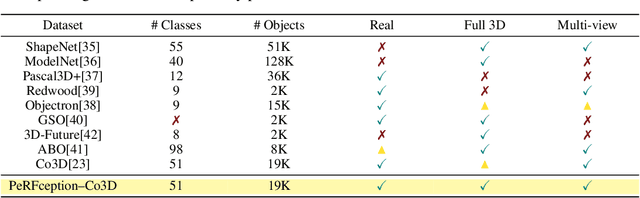
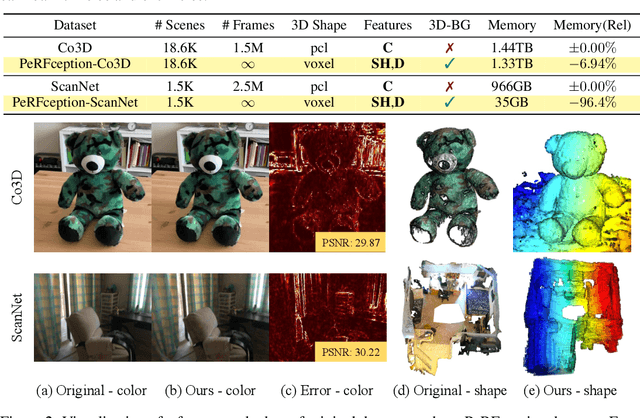

The recent progress in implicit 3D representation, i.e., Neural Radiance Fields (NeRFs), has made accurate and photorealistic 3D reconstruction possible in a differentiable manner. This new representation can effectively convey the information of hundreds of high-resolution images in one compact format and allows photorealistic synthesis of novel views. In this work, using the variant of NeRF called Plenoxels, we create the first large-scale implicit representation datasets for perception tasks, called the PeRFception, which consists of two parts that incorporate both object-centric and scene-centric scans for classification and segmentation. It shows a significant memory compression rate (96.4\%) from the original dataset, while containing both 2D and 3D information in a unified form. We construct the classification and segmentation models that directly take as input this implicit format and also propose a novel augmentation technique to avoid overfitting on backgrounds of images. The code and data are publicly available in https://postech-cvlab.github.io/PeRFception .