 Add to Chrome
 Add to Firefox
 Add to Edge
OmniGF: A Dual-Branch Vision-Language Framework for Unified Gaze Following
May 26, 2026
Understanding human gaze behavior is essential for complex scene comprehension and human-computer interaction. Traditional gaze following models are typically restricted to pure spatial localization, lacking the high-level capacity to reason about semantic targets or complex social contexts. Furthermore, these models often process individuals sequentially, requiring redundant computations over the same scene image for multi-person inference. While recent Vision-Language Models (VLMs) offer the exceptional semantic reasoning needed to address gaze-related semantic tasks, their reliance on discrete text generation inherently limits precision in continuous spatial tasks like gaze localization. To bridge this gap, we propose OmniGF, a unified vision-language framework that adapts foundational VLMs for highly scalable multi-person gaze reasoning. The model adopts a dual-branch decoding strategy: a structured language branch generates discrete reasoning states, while a continuous spatial branch directly taps into the VLM's dense hidden states. Supervising these extracted representations with high-resolution gaze target heatmaps effectively overcomes the spatial bottleneck of text-only coordinate generation. Furthermore, to explicitly ground the model in multi-person scenes, we augment the input with head embeddings encoded from cropped head images, providing fine-grained appearance and orientation cues for all individuals simultaneously. By modeling all individuals and leveraging the strong semantic capability of VLMs, OmniGF seamlessly integrates precise spatial gaze target estimation, semantic gaze prediction, and complex social gaze reasoning. Extensive experiments demonstrate that our framework establishes new state-of-the-art performance across multiple standard benchmarks. Code is available at https://github.com/cvlab-stonybrook/omnigf.

Dual Strategies for Test-Time Adaptation
Apr 19, 2026Conventional test-time adaptation (TTA) approaches typically adapt the model using only a small fraction of test samples, often those with low-entropy predictions, thereby failing to fully leverage the available information in the test distribution. This paper introduces DualTTA, a novel framework that improves performance under distribution shifts by utilizing a larger and more diverse set of test samples. DualTTA identifies two distinct groups: one where the model's predictions are likely consistent with the underlying semantics, and another where predictions are likely incorrect. For the first group, it minimizes prediction entropy to reinforce reliable decisions; for the second, it maximizes entropy to suppress overconfident errors and unlearn spurious behavior. These groups are adaptively selected using a new reliability criterion that measures prediction stability under both semantic-preserving and semantic-altering transformations, addressing the limitations of purely entropy-based selection. We further provide theoretical analysis and empirical justification showing that our approach enables a tighter separation between reliable and unreliable samples, in the context of their suitability for adaptation, leading to provably more effective model updates.
Detecting Precise Hand Touch Moments in Egocentric Video
Apr 14, 2026We address the challenging task of detecting the precise moment when hands make contact with objects in egocentric videos. This frame-level detection is crucial for augmented reality, human-computer interaction, assistive technologies, and robot learning applications, where contact onset signals action initiation or completion. Temporally precise detection is particularly challenging due to subtle hand motion variations near contact, frequent occlusions, fine-grained manipulation patterns, and the inherent motion dynamics of first-person perspectives. To tackle these challenges, we propose a Hand-informed Context Enhanced module (HiCE; pronounced `high-see') that leverages spatiotemporal features from hand regions and their surrounding context through cross-attention mechanisms, learning to identify potential contact patterns. Our approach is further refined with a grasp-aware loss and soft label that emphasizes hand pose patterns and movement dynamics characteristic of touch events, enabling the model to distinguish between near-contact and actual contact frames. We also introduce TouchMoment, an egocentric dataset containing 4,021 videos and 8,456 annotated contact moments spanning over one million frames. Experiments on TouchMoment show that, under a strict evaluation criterion that counts a prediction as correct only if it falls within a two-frame tolerance of the ground-truth moment, our method achieves substantial gains and outperforms state-of-the-art event-spotting baselines by 16.91% average precision.
BluRef: Unsupervised Image Deblurring with Dense-Matching References
Mar 15, 2026This paper introduces a novel unsupervised approach for image deblurring that utilizes a simple process for training data collection, thereby enhancing the applicability and effectiveness of deblurring methods. Our technique does not require meticulously paired data of blurred and corresponding sharp images; instead, it uses unpaired blurred and sharp images of similar scenes to generate pseudo-ground truth data by leveraging a dense matching model to identify correspondences between a blurry image and reference sharp images. Thanks to the simplicity of the training data collection process, our approach does not rely on existing paired training data or pre-trained networks, making it more adaptable to various scenarios and suitable for networks of different sizes, including those designed for low-resource devices. We demonstrate that this novel approach achieves state-of-the-art performance, marking a significant advancement in the field of image deblurring.
CountEx: Fine-Grained Counting via Exemplars and Exclusion
Feb 23, 2026This paper presents CountEx, a discriminative visual counting framework designed to address a key limitation of existing prompt-based methods: the inability to explicitly exclude visually similar distractors. While current approaches allow users to specify what to count via inclusion prompts, they often struggle in cluttered scenes with confusable object categories, leading to ambiguity and overcounting. CountEx enables users to express both inclusion and exclusion intent, specifying what to count and what to ignore, through multimodal prompts including natural language descriptions and optional visual exemplars. At the core of CountEx is a novel Discriminative Query Refinement module, which jointly reasons over inclusion and exclusion cues by first identifying shared visual features, then isolating exclusion-specific patterns, and finally applying selective suppression to refine the counting query. To support systematic evaluation of fine-grained counting methods, we introduce CoCount, a benchmark comprising 1,780 videos and 10,086 annotated frames across 97 category pairs. Experiments show that CountEx achieves substantial improvements over state-of-the-art methods for counting objects from both known and novel categories. The data and code are available at https://github.com/bbvisual/CountEx.
MoBind: Motion Binding for Fine-Grained IMU-Video Pose Alignment
Feb 22, 2026We aim to learn a joint representation between inertial measurement unit (IMU) signals and 2D pose sequences extracted from video, enabling accurate cross-modal retrieval, temporal synchronization, subject and body-part localization, and action recognition. To this end, we introduce MoBind, a hierarchical contrastive learning framework designed to address three challenges: (1) filtering out irrelevant visual background, (2) modeling structured multi-sensor IMU configurations, and (3) achieving fine-grained, sub-second temporal alignment. To isolate motion-relevant cues, MoBind aligns IMU signals with skeletal motion sequences rather than raw pixels. We further decompose full-body motion into local body-part trajectories, pairing each with its corresponding IMU to enable semantically grounded multi-sensor alignment. To capture detailed temporal correspondence, MoBind employs a hierarchical contrastive strategy that first aligns token-level temporal segments, then fuses local (body-part) alignment with global (body-wide) motion aggregation. Evaluated on mRi, TotalCapture, and EgoHumans, MoBind consistently outperforms strong baselines across all four tasks, demonstrating robust fine-grained temporal alignment while preserving coarse semantic consistency across modalities. Code is available at https://github.com/bbvisual/ MoBind.
Can Current AI Models Count What We Mean, Not What They See? A Benchmark and Systematic Evaluation
Sep 17, 2025Visual counting is a fundamental yet challenging task, especially when users need to count objects of a specific type in complex scenes. While recent models, including class-agnostic counting models and large vision-language models (VLMs), show promise in counting tasks, their ability to perform fine-grained, intent-driven counting remains unclear. In this paper, we introduce PairTally, a benchmark dataset specifically designed to evaluate fine-grained visual counting. Each of the 681 high-resolution images in PairTally contains two object categories, requiring models to distinguish and count based on subtle differences in shape, size, color, or semantics. The dataset includes both inter-category (distinct categories) and intra-category (closely related subcategories) settings, making it suitable for rigorous evaluation of selective counting capabilities. We benchmark a variety of state-of-the-art models, including exemplar-based methods, language-prompted models, and large VLMs. Our results show that despite recent advances, current models struggle to reliably count what users intend, especially in fine-grained and visually ambiguous cases. PairTally provides a new foundation for diagnosing and improving fine-grained visual counting systems.
DualMat: PBR Material Estimation via Coherent Dual-Path Diffusion
Aug 07, 2025We present DualMat, a novel dual-path diffusion framework for estimating Physically Based Rendering (PBR) materials from single images under complex lighting conditions. Our approach operates in two distinct latent spaces: an albedo-optimized path leveraging pretrained visual knowledge through RGB latent space, and a material-specialized path operating in a compact latent space designed for precise metallic and roughness estimation. To ensure coherent predictions between the albedo-optimized and material-specialized paths, we introduce feature distillation during training. We employ rectified flow to enhance efficiency by reducing inference steps while maintaining quality. Our framework extends to high-resolution and multi-view inputs through patch-based estimation and cross-view attention, enabling seamless integration into image-to-3D pipelines. DualMat achieves state-of-the-art performance on both Objaverse and real-world data, significantly outperforming existing methods with up to 28% improvement in albedo estimation and 39% reduction in metallic-roughness prediction errors.
Few-shot Personalized Scanpath Prediction
Apr 07, 2025A personalized model for scanpath prediction provides insights into the visual preferences and attention patterns of individual subjects. However, existing methods for training scanpath prediction models are data-intensive and cannot be effectively personalized to new individuals with only a few available examples. In this paper, we propose few-shot personalized scanpath prediction task (FS-PSP) and a novel method to address it, which aims to predict scanpaths for an unseen subject using minimal support data of that subject's scanpath behavior. The key to our method's adaptability is the Subject-Embedding Network (SE-Net), specifically designed to capture unique, individualized representations for each subject's scanpaths. SE-Net generates subject embeddings that effectively distinguish between subjects while minimizing variability among scanpaths from the same individual. The personalized scanpath prediction model is then conditioned on these subject embeddings to produce accurate, personalized results. Experiments on multiple eye-tracking datasets demonstrate that our method excels in FS-PSP settings and does not require any fine-tuning steps at test time. Code is available at: https://github.com/cvlab-stonybrook/few-shot-scanpath
Look Hear: Gaze Prediction for Speech-directed Human Attention
Jul 28, 2024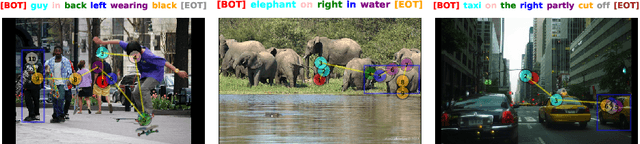
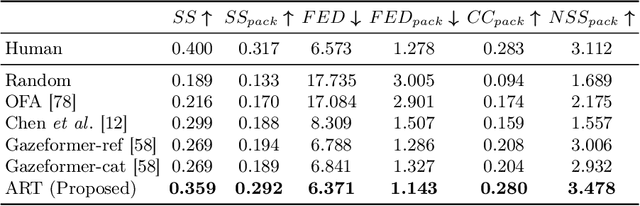
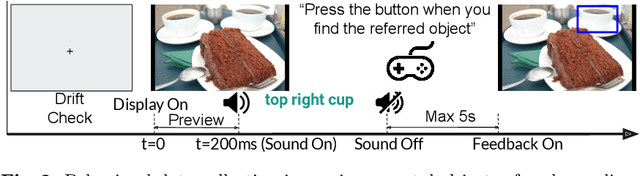
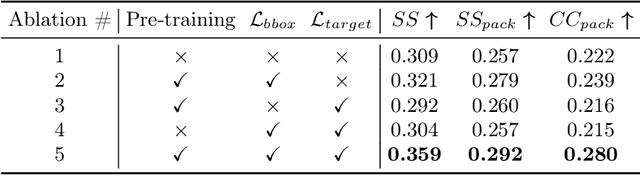
For computer systems to effectively interact with humans using spoken language, they need to understand how the words being generated affect the users' moment-by-moment attention. Our study focuses on the incremental prediction of attention as a person is seeing an image and hearing a referring expression defining the object in the scene that should be fixated by gaze. To predict the gaze scanpaths in this incremental object referral task, we developed the Attention in Referral Transformer model or ART, which predicts the human fixations spurred by each word in a referring expression. ART uses a multimodal transformer encoder to jointly learn gaze behavior and its underlying grounding tasks, and an autoregressive transformer decoder to predict, for each word, a variable number of fixations based on fixation history. To train ART, we created RefCOCO-Gaze, a large-scale dataset of 19,738 human gaze scanpaths, corresponding to 2,094 unique image-expression pairs, from 220 participants performing our referral task. In our quantitative and qualitative analyses, ART not only outperforms existing methods in scanpath prediction, but also appears to capture several human attention patterns, such as waiting, scanning, and verification.