 Add to Chrome
 Add to Firefox
 Add to Edge
Towards a theory of inference-time alignment with unknown rewards
Aug 15, 2026
Generative model alignment has received broad interest, and significant progress has been made in supervised fine-tuning and inference-time computation. Yet, alignment has remained poorly understood from a statistical learning perspective. We formulate inference-time alignment as a weak-to-strong learning problem, where a reference policy (weak learner) is assumed to be fairly good and the goal is to produce a strong learner that predicts a good response at test time with arbitrarily high probability. Our problem is formulated as learning from scratch --- everything is learned from data rather than assuming access to a good reward estimate, and thus differs from the existing inference-time alignment theory. Our model shares similarity to the recent work of arXiv:2510.15464, where for each prompt, there could be multiple good responses. Our definition of the alignment learnability follows the PAC learning principle. We introduce a novel combinatorial dimension of the reward class which we call the alignment dimension, and show that it completely characterizes the alignment learnability --- a reward class is alignment learnable if and only if its alignment dimension is finite. The core of our learning procedure works by invoking the ordinary one-inclusion graph algorithm to run a tournament over all pairs of label sets satisfying that neither is a subset of the other. We believe our results might shed light on establishing a complete theoretical understanding towards alignment.

Optimal Learning Under Tsybakov Noise
Aug 09, 2026Probably Approximately Correct (PAC) learning [Val84] is a fundamental learning model that has been extensively investigated. In this model, $\mathcal{H} \subseteq \{0,1\}^{\mathcal{X}}$ is a concept class, and $h^*\in\mathcal{H}$ is the target concept to be learned. Having access to i.i.d. labeled examples from a distribution $\mathcal{D}$ over $\mathcal{X}\times\{0,1\}$, which admits $h^*$ as the best concept in $\mathcal{H}$, the goal is to design a learning algorithm that outputs a hypothesis having low error competitive to $h^{*}$ with high probability. This model was initially studied under the realizable setting, which assumes that $h^*$ has no error. A natural relaxation is to allow label noise, that is, the true label can be flipped with probability $η\in(0,1/2)$. In reality, certain labels might be extremely noisy, especially for those points near the decision boundary. Hence, it is natural to allow very noisy points, though only rarely. This is quantified by a noise model introduced by [MT99] and [Tsy04], now known as Tsybakov noise. For learning general concept classes, [MN06] gave the general upper and lower bounds for error guarantees under Tsybakov noise. However, their upper and lower bounds differ by a logarithmic factor. Resolving this gap has remained a well-known open question for the past twenty years. In this work, we resolve this open question by improving the upper bound to match the best known lower bound, thus establishing the optimal error guarantee for learning under Tsybakov noise. Our learning algorithm operates by adaptively partitioning the instance space into regions, roughly corresponding to different noise levels, and returning a hypothesis in the concept class satisfying a specific error constraint for each region. Our technique shares a conceptual foundation with several recent advances in non-realizable learning, such as [HLZ24] and [Han25].
Attention-based representations for multi-task computation
Aug 04, 2026Multi-head attention layers produce vector representations that support multiple downstream tasks. We establish bounds on the number of heads required in two simple and concrete multi-task scenarios. In the first scenario, a vector representation is sought so that linear predictors can compute both the smallest and largest numbers in a given list. In this case, it is known two attention heads with small embedding dimension and bit precision level suffice. We prove that a single attention head requires exponentially higher embedding dimension or precision level. In the second scenario, a vector representation is sought so that a polynomial threshold function can compute the XOR of a given string of $n$ bits. This scenario is analogous to the first one for $n=2$, since XOR is readily computed by a linear function using a vector representation that encodes both the AND and the OR of the two bits. We observe that $n$-bit XOR requires the product of the number of heads and the polynomial degree to be at least $n$, and we construct multi-head attention layers that match this lower bound. These results generalize to arbitrary (symmetric) Boolean functions, where the bound is given in terms of the threshold degree.
When More Data Doesn't Help: Limits of Adaptation in Multitask Learning
Jan 28, 2026Multitask learning and related frameworks have achieved tremendous success in modern applications. In multitask learning problem, we are given a set of heterogeneous datasets collected from related source tasks and hope to enhance the performance above what we could hope to achieve by solving each of them individually. The recent work of arXiv:2006.15785 has showed that, without access to distributional information, no algorithm based on aggregating samples alone can guarantee optimal risk as long as the sample size per task is bounded. In this paper, we focus on understanding the statistical limits of multitask learning. We go beyond the no-free-lunch theorem in arXiv:2006.15785 by establishing a stronger impossibility result of adaptation that holds for arbitrarily large sample size per task. This improvement conveys an important message that the hardness of multitask learning cannot be overcame by having abundant data per task. We also discuss the notion of optimal adaptivity that may be of future interests.
To Grok Grokking: Provable Grokking in Ridge Regression
Jan 27, 2026We study grokking, the onset of generalization long after overfitting, in a classical ridge regression setting. We prove end-to-end grokking results for learning over-parameterized linear regression models using gradient descent with weight decay. Specifically, we prove that the following stages occur: (i) the model overfits the training data early during training; (ii) poor generalization persists long after overfitting has manifested; and (iii) the generalization error eventually becomes arbitrarily small. Moreover, we show, both theoretically and empirically, that grokking can be amplified or eliminated in a principled manner through proper hyperparameter tuning. To the best of our knowledge, these are the first rigorous quantitative bounds on the generalization delay (which we refer to as the "grokking time") in terms of training hyperparameters. Lastly, going beyond the linear setting, we empirically demonstrate that our quantitative bounds also capture the behavior of grokking on non-linear neural networks. Our results suggest that grokking is not an inherent failure mode of deep learning, but rather a consequence of specific training conditions, and thus does not require fundamental changes to the model architecture or learning algorithm to avoid.
Universal Rates of ERM for Agnostic Learning
Jun 17, 2025

The universal learning framework has been developed to obtain guarantees on the learning rates that hold for any fixed distribution, which can be much faster than the ones uniformly hold over all the distributions. Given that the Empirical Risk Minimization (ERM) principle being fundamental in the PAC theory and ubiquitous in practical machine learning, the recent work of arXiv:2412.02810 studied the universal rates of ERM for binary classification under the realizable setting. However, the assumption of realizability is too restrictive to hold in practice. Indeed, the majority of the literature on universal learning has focused on the realizable case, leaving the non-realizable case barely explored. In this paper, we consider the problem of universal learning by ERM for binary classification under the agnostic setting, where the ''learning curve" reflects the decay of the excess risk as the sample size increases. We explore the possibilities of agnostic universal rates and reveal a compact trichotomy: there are three possible agnostic universal rates of ERM, being either $e^{-n}$, $o(n^{-1/2})$, or arbitrarily slow. We provide a complete characterization of which concept classes fall into each of these categories. Moreover, we also establish complete characterizations for the target-dependent universal rates as well as the Bayes-dependent universal rates.
Rethinking Gradient-based Adversarial Attacks on Point Cloud Classification
May 28, 2025Gradient-based adversarial attacks have become a dominant approach for evaluating the robustness of point cloud classification models. However, existing methods often rely on uniform update rules that fail to consider the heterogeneous nature of point clouds, resulting in excessive and perceptible perturbations. In this paper, we rethink the design of gradient-based attacks by analyzing the limitations of conventional gradient update mechanisms and propose two new strategies to improve both attack effectiveness and imperceptibility. First, we introduce WAAttack, a novel framework that incorporates weighted gradients and an adaptive step-size strategy to account for the non-uniform contribution of points during optimization. This approach enables more targeted and subtle perturbations by dynamically adjusting updates according to the local structure and sensitivity of each point. Second, we propose SubAttack, a complementary strategy that decomposes the point cloud into subsets and focuses perturbation efforts on structurally critical regions. Together, these methods represent a principled rethinking of gradient-based adversarial attacks for 3D point cloud classification. Extensive experiments demonstrate that our approach outperforms state-of-the-art baselines in generating highly imperceptible adversarial examples. Code will be released upon paper acceptance.
LexPam: Legal Procedure Awareness-Guided Mathematical Reasoning
Apr 03, 2025The legal mathematical reasoning ability of LLMs is crucial when applying them to real-world scenarios, as it directly affects the credibility of the LLM. While existing legal LLMs can perform general judicial question answering, their legal mathematical reasoning capabilities have not been trained. Open-domain reasoning models, though able to generate detailed calculation steps, do not follow the reasoning logic required for legal scenarios. Additionally, there is currently a lack of legal mathematical reasoning datasets to help validate and enhance LLMs' reasoning abilities in legal contexts. To address these issues, we propose the first Chinese legal Mathematical Reasoning Dataset, LexNum, which includes three common legal mathematical reasoning scenarios: economic compensation, work injury compensation, and traffic accident compensation. Based on LexNum, we tested the performance of existing legal LLMs and reasoning LLMs, and introduced LexPam, a reinforcement learning algorithm guided by legal procedural awareness to train LLMs, enhancing their mathematical reasoning abilities in legal scenarios. Experiments on tasks in the three legal scenarios show that the performance of existing legal LLMs and reasoning models in legal mathematical reasoning tasks is unsatisfactory. LexPam can enhance the LLM's ability in these tasks.
Universal Rates of Empirical Risk Minimization
Dec 03, 2024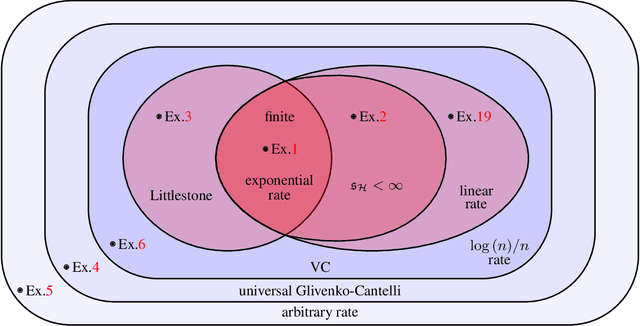
The well-known empirical risk minimization (ERM) principle is the basis of many widely used machine learning algorithms, and plays an essential role in the classical PAC theory. A common description of a learning algorithm's performance is its so-called "learning curve", that is, the decay of the expected error as a function of the input sample size. As the PAC model fails to explain the behavior of learning curves, recent research has explored an alternative universal learning model and has ultimately revealed a distinction between optimal universal and uniform learning rates (Bousquet et al., 2021). However, a basic understanding of such differences with a particular focus on the ERM principle has yet to be developed. In this paper, we consider the problem of universal learning by ERM in the realizable case and study the possible universal rates. Our main result is a fundamental tetrachotomy: there are only four possible universal learning rates by ERM, namely, the learning curves of any concept class learnable by ERM decay either at $e^{-n}$, $1/n$, $\log(n)/n$, or arbitrarily slow rates. Moreover, we provide a complete characterization of which concept classes fall into each of these categories, via new complexity structures. We also develop new combinatorial dimensions which supply sharp asymptotically-valid constant factors for these rates, whenever possible.
Efficient Estimation of the Central Mean Subspace via Smoothed Gradient Outer Products
Dec 24, 2023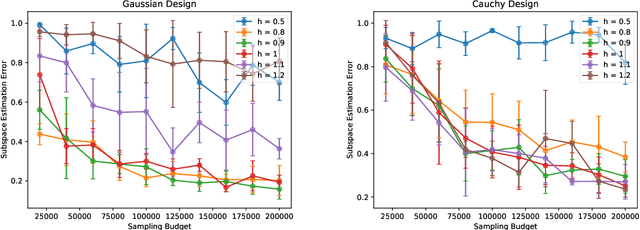
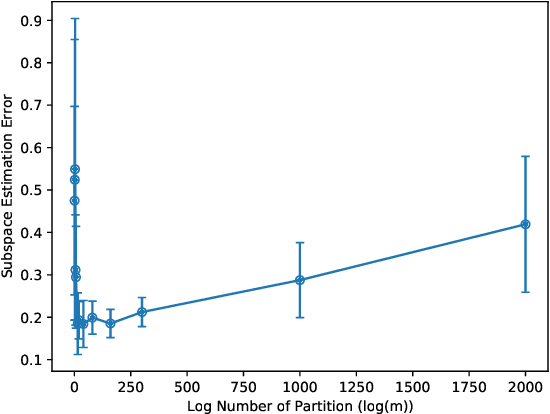
We consider the problem of sufficient dimension reduction (SDR) for multi-index models. The estimators of the central mean subspace in prior works either have slow (non-parametric) convergence rates, or rely on stringent distributional conditions (e.g., the covariate distribution $P_{\mathbf{X}}$ being elliptical symmetric). In this paper, we show that a fast parametric convergence rate of form $C_d \cdot n^{-1/2}$ is achievable via estimating the \emph{expected smoothed gradient outer product}, for a general class of distribution $P_{\mathbf{X}}$ admitting Gaussian or heavier distributions. When the link function is a polynomial with a degree of at most $r$ and $P_{\mathbf{X}}$ is the standard Gaussian, we show that the prefactor depends on the ambient dimension $d$ as $C_d \propto d^r$.