 Add to Chrome
 Add to Firefox
 Add to Edge
SkillProx: Self-Evolving Agent Skills via Proximal Textual Gradient Descent
Aug 07, 2026
LLM agents increasingly adapt to recurring tasks by accumulating procedural knowledge in skills. These skills are lightweight, reusable textual artifacts that are loaded into the agent's context without weight updates. Recent methods refine skills through iterative task execution, failure diagnosis, and trajectory-guided text-space updates. However, existing frameworks lack explicit diagnosis--outcome feedback and treat deletion as a generic edit operation rather than a dedicated mechanism for consolidating accumulated knowledge. We introduce SkillProx, a proximal-gradient-inspired forward--backward framework that couples closed-loop diagnostic evolution with utility-aware proximal refinement. Motivated by a composite objective balancing task loss and skill complexity, the forward stage re-executes diagnosis-driven edits on the same task batch, rolls back regressions, and feeds measured outcomes into subsequent diagnoses. The backward stage decomposes the resulting skill into auditable knowledge units, estimates their contributions using a frozen leave-one-out utility audit, and applies validation-gated consolidation, demotion, or removal. Experiments on in-distribution and out-of-distribution benchmarks across multiple backbone LLMs show that SkillProx improves average accuracy by 3.0 percentage points over the strongest gradient-based baseline. Component ablations demonstrate the complementary effects of closed-loop diagnosis and proximal refinement.

Structured Event Representation and Stock Return Predictability
Dec 22, 2025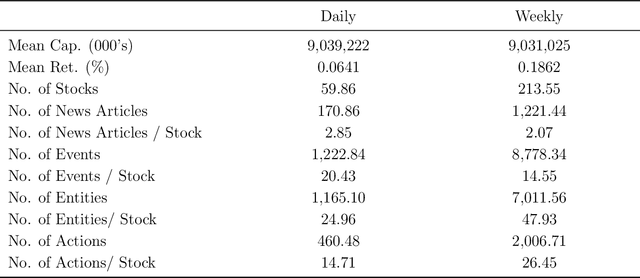
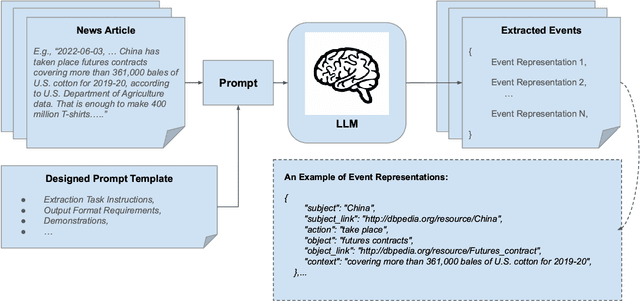
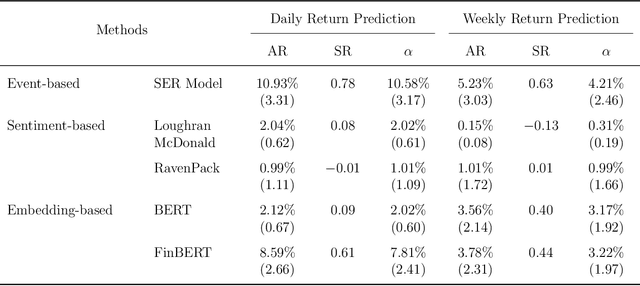
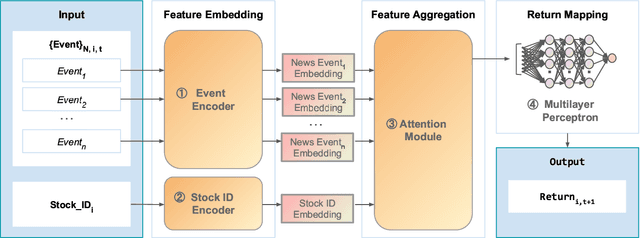
We find that event features extracted by large language models (LLMs) are effective for text-based stock return prediction. Using a pre-trained LLM to extract event features from news articles, we propose a novel deep learning model based on structured event representation (SER) and attention mechanisms to predict stock returns in the cross-section. Our SER-based model provides superior performance compared with other existing text-driven models to forecast stock returns out of sample and offers highly interpretable feature structures to examine the mechanisms underlying the stock return predictability. We further provide various implications based on SER and highlight the crucial benefit of structured model inputs in stock return predictability.
Sensing-aided Near-Field Secure Communications with Mobile Eavesdroppers
Aug 25, 2024


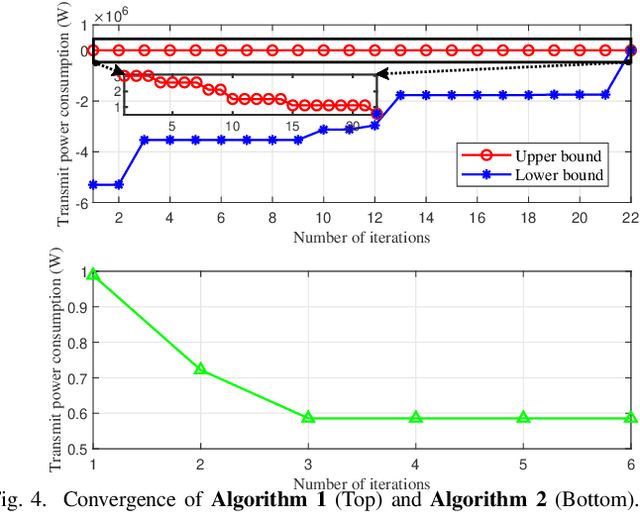
The additional degree of freedom (DoF) in the distance domain of near-field communication offers new opportunities for physical layer security (PLS) design. However, existing works mainly consider static eavesdroppers, and the related study with mobile eavesdroppers is still in its infancy due to the difficulty in obtaining the channel state information (CSI) of the eavesdropper. To this end, we propose to leverage the sensing capability of integrated sensing and communication (ISAC) systems to assist PLS design. To comprehensively study the dynamic behaviors of the system, we propose a Pareto optimization framework, where a multi-objective optimization problem (MOOP) is formulated to simultaneously optimize three key performance metrics: power consumption, number of securely served users, and tracking performance, while guaranteeing the achievable rate of the users with a given leakage rate constraint. A globally optimal design based on the generalized Benders decomposition (GBD) method is proposed to achieve the Pareto optimal solutions. To reduce the computational complexity, we further design a low-complexity algorithm based on zero-forcing (ZF) beamforming and successive convex approximation (SCA). Simulation results validate the effectiveness of the proposed algorithms and reveal the intrinsic trade-offs between the three performance metrics. It is observed that near-field communication offers a favorable beam diffraction effect for PLS, where the energy of the information signal is nulled around the eavesdropper and focused on the users.