 Add to Chrome
 Add to Firefox
 Add to Edge
PRISM: Decision-Centric Predictive Sensing for Cognitive Digital Twins in 6G
Aug 17, 2026
Integrated sensing and communication (ISAC) and Digital Twin (DT) technology have emerged as complementary for future wireless networks that require autonomous operations involving continuous interaction between physical and digital worlds. However, existing DT-assisted ISAC frameworks sense continuously and indiscriminately while optimizing only a single task, leaving little room for persistent, multi-domain knowledge or proactive sensing control. This article proposes a Predictive, Reasoning-driven, Intelligent Sensing Module (PRISM) engine that transforms the DT from a passive, domain-specific optimizer into a persistent, network-wide reasoning system. PRISM enables decision-centric predictive perception, proactively directing sensing toward anticipated decisions needs rather than following fixed sensing schedules. Using an illustrative extremely large multiple-input multiple-output (XL-MIMO) deployment scenario with a mixed eMBB, URLLC, and mMTC device population, we show how this principle benefits visibility-region sensing for channel acquisition and supports slice-aware operation. Preliminary simulations, including this deployment scenario and the resulting knowledge error, overhead, and latency results, confirm that this decision-centric approach substantially reduces sensing overhead while preserving decision reliability and latency, supporting the proposed architecture as a practical step toward self-aware, autonomously orchestrated 6G networks.

A Knowledge-Centric Communication For Autonomous Cislunar Networks
Aug 05, 2026Future lunar infrastructure requires communication as a persistent service rather than a mission specific capability. Communication, digital twin, and artificial intelligence (AI) research have advanced autonomy independently while largely assuming that system state can eventually be reconciled with ground truth. Cislunar communication violates this assumption because propagation delay is fundamentally limited by the speed of light, visibility is governed by orbital geometry, and autonomous decisions often precede confirming observations. Here we introduce a knowledge-centric communication framework in which a digital twin continuously integrates delayed observations, communication physics, learned models, uncertainty quantification, and mission objectives into an evolving Operational Knowledge State. To quantify what is known, how uncertain it remains, and how current it is, we define two quantities over the fused Bayesian belief maintained for each communication link: \emph{Knowledge Entropy}, the differential entropy of the posterior belief, and \emph{Knowledge Freshness}, which generalizes Age of Information (AoI) from a single information stream to the temporal validity of the fused Operational Knowledge State. We prove that distributed knowledge fusion systematically improves operational knowledge by reducing uncertainty and demonstrate its importance for mission success through simulations and comparisons with flight data from the Longjiang-2 lunar micro-satellite.
GenAI-Enhanced Digital Twins for Predictive Interference Management in Ultra-Dense Networks
Jul 09, 2026Ultra-dense indoor next-generation networks suffer severe interference from mobility-induced blockages and localized multi-user hotspots that conventional digital twins~(DTs) cannot anticipate. We propose a generative AI~(GenAI)-enhanced DT framework employing a conditional generative adversarial network~(cGAN) with a spatio-temporal generator and PatchGAN discriminator for proactive rare-event channel synthesis. A worst-case zero-forcing~(WC-ZF) beamformer driven by Monte Carlo synthetic trajectories realizes distributionally robust precoding, with control-channel overhead bounded to $\approx$2.1\,kB per 10\,ms slot. Sionna-based simulations confirm a 5--8\,dB median signal-to-interference-plus-noise-ratio (SINR) gain, 60--70\% packet-loss reduction, and 60--85\% closure of the perfect channel state information (CSI) oracle gap within a 2.8--4.1\,ms inference overhead.
Cognitive Digital Twins for Self-Aware Channel Estimation
Jul 05, 2026Artificial intelligence (AI) and machine learning (ML)-based channel estimators silently degrade when propagation conditions drift from their training distributions. This letter proposes a model-agnostic cognitive digital twin (CDT) framework that combines a variational autoencoder (VAE) with latent activation monitoring to detect distribution drift and autonomously execute \textsc{continue}, \textsc{update}, or \textsc{retire} lifecycle actions without requiring ground-truth channel knowledge. The proposed framework is fully compatible with the AI-native lifecycle management envisioned in 3rd Generation Partnership Project (3GPP). Simulations over various channels demonstrate accurate drift detection and robust channel estimation, consistently outperforming conventional offline-trained deep learning estimators under moderate and severe channel drift.
Towards Intelligent Wireless Networks: The Synergy of Generative AI and Digital Twins
Jun 08, 2026This paper proposes a generative AI (GenAI)-enabled digital twin (DT) framework for proactive and energy-aware wireless optimization in future 6G ecosystems. Most existing AI-assisted DT approaches remain fundamentally reactive, adjusting network parameters only after performance degradation occurs or restricting GenAI to isolated signal-level tasks such as channel estimation. This work adopts a proactive approach. Instead of responding to problems after they appear, the proposed framework continuously synchronizes channel states, mobility dynamics, traffic conditions, and energy information within a real-time DT environment, enabling the system to anticipate congestion, interference, and energy demand before they materialize. The result is a closed-loop proactive architecture that operates at the system level, jointly managing communication, mobility, and resource dynamics for autonomous wireless control. Evaluations on a UAV-assisted non-terrestrial network (NTN) scenario show approximately 69.2\% energy savings over reactive baselines while maintaining reliable quality-of-service (QoS) under dense and mobility-intensive conditions. Beyond this specific scenario, the framework offers a scalable foundation for broader AI-native 6G applications, including aerial platforms, autonomous systems, extended reality (XR), industrial automation, and space-air-ground-sea (SAGS) integrated infrastructures.
A Generative AI-Enhanced Digital Twin Framework for Proactive Interference Management in Hybrid Near/Far-Field Wireless Systems
May 11, 2026The applications of Digital Twins (DT) and Generative AI (GenAI) have demonstrated their capabilities in modeling and learning-based wireless communications. However, their joint potential for proactive wireless system design remains largely underexplored, particularly in extremely large-scale multiple-input multiple-output (XL-MIMO) networks, characterized by hybrid near-field (NF) and far-field (FF) propagation regimes. In this work, we propose an integrated GenAI-enhanced DT framework for proactive interference management in dynamic indoor scenarios. The DT constructs a high-resolution, site-specific virtual replica of the deployment environment, understanding where and why blockage occurs within a realistic 3D representation of the indoor space. Integration of the GenAI module further assists the framework in anticipating and proactively suppressing blockage, rather than reacting after the disruption occurs. Extensive simulation results based on Sionna ray-tracing datasets demonstrate that the proposed framework achieves significant improvements in interference suppression, signal-to-interference-plus-noise ratio (SINR), and outage probability compared to conventional reactive schemes and purely deterministic DT-based approaches.
Movable Antenna Aided NOMA: Joint Antenna Positioning, Precoding, and Decoding Design
Dec 17, 2024This paper investigates movable antenna (MA) aided non-orthogonal multiple access (NOMA) for multi-user downlink communication, where the base station (BS) is equipped with a fixed-position antenna (FPA) array to serve multiple MA-enabled users. An optimization problem is formulated to maximize the minimum achievable rate among all the users by jointly optimizing the MA positioning of each user, the precoding matrix at the BS, and the successive interference cancellation (SIC) decoding indicator matrix at the users, subject to a set of constraints including the limited movement area of the MAs, the maximum transmit power of the BS, and the SIC decoding condition. To solve this non-convex problem, we propose a two-loop iterative optimization algorithm that combines the hippopotamus optimization (HO) method with the alternating optimization (AO) method to obtain a suboptimal solution efficiently. Specifically, in the inner loop, the complex-valued precoding matrix and the binary decoding indicator matrix are optimized alternatively by the successive convex approximation (SCA) technique with customized greedy search to maximize the minimum achievable rate for the given positions of the MAs. In the outer loop, each user's antenna position is updated using the HO algorithm, following a novel nature-inspired intelligent optimization framework. Simulation results show that the proposed algorithms can effectively avoid local optimum for highly coupled variables and significantly improve the rate performance of the NOMA system compared to the conventional FPA system as well as other benchmark schemes.
Unlocking FAS-RIS Security Analysis with Block-Correlation Model
Nov 03, 2024
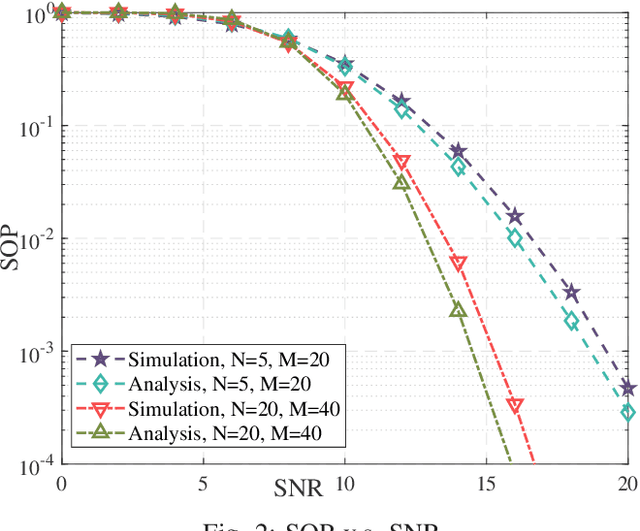
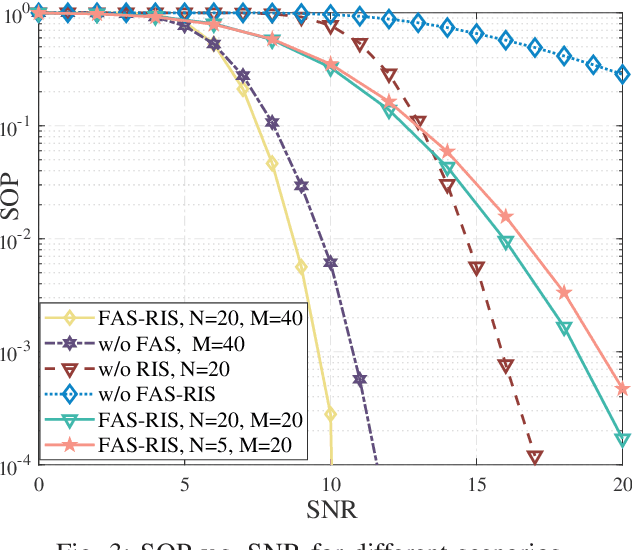

In this letter, we investigate the security of fluid antenna system (FAS)-reconfigurable intelligent surfaces (RIS) communication systems. The base station (BS) employs a single fixed-position antenna, while both the legitimate receiver and the eavesdropper are equipped with fluid antennas. By utilizing the block-correlation model and the central limit theorem (CLT), we derive approximate expressions for the average secrecy capacity and secrecy outage probability (SOP). Our analysis, validated by simulation results, demonstrates the effectiveness of the block-correlation model in accurately assessing the security performance. Moreover, simulation results reveal that FAS-RIS system significantly outperforms other systems in terms of security, further underscoring its potential in secure communication applications.
Sensing-aided Near-Field Secure Communications with Mobile Eavesdroppers
Aug 25, 2024


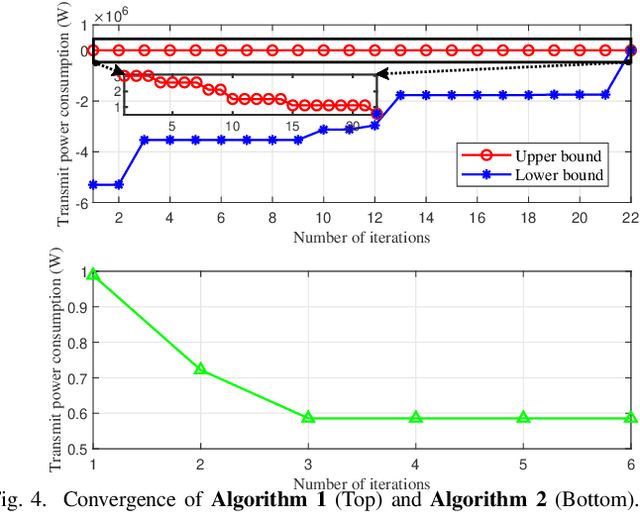
The additional degree of freedom (DoF) in the distance domain of near-field communication offers new opportunities for physical layer security (PLS) design. However, existing works mainly consider static eavesdroppers, and the related study with mobile eavesdroppers is still in its infancy due to the difficulty in obtaining the channel state information (CSI) of the eavesdropper. To this end, we propose to leverage the sensing capability of integrated sensing and communication (ISAC) systems to assist PLS design. To comprehensively study the dynamic behaviors of the system, we propose a Pareto optimization framework, where a multi-objective optimization problem (MOOP) is formulated to simultaneously optimize three key performance metrics: power consumption, number of securely served users, and tracking performance, while guaranteeing the achievable rate of the users with a given leakage rate constraint. A globally optimal design based on the generalized Benders decomposition (GBD) method is proposed to achieve the Pareto optimal solutions. To reduce the computational complexity, we further design a low-complexity algorithm based on zero-forcing (ZF) beamforming and successive convex approximation (SCA). Simulation results validate the effectiveness of the proposed algorithms and reveal the intrinsic trade-offs between the three performance metrics. It is observed that near-field communication offers a favorable beam diffraction effect for PLS, where the energy of the information signal is nulled around the eavesdropper and focused on the users.
The α-Lomax Distribution: A Compound Channel Model
Jun 06, 2024


In this paper, we propose the {\alpha}-Lomax distribution as a new compound fading channel model. This new distribution generalizes the recently introduced Lomax fading channel model. It is worth noting that the Lomax distribution is a decreasing function, while the {\alpha}-Lomax is a unimodal function, offering greater flexibility in modeling wireless fading channels. In particular, we derive closed-form expressions for the probability density function and cumulative distribution function for the instantaneous signal-to-noise ratio (SNR). Additionally, we provide closed-form expressions for several fundamental performance metrics, including outage probability, average bit error rate, and channel capacity. Furthermore, we derive closed-form expression for the average block-length error rate in short-packet communications. Moreover, we fit the PDF of the proposed channel model to empirical data obtained from a device-to-device communication system. We also offer simple and accurate approximations for these expressions in the high SNR regime.