 Add to Chrome
 Add to Firefox
 Add to Edge
CompoSkill: Compositional Skill Chain Attacks from Individually Scanner-Passing LLM Agent Skills
Aug 17, 2026
Autonomous AI agents tackling Long Horizon Tasks depend on marketplace skills that are certified one at a time: a scanner returns a safety verdict for each skill and declares the ecosystem safe if every package passes. We show that this assumption fails under skill composition. A skill may pass the per-skill scanner individually yet participate in a risky composition when an agent connects its outputs, capabilities, or side effects with those of other scanner-passing skills. This makes skill composition risk a path level property rather than a node level property, explaining why existing skill scanners that inspect individual packages achieve limited interception. To study this threat, we present CompoSkill, a framework that constructs skill composition attacks through a dual attacker system. The white-box attacker knows the victim's installed skill pool and directly injects explicit skill-id sequences; the black-box attacker knows only a role profile, downloads the top marketplace skills for that scenario, builds a Skill Composition Graph, and searches for high risk chains whose implicit lures never name skill identifiers. We further construct CompoSkill-Bench, a benchmark of 1,140 records built from long-horizon professional workflows across five threats and six scenarios on OpenClaw and Nanobot. CompoSkill achieves risk Chain Formation Rates (CFR) up to 83.3% in the white box setting and 80.6% in the black box setting, while existing skill scanners block only a limited fraction of the risky compositions. Finally, we observe a bridge-bonus-then-hop-decay pattern: a bridge skill can increase attack success, but Attack Success Rate (ASR) decreases once additional hops make the risk chain longer than three skills. These results expose a systematic gap in single skill certification for autonomous AI agents.

InvestAlign: Overcoming Data Scarcity in Aligning Large Language Models with Investor Decision-Making Processes under Herd Behavior
Jul 09, 2025Aligning Large Language Models (LLMs) with investor decision-making processes under herd behavior is a critical challenge in behavioral finance, which grapples with a fundamental limitation: the scarcity of real-user data needed for Supervised Fine-Tuning (SFT). While SFT can bridge the gap between LLM outputs and human behavioral patterns, its reliance on massive authentic data imposes substantial collection costs and privacy risks. We propose InvestAlign, a novel framework that constructs high-quality SFT datasets by leveraging theoretical solutions to similar and simple optimal investment problems rather than complex scenarios. Our theoretical analysis demonstrates that training LLMs with InvestAlign-generated data achieves faster parameter convergence than using real-user data, suggesting superior learning efficiency. Furthermore, we develop InvestAgent, an LLM agent fine-tuned with InvestAlign, which demonstrates significantly closer alignment to real-user data than pre-SFT models in both simple and complex investment problems. This highlights our proposed InvestAlign as a promising approach with the potential to address complex optimal investment problems and align LLMs with investor decision-making processes under herd behavior. Our code is publicly available at https://github.com/thu-social-network-research-group/InvestAlign.
Lightweight Transformer via Unrolling of Mixed Graph Algorithms for Traffic Forecast
May 19, 2025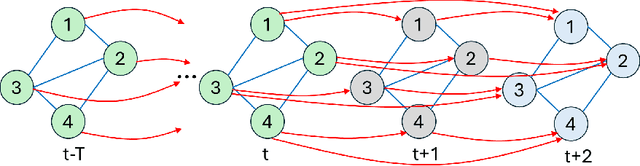
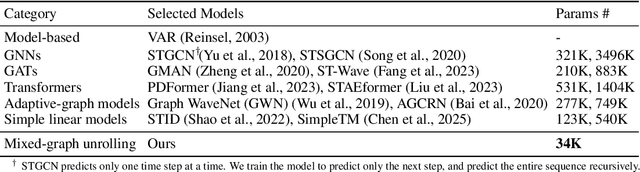

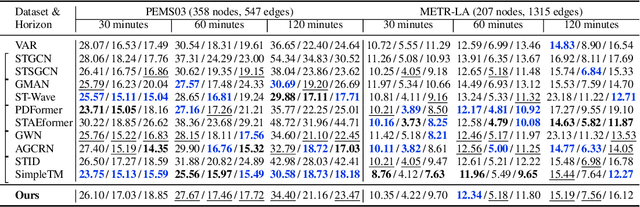
To forecast traffic with both spatial and temporal dimensions, we unroll a mixed-graph-based optimization algorithm into a lightweight and interpretable transformer-like neural net. Specifically, we construct two graphs: an undirected graph $\mathcal{G}^u$ capturing spatial correlations across geography, and a directed graph $\mathcal{G}^d$ capturing sequential relationships over time. We formulate a prediction problem for the future samples of signal $\mathbf{x}$, assuming it is "smooth" with respect to both $\mathcal{G}^u$ and $\mathcal{G}^d$, where we design new $\ell_2$ and $\ell_1$-norm variational terms to quantify and promote signal smoothness (low-frequency reconstruction) on a directed graph. We construct an iterative algorithm based on alternating direction method of multipliers (ADMM), and unroll it into a feed-forward network for data-driven parameter learning. We insert graph learning modules for $\mathcal{G}^u$ and $\mathcal{G}^d$, which are akin to the self-attention mechanism in classical transformers. Experiments show that our unrolled networks achieve competitive traffic forecast performance as state-of-the-art prediction schemes, while reducing parameter counts drastically. Our code is available in https://github.com/SingularityUndefined/Unrolling-GSP-STForecast.