 Add to Chrome
 Add to Firefox
 Add to Edge
Filling Before Advancing: Capability-Gap-Driven Post-Training for Scenario-Specialized Remote Sensing MLLMs
Jul 24, 2026
Remote sensing multimodal large language models (RS-MLLMs) have improved general aerial-image understanding. However, Earth observation applications require fine-grained scenario specialization, constrained by scarce high-quality scenario data and incomplete capability coverage. We formulate this adaptation as a capability-gap-driven post-training problem and propose filling before advancing (FBA). Rather than relying on single-stage supervised fine-tuning (SFT) over target-domain samples, FBA first fills prerequisite capability gaps before advancing toward scenario specialization. We instantiate FBA for coastal harbor understanding, a representative multi-source scenario, by constructing CPRS (Coastal-Port Remote Sensing), a three-layer supervision dataset coupled with three ordered stages: (1) RS semantic anchoring for overhead-view visual-language alignment; (2) domain-bridge convergence for shared RS priors across target and bridging scenarios under different modalities; and (3) evidence-grounded scenario tuning for downstream performance. We construct HarborEval, an eight-track diagnostic benchmark covering perception, spatial understanding, robustness, and generation. Under comparable training budgets, HarborEval increases from 57.95 with Direct-SFT to 70.29 with FBA on LLaVA-v1.5, and from 81.09 to 83.37 on Qwen3-VL. FBA also outperforms Collapsed-SFT and leads on harbor-related VRSBench/RSVQA subsets and OpenEval. Stage-wise and role-replacement analyses validate progressive gap filling and stage-specific roles. Public examples and release updates for CPRS, HarborEval, code, and trained weights are available at https://github.com/Z0ngL1ng/filling-before-advancing.

SoDa2: Single-Stage Open-Set Domain Adaptation via Decoupled Alignment for Cross-Scene Hyperspectral Image Classification
May 05, 2026Cross-scene hyperspectral image (HSI) classification stands as a fundamental research topic in remote sensing, with extensive applications spanning various fields. Owing to the inclusion of unknown categories in the target domain and the existence of domain shift across different scenes, open-set domain adaptation techniques are commonly employed to address cross-scene HSI classification. However, existing open-set cross-scene HSI classification methods still face two critical challenges: (1) domain shift issues arising from the direct alignment of mixed spectral-spatial features; (2) high computational costs caused by two-stage training strategies. To address these issues, this paper proposes a single-stage open-set domain adaptation method with decoupled alignment (SoDa$^2$) for cross-scene HSI classification. A contribution-aware dual-modality feature extraction is customized to disentangle the characteristics from spectral sequence signals and spatial details, selectively and adaptively enhancing discriminative features. The decoupled alignment module minimizes the Maximum Mean Discrepancy to independently reduce the spectral discrepancy and the spatial discrepancy between the source and target domains, extracting more fine-grained domain-invariant features. A cost-effective single-stage dual-branch framework is designed to learn MMD-constrainted aligned features and constraint-free intrinsic features for adaptive distinction between known and unknown classes. This framework employs a Gaussian Mixture Model to model the squared cosine similarity distribution between the two feature types, enabling open-set recognition without prior knowledge of unknown classes. Extensive experiments on three groups of HSI datasets demonstrate that SoDa$^2$ outperforms state-of-the-art methods, achieving superior classification accuracy and model transferability for open-set cross-scene tasks.
Multiset Transformer: Advancing Representation Learning in Persistence Diagrams
Nov 22, 2024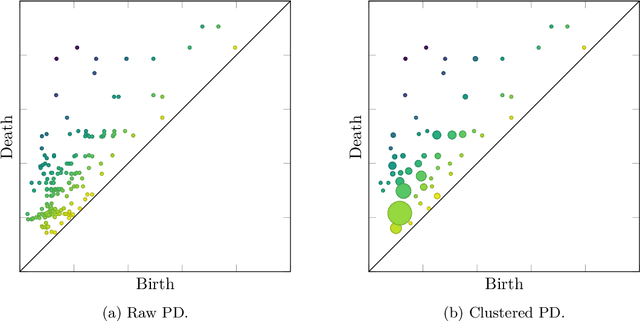



To improve persistence diagram representation learning, we propose Multiset Transformer. This is the first neural network that utilizes attention mechanisms specifically designed for multisets as inputs and offers rigorous theoretical guarantees of permutation invariance. The architecture integrates multiset-enhanced attentions with a pool-decomposition scheme, allowing multiplicities to be preserved across equivariant layers. This capability enables full leverage of multiplicities while significantly reducing both computational and spatial complexity compared to the Set Transformer. Additionally, our method can greatly benefit from clustering as a preprocessing step to further minimize complexity, an advantage not possessed by the Set Transformer. Experimental results demonstrate that the Multiset Transformer outperforms existing neural network methods in the realm of persistence diagram representation learning.
Tensor Decompositions for Hyperspectral Data Processing in Remote Sensing: A Comprehensive Review
May 13, 2022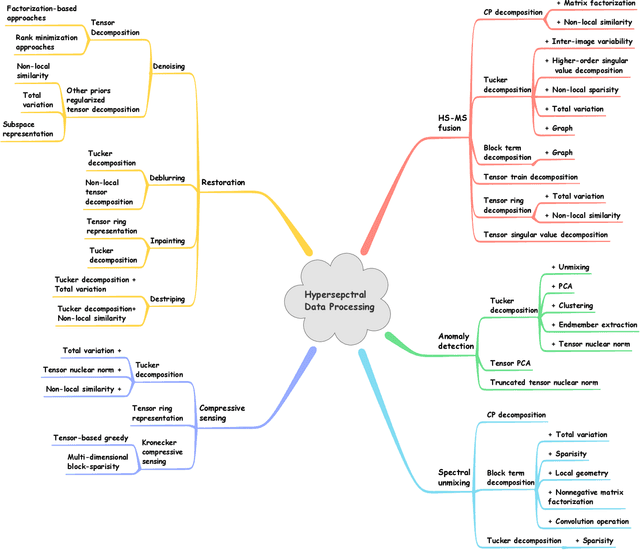


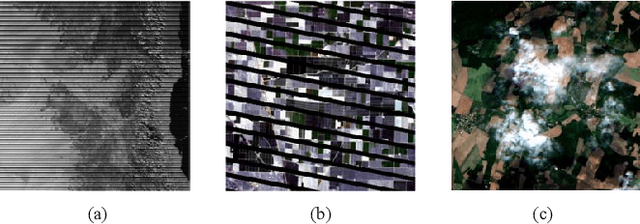
Owing to the rapid development of sensor technology, hyperspectral (HS) remote sensing (RS) imaging has provided a significant amount of spatial and spectral information for the observation and analysis of the Earth's surface at a distance of data acquisition devices, such as aircraft, spacecraft, and satellite. The recent advancement and even revolution of the HS RS technique offer opportunities to realize the full potential of various applications, while confronting new challenges for efficiently processing and analyzing the enormous HS acquisition data. Due to the maintenance of the 3-D HS inherent structure, tensor decomposition has aroused widespread concern and research in HS data processing tasks over the past decades. In this article, we aim at presenting a comprehensive overview of tensor decomposition, specifically contextualizing the five broad topics in HS data processing, and they are HS restoration, compressed sensing, anomaly detection, super-resolution, and spectral unmixing. For each topic, we elaborate on the remarkable achievements of tensor decomposition models for HS RS with a pivotal description of the existing methodologies and a representative exhibition on the experimental results. As a result, the remaining challenges of the follow-up research directions are outlined and discussed from the perspective of the real HS RS practices and tensor decomposition merged with advanced priors and even with deep neural networks. This article summarizes different tensor decomposition-based HS data processing methods and categorizes them into different classes from simple adoptions to complex combinations with other priors for the algorithm beginners. We also expect this survey can provide new investigations and development trends for the experienced researchers who understand tensor decomposition and HS RS to some extent.