 Add to Chrome
 Add to Firefox
 Add to Edge
Process Matters more than Output for Distinguishing Humans from Machines
May 07, 2026
Reliable human-machine discrimination is becoming increasingly important as large language models and autonomous agents are deployed in online settings. Existing approaches evaluate whether a system can produce behavior or responses indistinguishable from those of a human, following the emphasis on outputs as a criterion for intelligence proposed by Alan Turing. Cognitive science offers an alternative perspective: evaluating the process by which behavior is produced. To test whether cognitive processes can reliably distinguish humans from machines, we introduce CogCAPTCHA30, a battery of 30 cognitive tasks designed to elicit diagnostic process-level features even when task performance is matched. Across the battery, process-level features provide stronger discriminative signal than performance metrics alone, reliably distinguishing humans from agents even under output matching (mean process-feature classifier AUC = 0.88). To evaluate agentic process differences, we compare off-the-shelf frontier agents (Claude Sonnet 4.5, GPT-5, Gemini 2.5 Pro), Centaur (a language model fine-tuned on 10.7M human decisions), and two task-specific fine-tuning approaches applied to Qwen2.5-1.5B-Instruct: action-level supervised fine-tuning (A-SFT) and process-level fine-tuning (P-SFT), which directly optimizes process features. Broad fine-tuning on human decisions improves human-like task processes relative to off-the-shelf agents, while task-specific process-level supervision further improves behavioral mimicry. However, this advantage diminishes under cross-task transfer when supervised process targets do not naturally generalize across tasks. Explicit process-level supervision can improve human behavioral mimicry, but only if appropriate task-specific process representations are available, highlighting process specification as a bottleneck for achieving human-like cognitive processes in machines.

Can we automatize scientific discovery in the cognitive sciences?
Mar 22, 2026The cognitive sciences aim to understand intelligence by formalizing underlying operations as computational models. Traditionally, this follows a cycle of discovery where researchers develop paradigms, collect data, and test predefined model classes. However, this manual pipeline is fundamentally constrained by the slow pace of human intervention and a search space limited by researchers' background and intuition. Here, we propose a paradigm shift toward a fully automated, in silico science of the mind that implements every stage of the discovery cycle using Large Language Models (LLMs). In this framework, experimental paradigms exploring conceptually meaningful task structures are directly sampled from an LLM. High-fidelity behavioral data are then simulated using foundation models of cognition. The tedious step of handcrafting cognitive models is replaced by LLM-based program synthesis, which performs a high-throughput search over a vast landscape of algorithmic hypotheses. Finally, the discovery loop is closed by optimizing for ''interestingness'', a metric of conceptual yield evaluated by an LLM-critic. By enabling a fast and scalable approach to theory development, this automated loop functions as a high-throughput in-silico discovery engine, surfacing informative experiments and mechanisms for subsequent validation in real human populations.
Automated scientific minimization of regret
May 23, 2025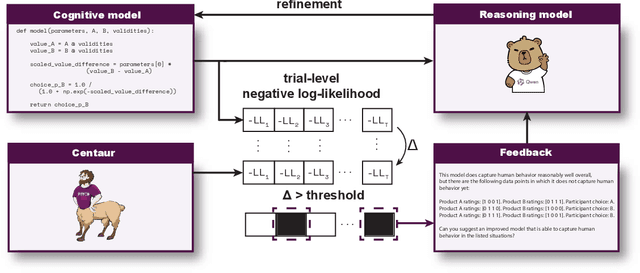
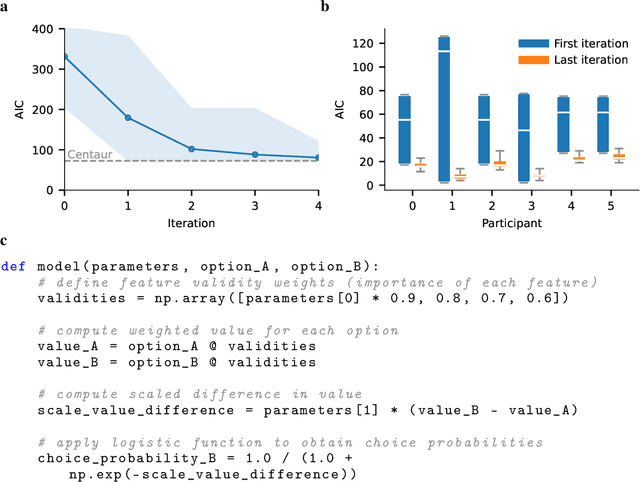
We introduce automated scientific minimization of regret (ASMR) -- a framework for automated computational cognitive science. Building on the principles of scientific regret minimization, ASMR leverages Centaur -- a recently proposed foundation model of human cognition -- to identify gaps in an interpretable cognitive model. These gaps are then addressed through automated revisions generated by a language-based reasoning model. We demonstrate the utility of this approach in a multi-attribute decision-making task, showing that ASMR discovers cognitive models that predict human behavior at noise ceiling while retaining interpretability. Taken together, our results highlight the potential of ASMR to automate core components of the cognitive modeling pipeline.
Towards Automation of Cognitive Modeling using Large Language Models
Feb 02, 2025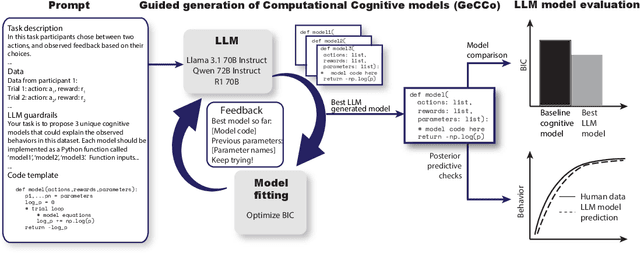
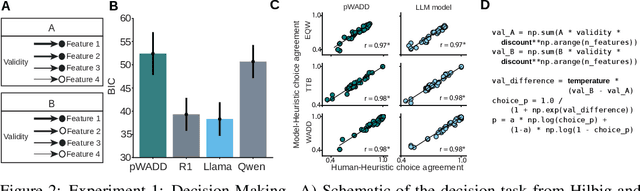
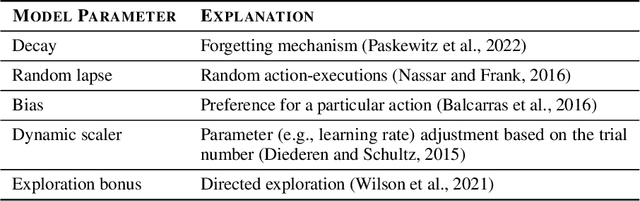
Computational cognitive models, which formalize theories of cognition, enable researchers to quantify cognitive processes and arbitrate between competing theories by fitting models to behavioral data. Traditionally, these models are handcrafted, which requires significant domain knowledge, coding expertise, and time investment. Previous work has demonstrated that Large Language Models (LLMs) are adept at pattern recognition in-context, solving complex problems, and generating executable code. In this work, we leverage these abilities to explore the potential of LLMs in automating the generation of cognitive models based on behavioral data. We evaluated the LLM in two different tasks: model identification (relating data to a source model), and model generation (generating the underlying cognitive model). We performed these tasks across two cognitive domains - decision making and learning. In the case of data simulated from canonical cognitive models, we found that the LLM successfully identified and generated the ground truth model. In the case of human data, where behavioral noise and lack of knowledge of the true underlying process pose significant challenges, the LLM generated models that are identical or close to the winning model from cognitive science literature. Our findings suggest that LLMs can have a transformative impact on cognitive modeling. With this project, we aim to contribute to an ongoing effort of automating scientific discovery in cognitive science.
Centaur: a foundation model of human cognition
Oct 26, 2024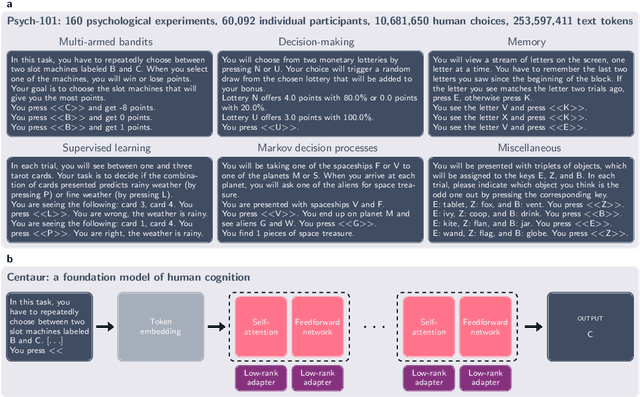
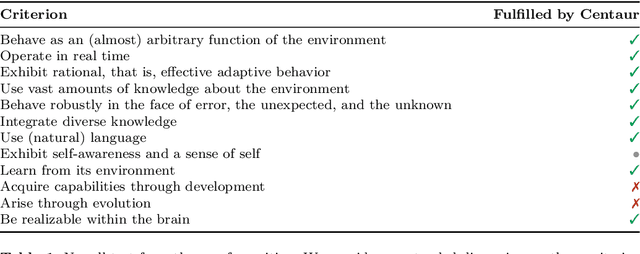
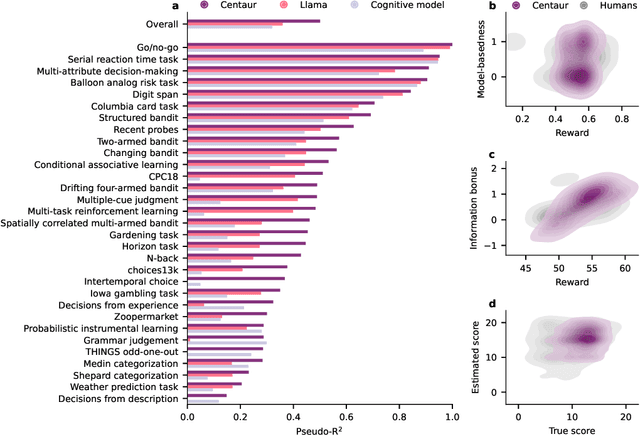
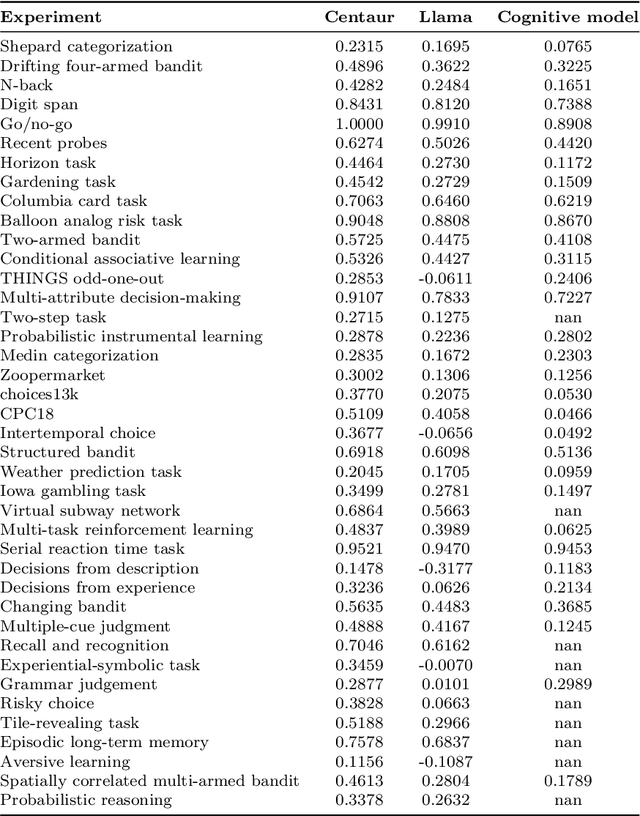
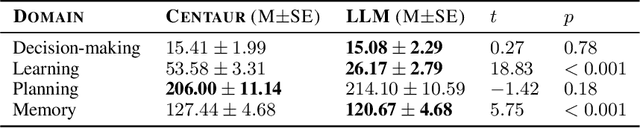
Establishing a unified theory of cognition has been a major goal of psychology. While there have been previous attempts to instantiate such theories by building computational models, we currently do not have one model that captures the human mind in its entirety. Here we introduce Centaur, a computational model that can predict and simulate human behavior in any experiment expressible in natural language. We derived Centaur by finetuning a state-of-the-art language model on a novel, large-scale data set called Psych-101. Psych-101 reaches an unprecedented scale, covering trial-by-trial data from over 60,000 participants performing over 10,000,000 choices in 160 experiments. Centaur not only captures the behavior of held-out participants better than existing cognitive models, but also generalizes to new cover stories, structural task modifications, and entirely new domains. Furthermore, we find that the model's internal representations become more aligned with human neural activity after finetuning. Taken together, Centaur is the first real candidate for a unified model of human cognition. We anticipate that it will have a disruptive impact on the cognitive sciences, challenging the existing paradigm for developing computational models.