 Add to Chrome
 Add to Firefox
 Add to Edge
Meta-learning as a principle for human-like visual representations
Jun 24, 2026
The structure of human visual representations underpins our capacity for adaptive behaviour. While pretrained neural networks model human visual representations with unprecedented success, a large discrepancy remains. We propose one reason: these networks optimise a single fixed objective, whereas human representations must support open-ended tasks. We hypothesise this flexibility arises from meta-learning (learning to learn), a pressure shaping representations to acquire new tasks from few observations. To test this, we train a sequence model, without any supervision from human data, across thousands of semantically rich tasks mapping images to high-level concepts. Compared to their pretrained base encoders, meta-learned representations better predict human similarity judgements, semantic rule learning, and high-level visual cortex. Behavioural gains depend on disentangled, high-level task distributions, while brain alignment is driven primarily by the learning-to-learn pressure. Our results suggest the flexibility of human visual representations reflects the functional demand to learn new semantic relationships on the fly.

Can we automatize scientific discovery in the cognitive sciences?
Mar 22, 2026The cognitive sciences aim to understand intelligence by formalizing underlying operations as computational models. Traditionally, this follows a cycle of discovery where researchers develop paradigms, collect data, and test predefined model classes. However, this manual pipeline is fundamentally constrained by the slow pace of human intervention and a search space limited by researchers' background and intuition. Here, we propose a paradigm shift toward a fully automated, in silico science of the mind that implements every stage of the discovery cycle using Large Language Models (LLMs). In this framework, experimental paradigms exploring conceptually meaningful task structures are directly sampled from an LLM. High-fidelity behavioral data are then simulated using foundation models of cognition. The tedious step of handcrafting cognitive models is replaced by LLM-based program synthesis, which performs a high-throughput search over a vast landscape of algorithmic hypotheses. Finally, the discovery loop is closed by optimizing for ''interestingness'', a metric of conceptual yield evaluated by an LLM-critic. By enabling a fast and scalable approach to theory development, this automated loop functions as a high-throughput in-silico discovery engine, surfacing informative experiments and mechanisms for subsequent validation in real human populations.
Automated scientific minimization of regret
May 23, 2025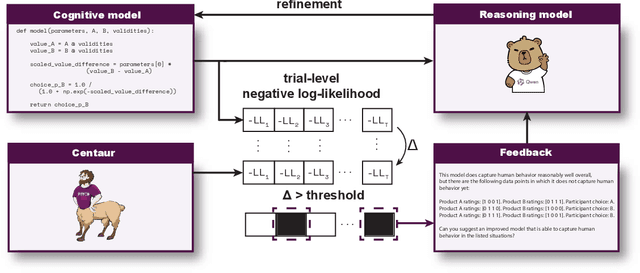
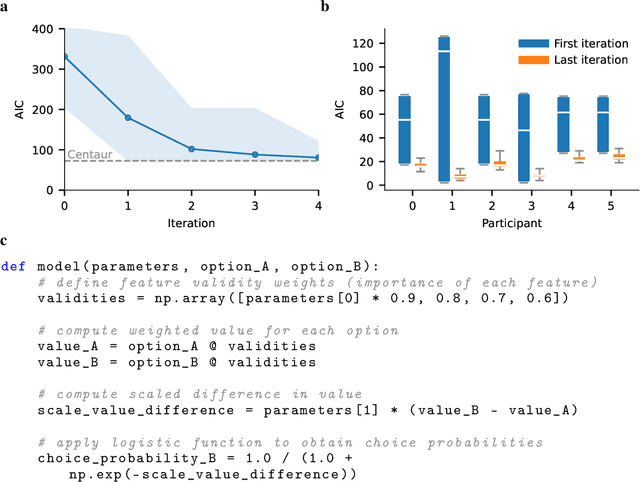
We introduce automated scientific minimization of regret (ASMR) -- a framework for automated computational cognitive science. Building on the principles of scientific regret minimization, ASMR leverages Centaur -- a recently proposed foundation model of human cognition -- to identify gaps in an interpretable cognitive model. These gaps are then addressed through automated revisions generated by a language-based reasoning model. We demonstrate the utility of this approach in a multi-attribute decision-making task, showing that ASMR discovers cognitive models that predict human behavior at noise ceiling while retaining interpretability. Taken together, our results highlight the potential of ASMR to automate core components of the cognitive modeling pipeline.
Centaur: a foundation model of human cognition
Oct 26, 2024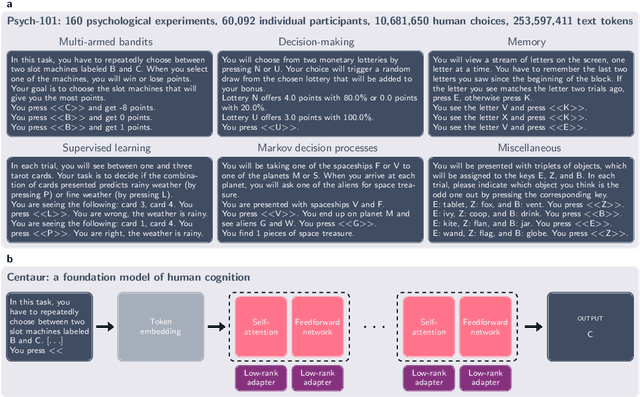
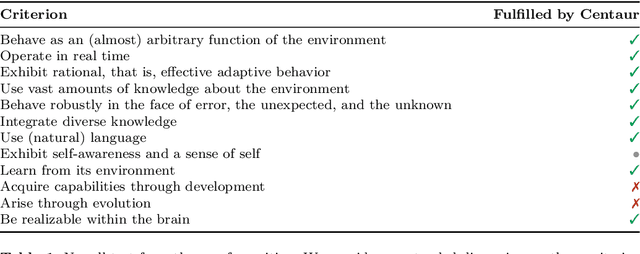
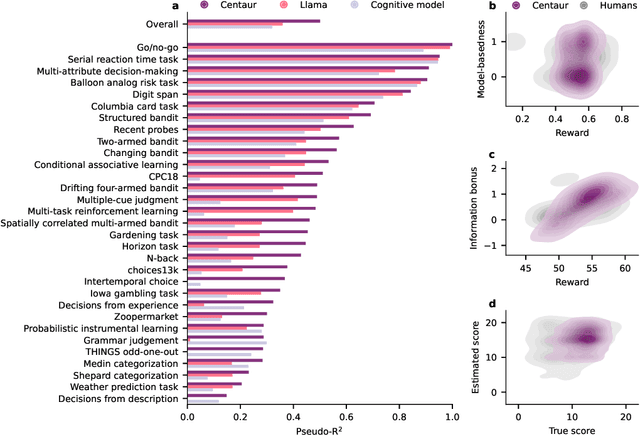
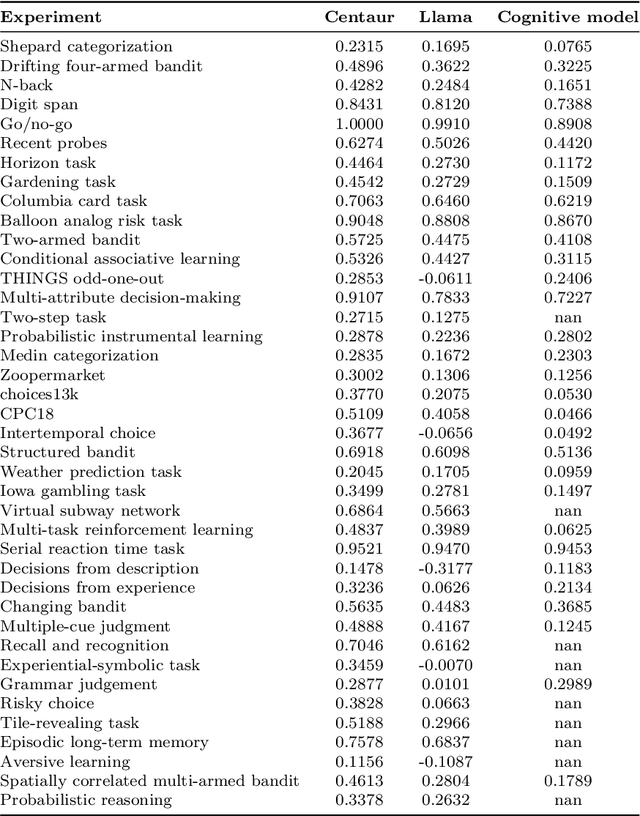
Establishing a unified theory of cognition has been a major goal of psychology. While there have been previous attempts to instantiate such theories by building computational models, we currently do not have one model that captures the human mind in its entirety. Here we introduce Centaur, a computational model that can predict and simulate human behavior in any experiment expressible in natural language. We derived Centaur by finetuning a state-of-the-art language model on a novel, large-scale data set called Psych-101. Psych-101 reaches an unprecedented scale, covering trial-by-trial data from over 60,000 participants performing over 10,000,000 choices in 160 experiments. Centaur not only captures the behavior of held-out participants better than existing cognitive models, but also generalizes to new cover stories, structural task modifications, and entirely new domains. Furthermore, we find that the model's internal representations become more aligned with human neural activity after finetuning. Taken together, Centaur is the first real candidate for a unified model of human cognition. We anticipate that it will have a disruptive impact on the cognitive sciences, challenging the existing paradigm for developing computational models.
Sparse Autoencoders Reveal Temporal Difference Learning in Large Language Models
Oct 02, 2024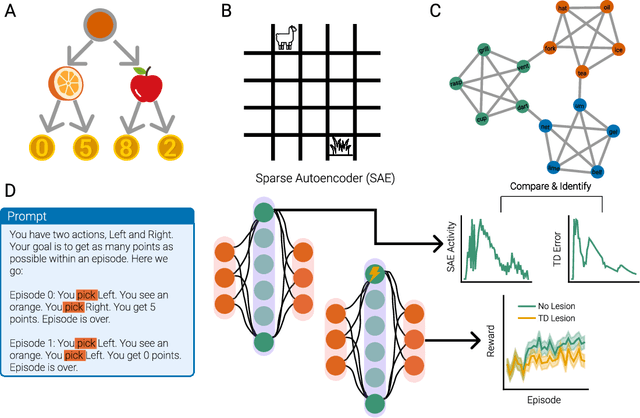
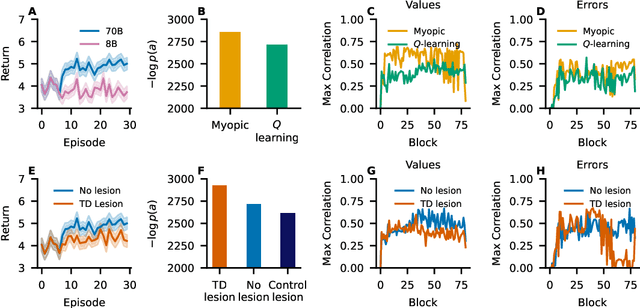
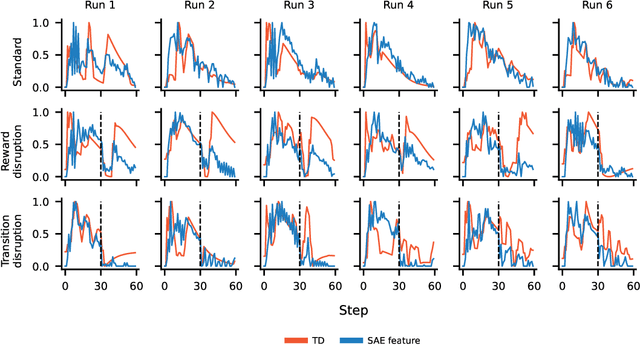
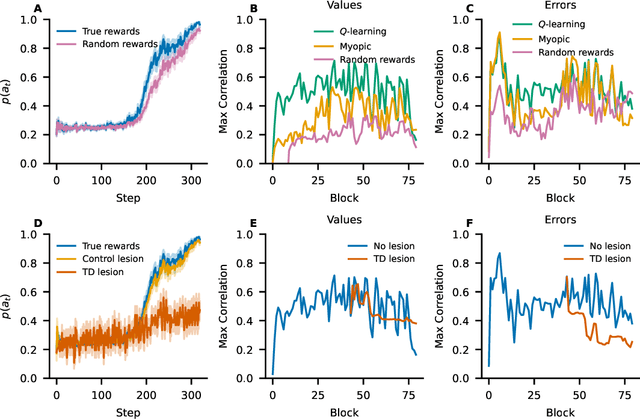
In-context learning, the ability to adapt based on a few examples in the input prompt, is a ubiquitous feature of large language models (LLMs). However, as LLMs' in-context learning abilities continue to improve, understanding this phenomenon mechanistically becomes increasingly important. In particular, it is not well-understood how LLMs learn to solve specific classes of problems, such as reinforcement learning (RL) problems, in-context. Through three different tasks, we first show that Llama $3$ $70$B can solve simple RL problems in-context. We then analyze the residual stream of Llama using Sparse Autoencoders (SAEs) and find representations that closely match temporal difference (TD) errors. Notably, these representations emerge despite the model only being trained to predict the next token. We verify that these representations are indeed causally involved in the computation of TD errors and $Q$-values by performing carefully designed interventions on them. Taken together, our work establishes a methodology for studying and manipulating in-context learning with SAEs, paving the way for a more mechanistic understanding.
CogBench: a large language model walks into a psychology lab
Feb 28, 2024
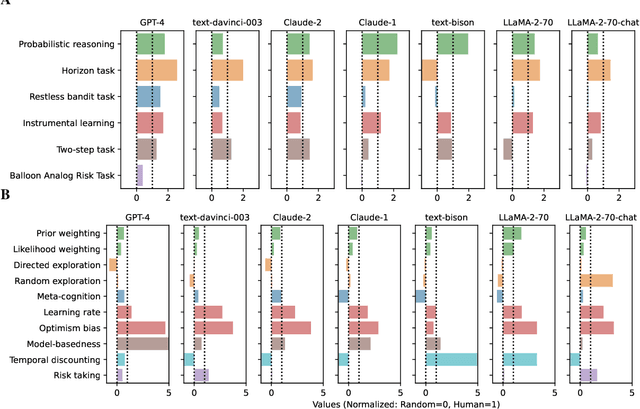

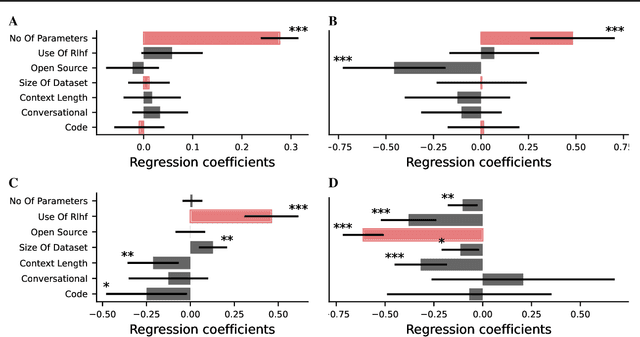
Large language models (LLMs) have significantly advanced the field of artificial intelligence. Yet, evaluating them comprehensively remains challenging. We argue that this is partly due to the predominant focus on performance metrics in most benchmarks. This paper introduces CogBench, a benchmark that includes ten behavioral metrics derived from seven cognitive psychology experiments. This novel approach offers a toolkit for phenotyping LLMs' behavior. We apply CogBench to 35 LLMs, yielding a rich and diverse dataset. We analyze this data using statistical multilevel modeling techniques, accounting for the nested dependencies among fine-tuned versions of specific LLMs. Our study highlights the crucial role of model size and reinforcement learning from human feedback (RLHF) in improving performance and aligning with human behavior. Interestingly, we find that open-source models are less risk-prone than proprietary models and that fine-tuning on code does not necessarily enhance LLMs' behavior. Finally, we explore the effects of prompt-engineering techniques. We discover that chain-of-thought prompting improves probabilistic reasoning, while take-a-step-back prompting fosters model-based behaviors.
In-context learning agents are asymmetric belief updaters
Feb 06, 2024

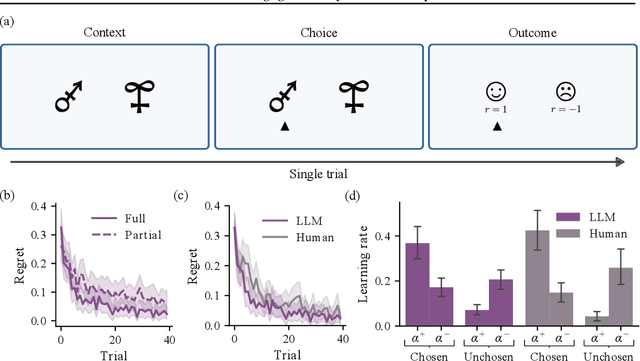

We study the in-context learning dynamics of large language models (LLMs) using three instrumental learning tasks adapted from cognitive psychology. We find that LLMs update their beliefs in an asymmetric manner and learn more from better-than-expected outcomes than from worse-than-expected ones. Furthermore, we show that this effect reverses when learning about counterfactual feedback and disappears when no agency is implied. We corroborate these findings by investigating idealized in-context learning agents derived through meta-reinforcement learning, where we observe similar patterns. Taken together, our results contribute to our understanding of how in-context learning works by highlighting that the framing of a problem significantly influences how learning occurs, a phenomenon also observed in human cognition.
Ecologically rational meta-learned inference explains human category learning
Feb 02, 2024Ecological rationality refers to the notion that humans are rational agents adapted to their environment. However, testing this theory remains challenging due to two reasons: the difficulty in defining what tasks are ecologically valid and building rational models for these tasks. In this work, we demonstrate that large language models can generate cognitive tasks, specifically category learning tasks, that match the statistics of real-world tasks, thereby addressing the first challenge. We tackle the second challenge by deriving rational agents adapted to these tasks using the framework of meta-learning, leading to a class of models called ecologically rational meta-learned inference (ERMI). ERMI quantitatively explains human data better than seven other cognitive models in two different experiments. It additionally matches human behavior on a qualitative level: (1) it finds the same tasks difficult that humans find difficult, (2) it becomes more reliant on an exemplar-based strategy for assigning categories with learning, and (3) it generalizes to unseen stimuli in a human-like way. Furthermore, we show that ERMI's ecologically valid priors allow it to achieve state-of-the-art performance on the OpenML-CC18 classification benchmark.
How should the advent of large language models affect the practice of science?
Dec 05, 2023Large language models (LLMs) are being increasingly incorporated into scientific workflows. However, we have yet to fully grasp the implications of this integration. How should the advent of large language models affect the practice of science? For this opinion piece, we have invited four diverse groups of scientists to reflect on this query, sharing their perspectives and engaging in debate. Schulz et al. make the argument that working with LLMs is not fundamentally different from working with human collaborators, while Bender et al. argue that LLMs are often misused and over-hyped, and that their limitations warrant a focus on more specialized, easily interpretable tools. Marelli et al. emphasize the importance of transparent attribution and responsible use of LLMs. Finally, Botvinick and Gershman advocate that humans should retain responsibility for determining the scientific roadmap. To facilitate the discussion, the four perspectives are complemented with a response from each group. By putting these different perspectives in conversation, we aim to bring attention to important considerations within the academic community regarding the adoption of LLMs and their impact on both current and future scientific practices.
The Acquisition of Physical Knowledge in Generative Neural Networks
Oct 30, 2023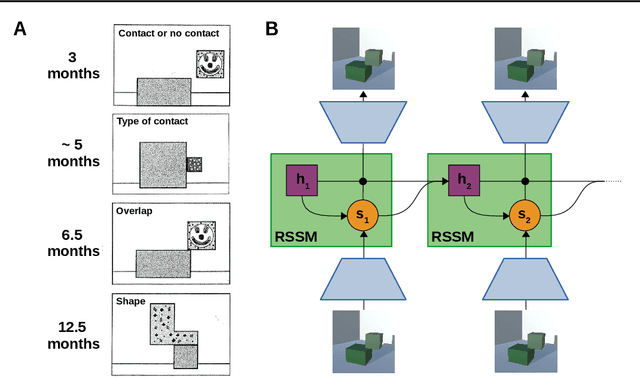
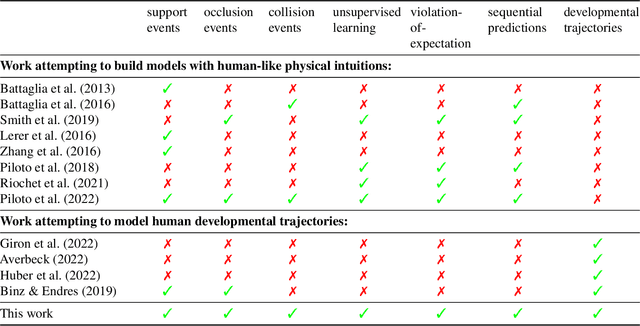
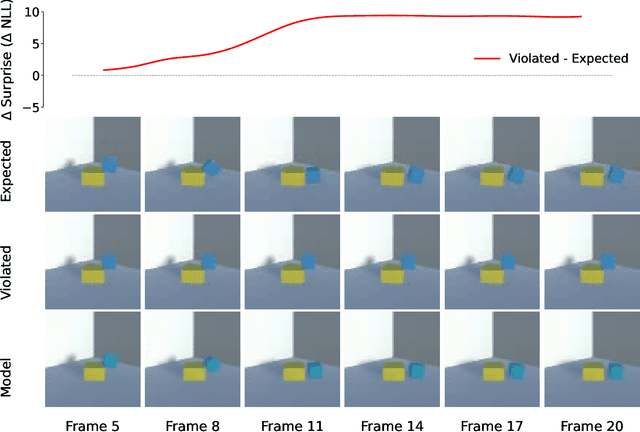

As children grow older, they develop an intuitive understanding of the physical processes around them. Their physical understanding develops in stages, moving along developmental trajectories which have been mapped out extensively in previous empirical research. Here, we investigate how the learning trajectories of deep generative neural networks compare to children's developmental trajectories using physical understanding as a testbed. We outline an approach that allows us to examine two distinct hypotheses of human development - stochastic optimization and complexity increase. We find that while our models are able to accurately predict a number of physical processes, their learning trajectories under both hypotheses do not follow the developmental trajectories of children.