 Add to Chrome
 Add to Firefox
 Add to Edge
Better Together: Enhancing Generative Knowledge Graph Completion with Language Models and Neighborhood Information
Nov 02, 2023
Real-world Knowledge Graphs (KGs) often suffer from incompleteness, which limits their potential performance. Knowledge Graph Completion (KGC) techniques aim to address this issue. However, traditional KGC methods are computationally intensive and impractical for large-scale KGs, necessitating the learning of dense node embeddings and computing pairwise distances. Generative transformer-based language models (e.g., T5 and recent KGT5) offer a promising solution as they can predict the tail nodes directly. In this study, we propose to include node neighborhoods as additional information to improve KGC methods based on language models. We examine the effects of this imputation and show that, on both inductive and transductive Wikidata subsets, our method outperforms KGT5 and conventional KGC approaches. We also provide an extensive analysis of the impact of neighborhood on model prediction and show its importance. Furthermore, we point the way to significantly improve KGC through more effective neighborhood selection.

Monolingual and Cross-Lingual Knowledge Transfer for Topic Classification
Jul 04, 2023This article investigates the knowledge transfer from the RuQTopics dataset. This Russian topical dataset combines a large sample number (361,560 single-label, 170,930 multi-label) with extensive class coverage (76 classes). We have prepared this dataset from the "Yandex Que" raw data. By evaluating the RuQTopics - trained models on the six matching classes of the Russian MASSIVE subset, we have proved that the RuQTopics dataset is suitable for real-world conversational tasks, as the Russian-only models trained on this dataset consistently yield an accuracy around 85\% on this subset. We also have figured out that for the multilingual BERT, trained on the RuQTopics and evaluated on the same six classes of MASSIVE (for all MASSIVE languages), the language-wise accuracy closely correlates (Spearman correlation 0.773 with p-value 2.997e-11) with the approximate size of the pretraining BERT's data for the corresponding language. At the same time, the correlation of the language-wise accuracy with the linguistical distance from Russian is not statistically significant.
Active Learning for Abstractive Text Summarization
Jan 09, 2023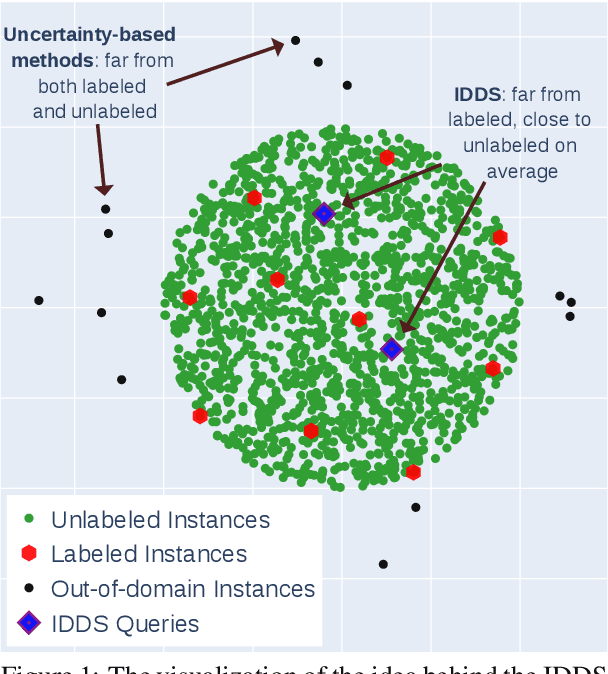
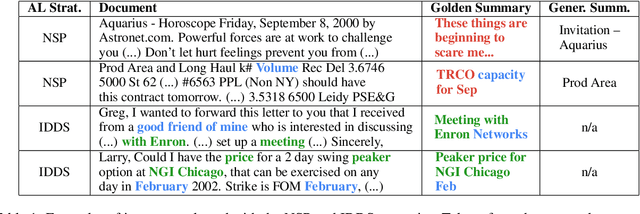
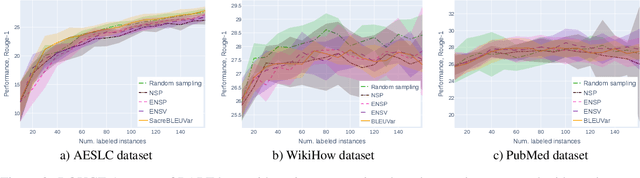
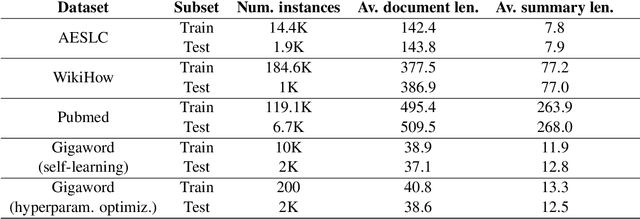
Construction of human-curated annotated datasets for abstractive text summarization (ATS) is very time-consuming and expensive because creating each instance requires a human annotator to read a long document and compose a shorter summary that would preserve the key information relayed by the original document. Active Learning (AL) is a technique developed to reduce the amount of annotation required to achieve a certain level of machine learning model performance. In information extraction and text classification, AL can reduce the amount of labor up to multiple times. Despite its potential for aiding expensive annotation, as far as we know, there were no effective AL query strategies for ATS. This stems from the fact that many AL strategies rely on uncertainty estimation, while as we show in our work, uncertain instances are usually noisy, and selecting them can degrade the model performance compared to passive annotation. We address this problem by proposing the first effective query strategy for AL in ATS based on diversity principles. We show that given a certain annotation budget, using our strategy in AL annotation helps to improve the model performance in terms of ROUGE and consistency scores. Additionally, we analyze the effect of self-learning and show that it can further increase the performance of the model.
Collecting Interactive Multi-modal Datasets for Grounded Language Understanding
Nov 18, 2022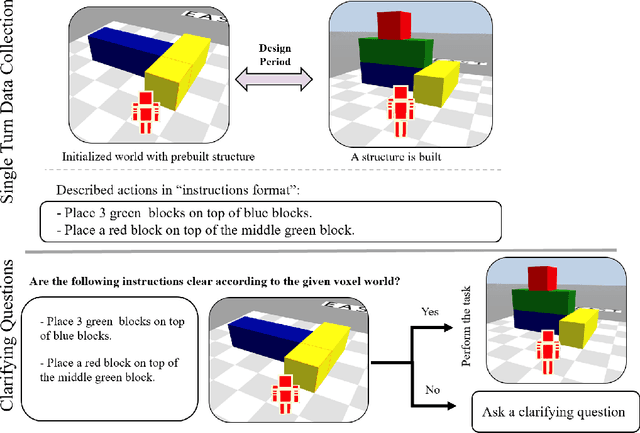
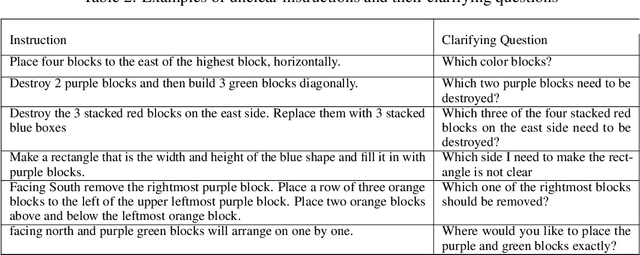
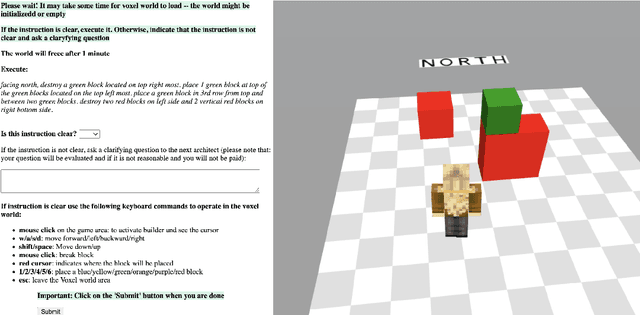
Human intelligence can remarkably adapt quickly to new tasks and environments. Starting from a very young age, humans acquire new skills and learn how to solve new tasks either by imitating the behavior of others or by following provided natural language instructions. To facilitate research which can enable similar capabilities in machines, we made the following contributions (1) formalized the collaborative embodied agent using natural language task; (2) developed a tool for extensive and scalable data collection; and (3) collected the first dataset for interactive grounded language understanding.
Learning to Solve Voxel Building Embodied Tasks from Pixels and Natural Language Instructions
Nov 01, 2022The adoption of pre-trained language models to generate action plans for embodied agents is a promising research strategy. However, execution of instructions in real or simulated environments requires verification of the feasibility of actions as well as their relevance to the completion of a goal. We propose a new method that combines a language model and reinforcement learning for the task of building objects in a Minecraft-like environment according to the natural language instructions. Our method first generates a set of consistently achievable sub-goals from the instructions and then completes associated sub-tasks with a pre-trained RL policy. The proposed method formed the RL baseline at the IGLU 2022 competition.
Explain My Surprise: Learning Efficient Long-Term Memory by Predicting Uncertain Outcomes
Jul 27, 2022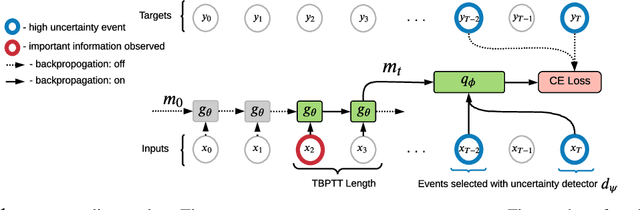
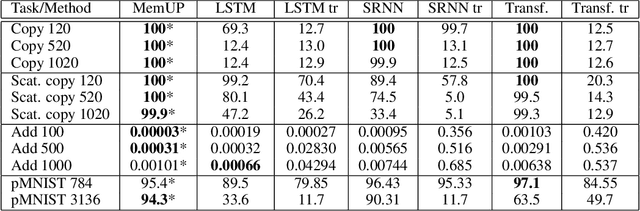
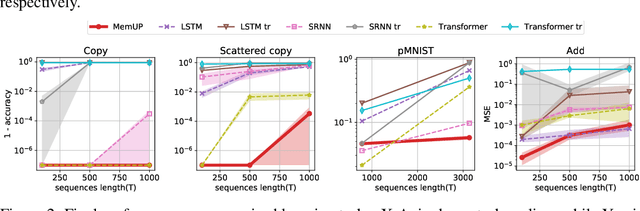
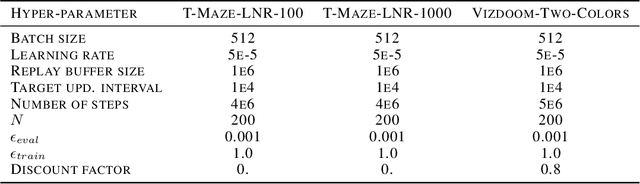
In many sequential tasks, a model needs to remember relevant events from the distant past to make correct predictions. Unfortunately, a straightforward application of gradient based training requires intermediate computations to be stored for every element of a sequence. This requires prohibitively large computing memory if a sequence consists of thousands or even millions elements, and as a result, makes learning of very long-term dependencies infeasible. However, the majority of sequence elements can usually be predicted by taking into account only temporally local information. On the other hand, predictions affected by long-term dependencies are sparse and characterized by high uncertainty given only local information. We propose MemUP, a new training method that allows to learn long-term dependencies without backpropagating gradients through the whole sequence at a time. This method can be potentially applied to any gradient based sequence learning. MemUP implementation for recurrent architectures shows performances better or comparable to baselines while requiring significantly less computing memory.
IGLU 2022: Interactive Grounded Language Understanding in a Collaborative Environment at NeurIPS 2022
May 27, 2022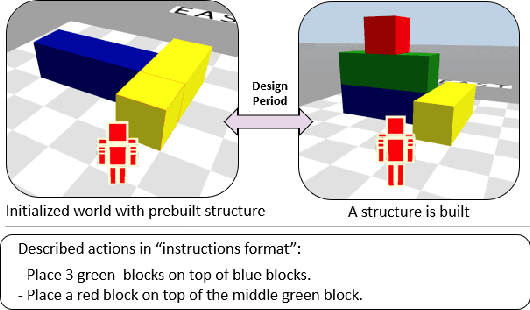

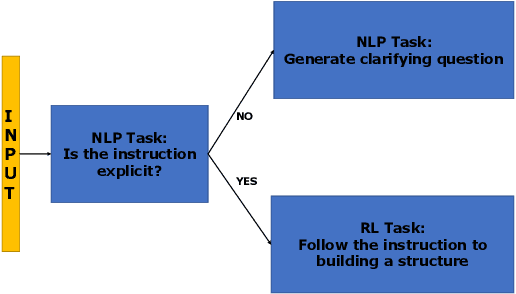
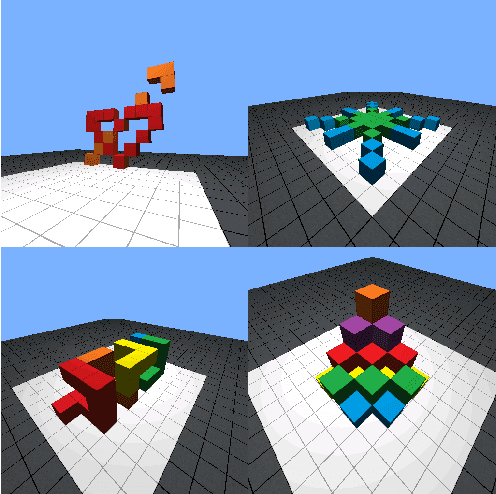
Human intelligence has the remarkable ability to adapt to new tasks and environments quickly. Starting from a very young age, humans acquire new skills and learn how to solve new tasks either by imitating the behavior of others or by following provided natural language instructions. To facilitate research in this direction, we propose IGLU: Interactive Grounded Language Understanding in a Collaborative Environment. The primary goal of the competition is to approach the problem of how to develop interactive embodied agents that learn to solve a task while provided with grounded natural language instructions in a collaborative environment. Understanding the complexity of the challenge, we split it into sub-tasks to make it feasible for participants. This research challenge is naturally related, but not limited, to two fields of study that are highly relevant to the NeurIPS community: Natural Language Understanding and Generation (NLU/G) and Reinforcement Learning (RL). Therefore, the suggested challenge can bring two communities together to approach one of the crucial challenges in AI. Another critical aspect of the challenge is the dedication to perform a human-in-the-loop evaluation as a final evaluation for the agents developed by contestants.
Interactive Grounded Language Understanding in a Collaborative Environment: IGLU 2021
May 05, 2022
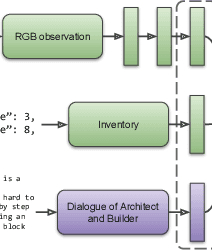
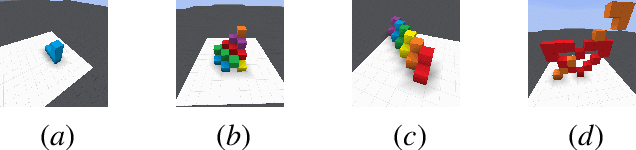
Human intelligence has the remarkable ability to quickly adapt to new tasks and environments. Starting from a very young age, humans acquire new skills and learn how to solve new tasks either by imitating the behavior of others or by following provided natural language instructions. To facilitate research in this direction, we propose \emph{IGLU: Interactive Grounded Language Understanding in a Collaborative Environment}. The primary goal of the competition is to approach the problem of how to build interactive agents that learn to solve a task while provided with grounded natural language instructions in a collaborative environment. Understanding the complexity of the challenge, we split it into sub-tasks to make it feasible for participants.
* arXiv admin note: substantial text overlap with arXiv:2110.06536
Knowledge Distillation of Russian Language Models with Reduction of Vocabulary
May 04, 2022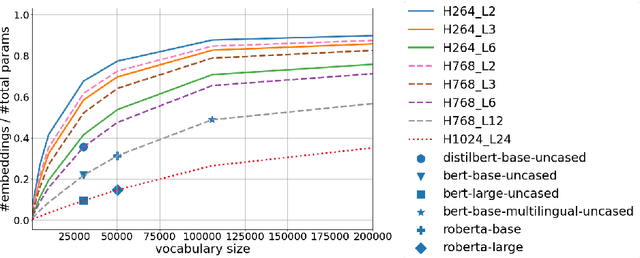
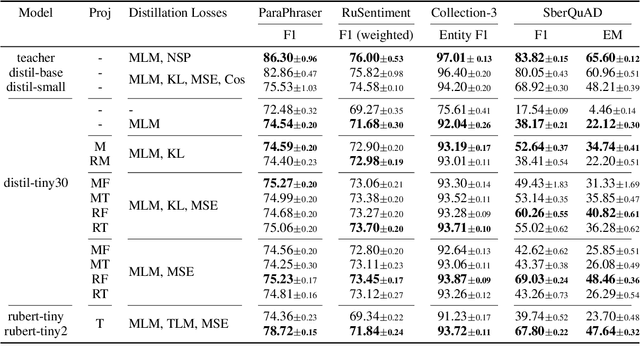

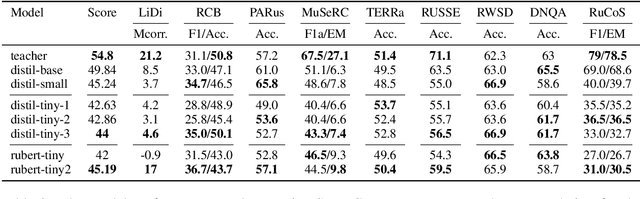
Today, transformer language models serve as a core component for majority of natural language processing tasks. Industrial application of such models requires minimization of computation time and memory footprint. Knowledge distillation is one of approaches to address this goal. Existing methods in this field are mainly focused on reducing the number of layers or dimension of embeddings/hidden representations. Alternative option is to reduce the number of tokens in vocabulary and therefore the embeddings matrix of the student model. The main problem with vocabulary minimization is mismatch between input sequences and output class distributions of a teacher and a student models. As a result, it is impossible to directly apply KL-based knowledge distillation. We propose two simple yet effective alignment techniques to make knowledge distillation to the students with reduced vocabulary. Evaluation of distilled models on a number of common benchmarks for Russian such as Russian SuperGLUE, SberQuAD, RuSentiment, ParaPhaser, Collection-3 demonstrated that our techniques allow to achieve compression from $17\times$ to $49\times$, while maintaining quality of $1.7\times$ compressed student with the full-sized vocabulary, but reduced number of Transformer layers only. We make our code and distilled models available.
NeurIPS 2021 Competition IGLU: Interactive Grounded Language Understanding in a Collaborative Environment
Oct 15, 2021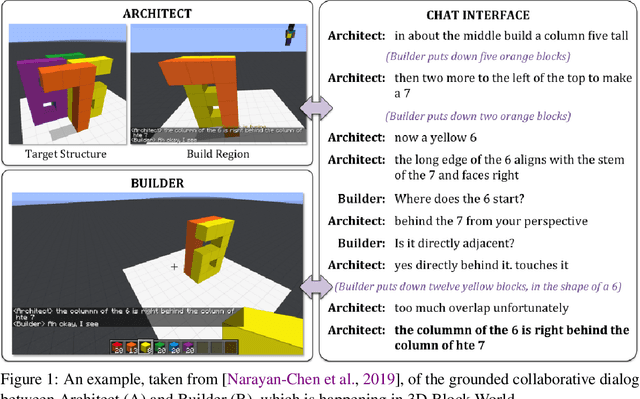

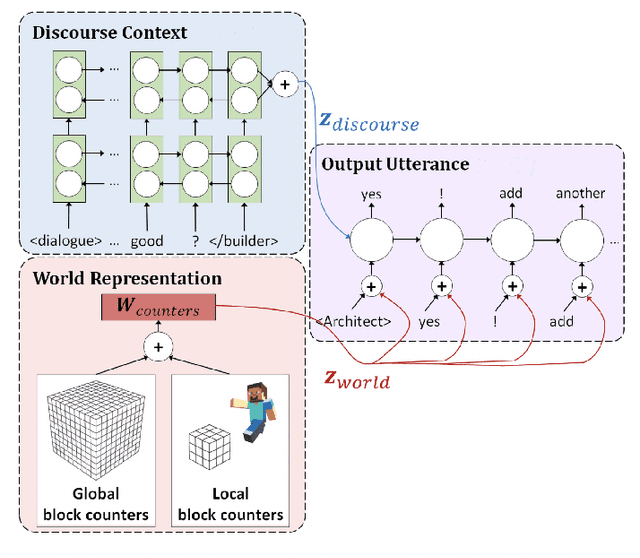
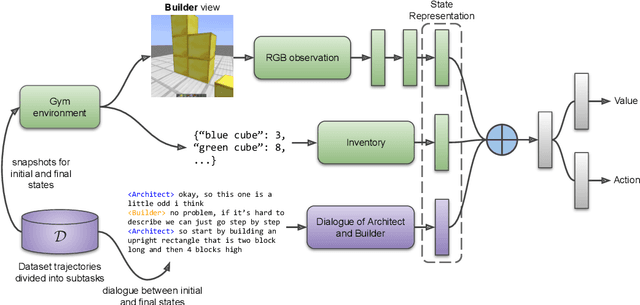
Human intelligence has the remarkable ability to adapt to new tasks and environments quickly. Starting from a very young age, humans acquire new skills and learn how to solve new tasks either by imitating the behavior of others or by following provided natural language instructions. To facilitate research in this direction, we propose IGLU: Interactive Grounded Language Understanding in a Collaborative Environment. The primary goal of the competition is to approach the problem of how to build interactive agents that learn to solve a task while provided with grounded natural language instructions in a collaborative environment. Understanding the complexity of the challenge, we split it into sub-tasks to make it feasible for participants. This research challenge is naturally related, but not limited, to two fields of study that are highly relevant to the NeurIPS community: Natural Language Understanding and Generation (NLU/G) and Reinforcement Learning (RL). Therefore, the suggested challenge can bring two communities together to approach one of the important challenges in AI. Another important aspect of the challenge is the dedication to perform a human-in-the-loop evaluation as a final evaluation for the agents developed by contestants.