 Add to Chrome
 Add to Firefox
 Add to Edge
Causal Object-Centric Models for Planning with Monte Carlo Tree Search
Jun 12, 2026
We introduce COMET (Causal Object-centric Model for Efficient Tree search), a model-based reinforcement learning algorithm that performs Monte Carlo Tree Search in a slot-structured latent space. COMET pairs a frozen unsupervised object-centric encoder with a transformer-based world model, in which actions are bound to objects through a novel action-slot fusion mechanism that is used in slot transition prediction. Policy and value heads use object-causal attention, modulating token interactions by learned per-slot relevance scores so that decision-making concentrates on task-relevant entities. COMET adds an explicit object-level inductive bias to MuZero-style latent planning. Across eight visually and dynamically diverse tasks from the Object-Centric Visual RL benchmark, ManiSkill, Robosuite, and VizDoom, COMET achieves a higher mean normalized score during the early stages of training compared to object-centric and monolithic baselines.

$μ$VLA: On Recurrent Memory for Partially Observable Manipulation in VLA Models
Jun 10, 2026Vision-language-action (VLA) models predict chunks of future actions from the current observation, an assumption that fails under partial observability, where decisions depend on information no longer visible. Existing memory-augmented VLAs simultaneously introduce recurrence, retrieval, compression modules, auxiliary objectives, hierarchical memory, or task-specific architectural changes, so the contribution of recurrence itself remains entangled with surrounding machinery. We present a controlled isolation study of recurrence in a strong pretrained VLA backbone. Our formulation augments the transformer with a small set of learnable memory tokens carried across timesteps and updated through self-attention, trained end to end with truncated backpropagation through time, with no auxiliary losses and no architectural changes. We instantiate this as $μ$VLA, a family of OpenVLA-OFT variants parameterized by memory width m, TBPTT length K, and the memory update rule (cross-step gradients or a detached EMA), so that recurrence is the only varying factor. On MIKASA-Robo, $μ$VLA improves average success rate on five training tasks from 0.42 to 0.84 at the strongest setting and reaches 0.23 on held-out tasks with the same memory structure versus 0.07 for the memoryless baseline. On tasks requiring different memory structure, performance remains near baseline. On LIBERO, the strongest recurrent variant achieves 96.2% average success, indicating no regression under full observability. We interpret these results as a calibration of the capability envelope of minimal in-backbone recurrence, identifying the regime in which it is sufficient and the regime where additional memory structure is required. Demos and videos can be found in https://avanturist322.github.io/mu-vla/.
Self-Guided Plan Extraction for Instruction-Following Tasks with Goal-Conditional Reinforcement Learning
Apr 22, 2026We introduce SuperIgor, a framework for instruction-following tasks. Unlike prior methods that rely on predefined subtasks, SuperIgor enables a language model to generate and refine high-level plans through a self-learning mechanism, reducing the need for manual dataset annotation. Our approach involves iterative co-training: an RL agent is trained to follow the generated plans, while the language model adapts and modifies these plans based on RL feedback and preferences. This creates a feedback loop where both the agent and the planner improve jointly. We validate our framework in environments with rich dynamics and stochasticity. Results show that SuperIgor agents adhere to instructions more strictly than baseline methods, while also demonstrating strong generalization to previously unseen instructions.
MARL-GPT: Foundation Model for Multi-Agent Reinforcement Learning
Apr 07, 2026Recent advances in multi-agent reinforcement learning (MARL) have demonstrated success in numerous challenging domains and environments, but typically require specialized models for each task. In this work, we propose a coherent methodology that makes it possible for a single GPT-based model to learn and perform well across diverse MARL environments and tasks, including StarCraft Multi-Agent Challenge, Google Research Football and POGEMA. Our method, MARL-GPT, applies offline reinforcement learning to train at scale on the expert trajectories (400M for SMACv2, 100M for GRF, and 1B for POGEMA) combined with a single transformer-based observation encoder that requires no task-specific tuning. Experiments show that MARL-GPT achieves competitive performance compared to specialized baselines in all tested environments. Thus, our findings suggest that it is, indeed, possible to build a multi-task transformer-based model for a wide variety of (significantly different) multi-agent problems paving the way to the fundamental MARL model (akin to ChatGPT, Llama, Mistral etc. in natural language modeling).
Revisiting Tree Search for LLMs: Gumbel and Sequential Halving for Budget-Scalable Reasoning
Mar 22, 2026Neural tree search is a powerful decision-making algorithm widely used in complex domains such as game playing and model-based reinforcement learning. Recent work has applied AlphaZero-style tree search to enhance the reasoning capabilities of Large Language Models (LLMs) during inference, but we find that this approach suffers from a scaling failure: on GSM8K and Game24, accuracy drops as the search budget increases. In this paper, we present ReSCALE, an adaptation of Gumbel AlphaZero MCTS that replaces Dirichlet noise and PUCT selection with Gumbel sampling and Sequential Halving, restoring monotonic scaling without changes to the model or its training. ReSCALE reaches 58.4\% on GSM8K and 85.3\% on Game24 at budgets where the baseline degrades. Ablations confirm that Sequential Halving is the primary driver of the improvement.
CoRL-MPPI: Enhancing MPPI With Learnable Behaviours For Efficient And Provably-Safe Multi-Robot Collision Avoidance
Nov 12, 2025Decentralized collision avoidance remains a core challenge for scalable multi-robot systems. One of the promising approaches to tackle this problem is Model Predictive Path Integral (MPPI) -- a framework that is naturally suited to handle any robot motion model and provides strong theoretical guarantees. Still, in practice MPPI-based controller may provide suboptimal trajectories as its performance relies heavily on uninformed random sampling. In this work, we introduce CoRL-MPPI, a novel fusion of Cooperative Reinforcement Learning and MPPI to address this limitation. We train an action policy (approximated as deep neural network) in simulation that learns local cooperative collision avoidance behaviors. This learned policy is then embedded into the MPPI framework to guide its sampling distribution, biasing it towards more intelligent and cooperative actions. Notably, CoRL-MPPI preserves all the theoretical guarantees of regular MPPI. We evaluate our approach in dense, dynamic simulation environments against state-of-the-art baselines, including ORCA, BVC, and a multi-agent MPPI implementation. Our results demonstrate that CoRL-MPPI significantly improves navigation efficiency (measured by success rate and makespan) and safety, enabling agile and robust multi-robot navigation.
CrafText Benchmark: Advancing Instruction Following in Complex Multimodal Open-Ended World
May 17, 2025Following instructions in real-world conditions requires the ability to adapt to the world's volatility and entanglement: the environment is dynamic and unpredictable, instructions can be linguistically complex with diverse vocabulary, and the number of possible goals an agent may encounter is vast. Despite extensive research in this area, most studies are conducted in static environments with simple instructions and a limited vocabulary, making it difficult to assess agent performance in more diverse and challenging settings. To address this gap, we introduce CrafText, a benchmark for evaluating instruction following in a multimodal environment with diverse instructions and dynamic interactions. CrafText includes 3,924 instructions with 3,423 unique words, covering Localization, Conditional, Building, and Achievement tasks. Additionally, we propose an evaluation protocol that measures an agent's ability to generalize to novel instruction formulations and dynamically evolving task configurations, providing a rigorous test of both linguistic understanding and adaptive decision-making.
MAPF-GPT: Imitation Learning for Multi-Agent Pathfinding at Scale
Aug 29, 2024Multi-agent pathfinding (MAPF) is a challenging computational problem that typically requires to find collision-free paths for multiple agents in a shared environment. Solving MAPF optimally is NP-hard, yet efficient solutions are critical for numerous applications, including automated warehouses and transportation systems. Recently, learning-based approaches to MAPF have gained attention, particularly those leveraging deep reinforcement learning. Following current trends in machine learning, we have created a foundation model for the MAPF problems called MAPF-GPT. Using imitation learning, we have trained a policy on a set of pre-collected sub-optimal expert trajectories that can generate actions in conditions of partial observability without additional heuristics, reward functions, or communication with other agents. The resulting MAPF-GPT model demonstrates zero-shot learning abilities when solving the MAPF problem instances that were not present in the training dataset. We show that MAPF-GPT notably outperforms the current best-performing learnable-MAPF solvers on a diverse range of problem instances and is efficient in terms of computation (in the inference mode).
POGEMA: A Benchmark Platform for Cooperative Multi-Agent Navigation
Jul 20, 2024Multi-agent reinforcement learning (MARL) has recently excelled in solving challenging cooperative and competitive multi-agent problems in various environments with, mostly, few agents and full observability. Moreover, a range of crucial robotics-related tasks, such as multi-robot navigation and obstacle avoidance, that have been conventionally approached with the classical non-learnable methods (e.g., heuristic search) is currently suggested to be solved by the learning-based or hybrid methods. Still, in this domain, it is hard, not to say impossible, to conduct a fair comparison between classical, learning-based, and hybrid approaches due to the lack of a unified framework that supports both learning and evaluation. To this end, we introduce POGEMA, a set of comprehensive tools that includes a fast environment for learning, a generator of problem instances, the collection of pre-defined ones, a visualization toolkit, and a benchmarking tool that allows automated evaluation. We introduce and specify an evaluation protocol defining a range of domain-related metrics computed on the basics of the primary evaluation indicators (such as success rate and path length), allowing a fair multi-fold comparison. The results of such a comparison, which involves a variety of state-of-the-art MARL, search-based, and hybrid methods, are presented.
IDAT: A Multi-Modal Dataset and Toolkit for Building and Evaluating Interactive Task-Solving Agents
Jul 12, 2024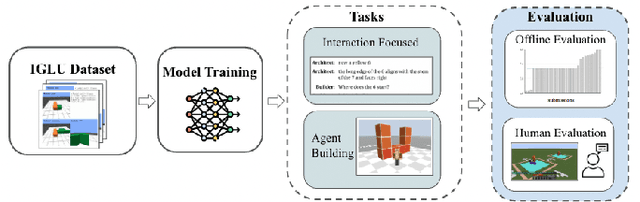


Seamless interaction between AI agents and humans using natural language remains a key goal in AI research. This paper addresses the challenges of developing interactive agents capable of understanding and executing grounded natural language instructions through the IGLU competition at NeurIPS. Despite advancements, challenges such as a scarcity of appropriate datasets and the need for effective evaluation platforms persist. We introduce a scalable data collection tool for gathering interactive grounded language instructions within a Minecraft-like environment, resulting in a Multi-Modal dataset with around 9,000 utterances and over 1,000 clarification questions. Additionally, we present a Human-in-the-Loop interactive evaluation platform for qualitative analysis and comparison of agent performance through multi-turn communication with human annotators. We offer to the community these assets referred to as IDAT (IGLU Dataset And Toolkit) which aim to advance the development of intelligent, interactive AI agents and provide essential resources for further research.