 Add to Chrome
 Add to Firefox
 Add to Edge
Aggregating Multiple Bio-Inspired Image Region Classifiers For Effective And Lightweight Visual Place Recognition
Dec 20, 2023
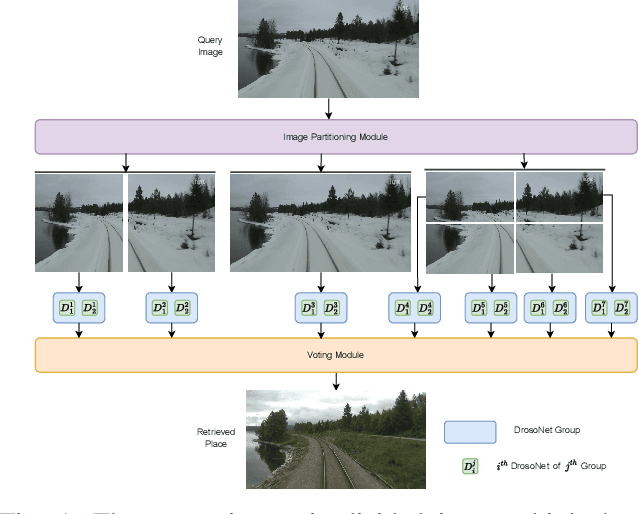
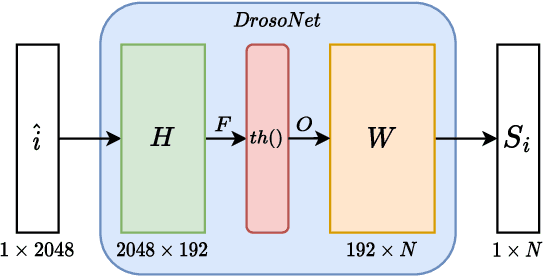
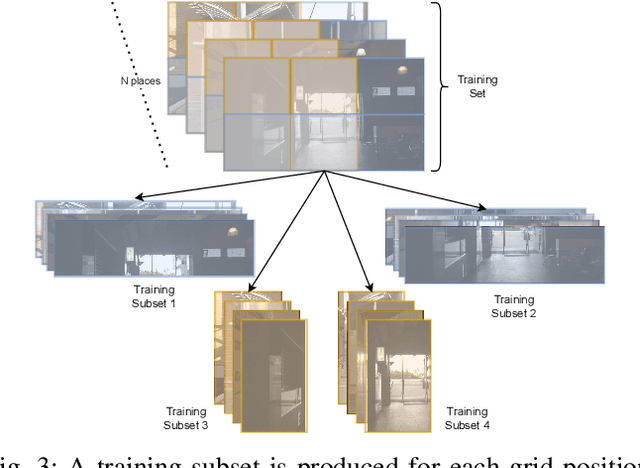
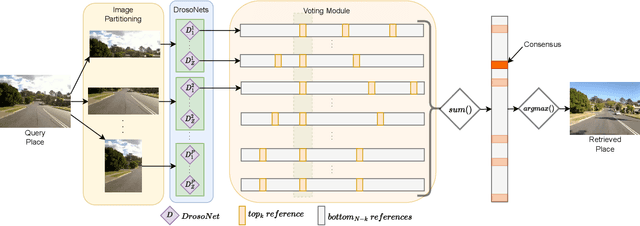
Visual place recognition (VPR) enables autonomous systems to localize themselves within an environment using image information. While VPR techniques built upon a Convolutional Neural Network (CNN) backbone dominate state-of-the-art VPR performance, their high computational requirements make them unsuitable for platforms equipped with low-end hardware. Recently, a lightweight VPR system based on multiple bio-inspired classifiers, dubbed DrosoNets, has been proposed, achieving great computational efficiency at the cost of reduced absolute place retrieval performance. In this work, we propose a novel multi-DrosoNet localization system, dubbed RegionDrosoNet, with significantly improved VPR performance, while preserving a low-computational profile. Our approach relies on specializing distinct groups of DrosoNets on differently sliced partitions of the original image, increasing extrinsic model differentiation. Furthermore, we introduce a novel voting module to combine the outputs of all DrosoNets into the final place prediction which considers multiple top refence candidates from each DrosoNet. RegionDrosoNet outperforms other lightweight VPR techniques when dealing with both appearance changes and viewpoint variations. Moreover, it competes with computationally expensive methods on some benchmark datasets at a small fraction of their online inference time.

Design Space Exploration of Low-Bit Quantized Neural Networks for Visual Place Recognition
Dec 14, 2023Visual Place Recognition (VPR) is a critical task for performing global re-localization in visual perception systems. It requires the ability to accurately recognize a previously visited location under variations such as illumination, occlusion, appearance and viewpoint. In the case of robotic systems and augmented reality, the target devices for deployment are battery powered edge devices. Therefore whilst the accuracy of VPR methods is important so too is memory consumption and latency. Recently new works have focused on the recall@1 metric as a performance measure with limited focus on resource utilization. This has resulted in methods that use deep learning models too large to deploy on low powered edge devices. We hypothesize that these large models are highly over-parameterized and can be optimized to satisfy the constraints of a low powered embedded system whilst maintaining high recall performance. Our work studies the impact of compact convolutional network architecture design in combination with full-precision and mixed-precision post-training quantization on VPR performance. Importantly we not only measure performance via the recall@1 score but also measure memory consumption and latency. We characterize the design implications on memory, latency and recall scores and provide a number of design recommendations for VPR systems under these resource limitations.
Applications of Spiking Neural Networks in Visual Place Recognition
Nov 22, 2023In robotics, Spiking Neural Networks (SNNs) are increasingly recognized for their largely-unrealized potential energy efficiency and low latency particularly when implemented on neuromorphic hardware. Our paper highlights three advancements for SNNs in Visual Place Recognition (VPR). First, we propose Modular SNNs, where each SNN represents a set of non-overlapping geographically distinct places, enabling scalable networks for large environments. Secondly, we present Ensembles of Modular SNNs, where multiple networks represent the same place, significantly enhancing accuracy compared to single-network models. Our SNNs are compact and small, comprising only 1500 neurons and 474k synapses, which makes them ideally suited for ensembling due to this small size. Lastly, we investigate the role of sequence matching in SNN-based VPR, a technique where consecutive images are used to refine place recognition. We analyze the responsiveness of SNNs to ensembling and sequence matching compared to other VPR techniques. Our contributions highlight the viability of SNNs for VPR, offering scalable and robust solutions, paving the way for their application in various energy-sensitive robotic tasks.
FocusTune: Tuning Visual Localization through Focus-Guided Sampling
Nov 06, 2023We propose FocusTune, a focus-guided sampling technique to improve the performance of visual localization algorithms. FocusTune directs a scene coordinate regression model towards regions critical for 3D point triangulation by exploiting key geometric constraints. Specifically, rather than uniformly sampling points across the image for training the scene coordinate regression model, we instead re-project 3D scene coordinates onto the 2D image plane and sample within a local neighborhood of the re-projected points. While our proposed sampling strategy is generally applicable, we showcase FocusTune by integrating it with the recently introduced Accelerated Coordinate Encoding (ACE) model. Our results demonstrate that FocusTune both improves or matches state-of-the-art performance whilst keeping ACE's appealing low storage and compute requirements, for example reducing translation error from 25 to 19 and 17 to 15 cm for single and ensemble models, respectively, on the Cambridge Landmarks dataset. This combination of high performance and low compute and storage requirements is particularly promising for applications in areas like mobile robotics and augmented reality. We made our code available at \url{https://github.com/sontung/focus-tune}.
Collaborative Visual Place Recognition
Oct 09, 2023


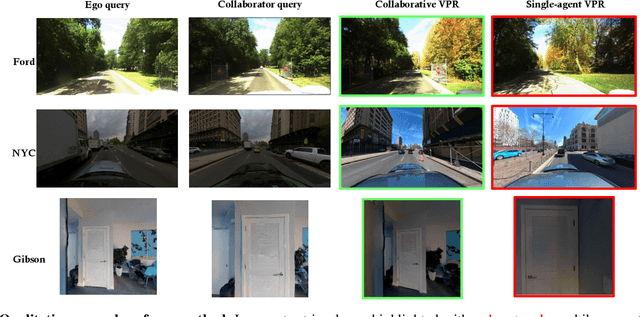
Visual place recognition (VPR) capabilities enable autonomous robots to navigate complex environments by discovering the environment's topology based on visual input. Most research efforts focus on enhancing the accuracy and robustness of single-robot VPR but often encounter issues such as occlusion due to individual viewpoints. Despite a number of research on multi-robot metric-based localization, there is a notable gap in research concerning more robust and efficient place-based localization with a multi-robot system. This work proposes collaborative VPR, where multiple robots share abstracted visual features to enhance place recognition capabilities. We also introduce a novel collaborative VPR framework based on similarity-regularized information fusion, reducing irrelevant noise while harnessing valuable data from collaborators. This framework seamlessly integrates with well-established single-robot VPR techniques and supports end-to-end training with a weakly-supervised contrastive loss. We conduct experiments in urban, rural, and indoor scenes, achieving a notable improvement over single-agent VPR in urban environments (~12\%), along with consistent enhancements in rural (~3\%) and indoor (~1\%) scenarios. Our work presents a promising solution to the pressing challenges of VPR, representing a substantial step towards safe and robust autonomous systems.
Teach and Repeat Navigation: A Robust Control Approach
Sep 27, 2023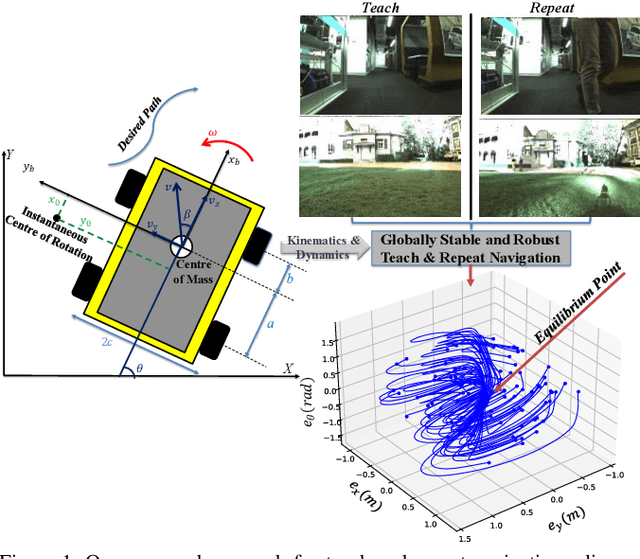
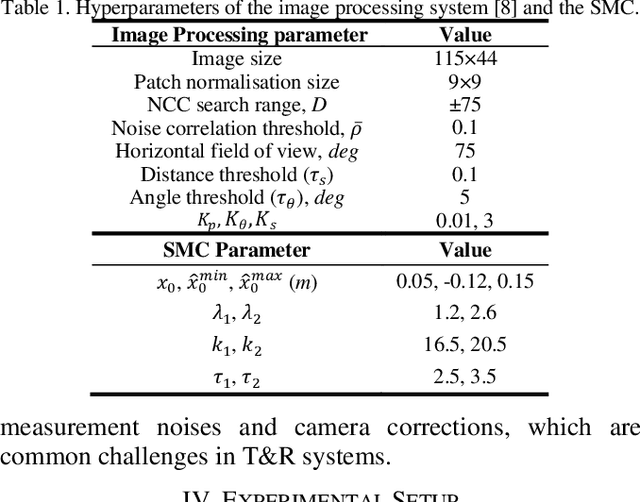
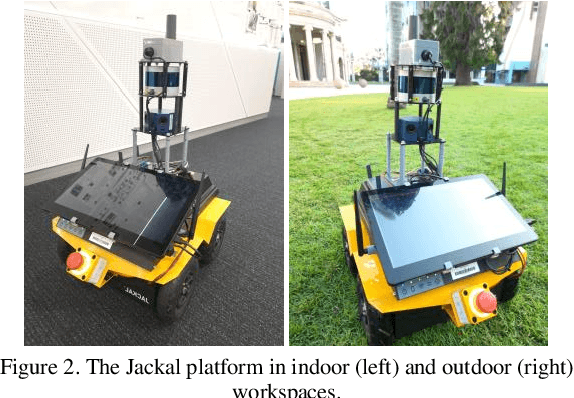

Robot navigation requires an autonomy pipeline that is robust to environmental changes and effective in varying conditions. Teach and Repeat (T&R) navigation has shown high performance in autonomous repeated tasks under challenging circumstances, but research within T&R has predominantly focused on motion planning as opposed to motion control. In this paper, we propose a novel T&R system based on a robust motion control technique for a skid-steering mobile robot using sliding-mode control that effectively handles uncertainties that are particularly pronounced in the T&R task, where sensor noises, parametric uncertainties, and wheel-terrain interaction are common challenges. We first theoretically demonstrate that the proposed T&R system is globally stable and robust while considering the uncertainties of the closed-loop system. When deployed on a Clearpath Jackal robot, we then show the global stability of the proposed system in both indoor and outdoor environments covering different terrains, outperforming previous state-of-the-art methods in terms of mean average trajectory error and stability in these challenging environments. This paper makes an important step towards long-term autonomous T&R navigation with ensured safety guarantees.
VPRTempo: A Fast Temporally Encoded Spiking Neural Network for Visual Place Recognition
Sep 19, 2023Spiking Neural Networks (SNNs) are at the forefront of neuromorphic computing thanks to their potential energy-efficiency, low latencies, and capacity for continual learning. While these capabilities are well suited for robotics tasks, SNNs have seen limited adaptation in this field thus far. This work introduces a SNN for Visual Place Recognition (VPR) that is both trainable within minutes and queryable in milliseconds, making it well suited for deployment on compute-constrained robotic systems. Our proposed system, VPRTempo, overcomes slow training and inference times using an abstracted SNN that trades biological realism for efficiency. VPRTempo employs a temporal code that determines the timing of a single spike based on a pixel's intensity, as opposed to prior SNNs relying on rate coding that determined the number of spikes; improving spike efficiency by over 100%. VPRTempo is trained using Spike-Timing Dependent Plasticity and a supervised delta learning rule enforcing that each output spiking neuron responds to just a single place. We evaluate our system on the Nordland and Oxford RobotCar benchmark localization datasets, which include up to 27k places. We found that VPRTempo's accuracy is comparable to prior SNNs and the popular NetVLAD place recognition algorithm, while being several orders of magnitude faster and suitable for real-time deployment -- with inference speeds over 50 Hz on CPU. VPRTempo could be integrated as a loop closure component for online SLAM on resource-constrained systems such as space and underwater robots.
Motion-Bias-Free Feature-Based SLAM
Sep 13, 2023For SLAM to be safely deployed in unstructured real world environments, it must possess several key properties that are not encompassed by conventional benchmarks. In this paper we show that SLAM commutativity, that is, consistency in trajectory estimates on forward and reverse traverses of the same route, is a significant issue for the state of the art. Current pipelines show a significant bias between forward and reverse directions of travel, that is in addition inconsistent regarding which direction of travel exhibits better performance. In this paper we propose several contributions to feature-based SLAM pipelines that remedies the motion bias problem. In a comprehensive evaluation across four datasets, we show that our contributions implemented in ORB-SLAM2 substantially reduce the bias between forward and backward motion and additionally improve the aggregated trajectory error. Removing the SLAM motion bias has significant relevance for the wide range of robotics and computer vision applications where performance consistency is important.
Trajectory Tracking via Multiscale Continuous Attractor Networks
Aug 01, 2023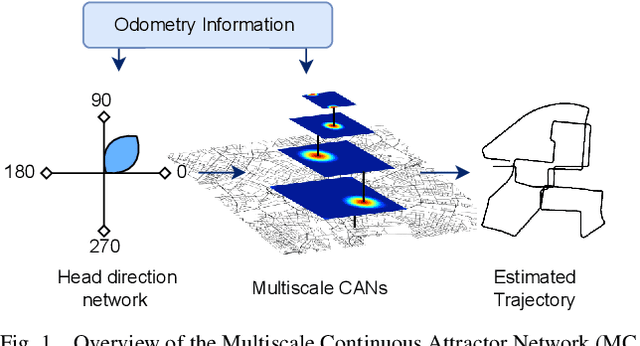
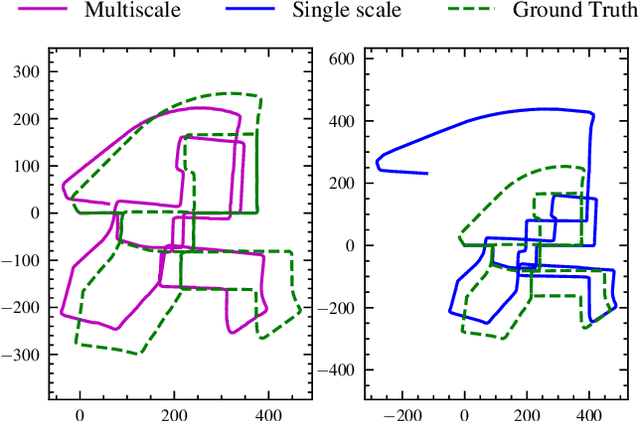
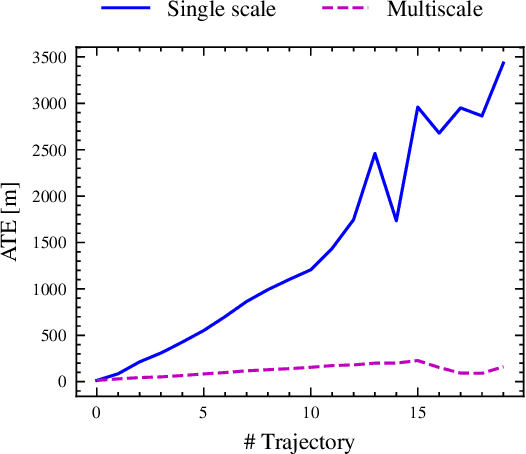
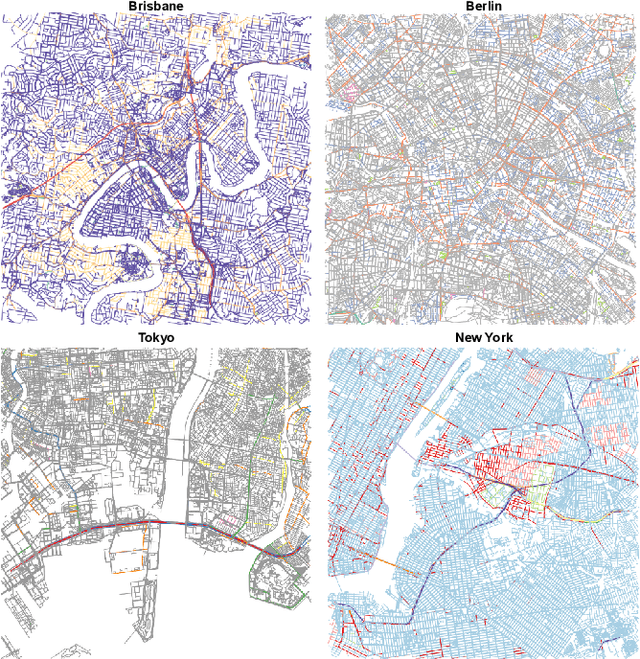
Animals and insects showcase remarkably robust and adept navigational abilities, up to literally circumnavigating the globe. Primary progress in robotics inspired by these natural systems has occurred in two areas: highly theoretical computational neuroscience models, and handcrafted systems like RatSLAM and NeuroSLAM. In this research, we present work bridging the gap between the two, in the form of Multiscale Continuous Attractor Networks (MCAN), that combine the multiscale parallel spatial neural networks of the previous theoretical models with the real-world robustness of the robot-targeted systems, to enable trajectory tracking over large velocity ranges. To overcome the limitations of the reliance of previous systems on hand-tuned parameters, we present a genetic algorithm-based approach for automated tuning of these networks, substantially improving their usability. To provide challenging navigational scale ranges, we open source a flexible city-scale navigation simulator that adapts to any street network, enabling high throughput experimentation. In extensive experiments using the city-scale navigation environment and Kitti, we show that the system is capable of stable dead reckoning over a wide range of velocities and environmental scales, where a single-scale approach fails.
Unsupervised Quality Prediction for Improved Single-Frame and Weighted Sequential Visual Place Recognition
Jul 04, 2023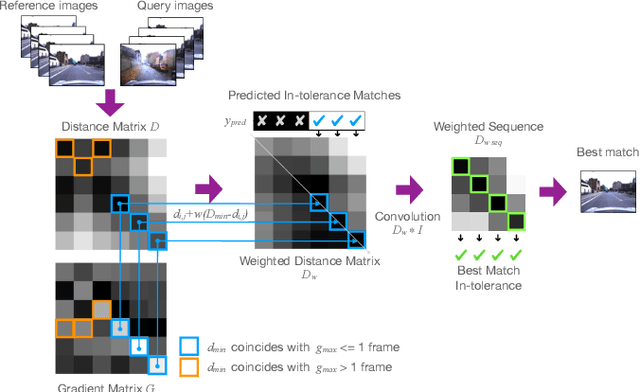
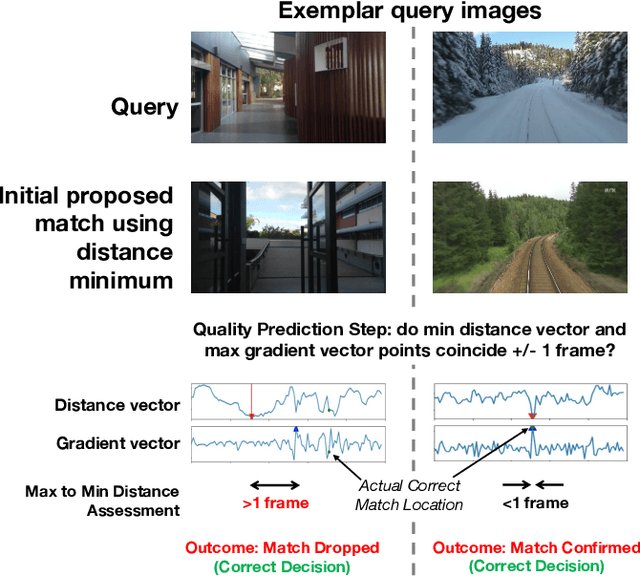
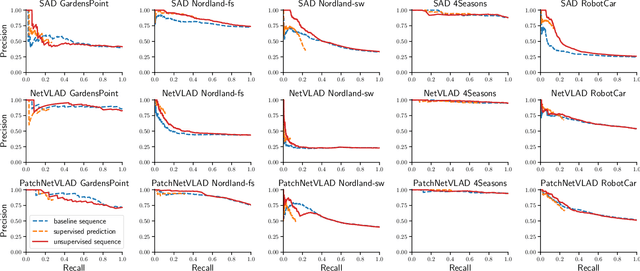
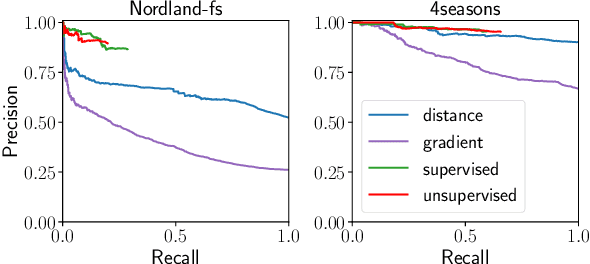
While substantial progress has been made in the absolute performance of localization and Visual Place Recognition (VPR) techniques, it is becoming increasingly clear from translating these systems into applications that other capabilities like integrity and predictability are just as important, especially for safety- or operationally-critical autonomous systems. In this research we present a new, training-free approach to predicting the likely quality of localization estimates, and a novel method for using these predictions to bias a sequence-matching process to produce additional performance gains beyond that of a naive sequence matching approach. Our combined system is lightweight, runs in real-time and is agnostic to the underlying VPR technique. On extensive experiments across four datasets and three VPR techniques, we demonstrate our system improves precision performance, especially at the high-precision/low-recall operating point. We also present ablation and analysis identifying the performance contributions of the prediction and weighted sequence matching components in isolation, and the relationship between the quality of the prediction system and the benefits of the weighted sequential matcher.