 Add to Chrome
 Add to Firefox
 Add to Edge
Virtual Width Networks
Nov 17, 2025
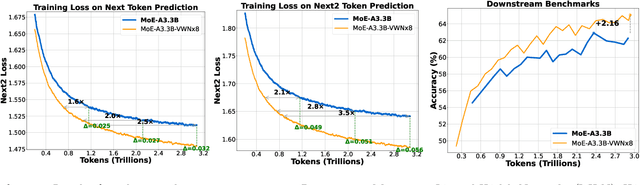
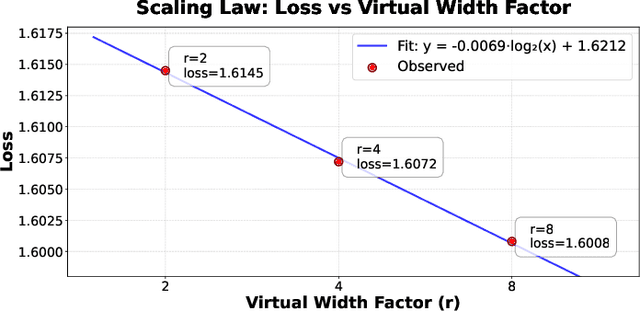
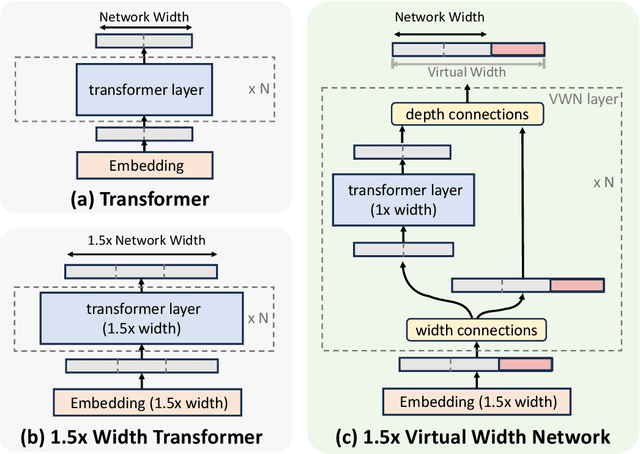
We introduce Virtual Width Networks (VWN), a framework that delivers the benefits of wider representations without incurring the quadratic cost of increasing the hidden size. VWN decouples representational width from backbone width, expanding the embedding space while keeping backbone compute nearly constant. In our large-scale experiment, an 8-times expansion accelerates optimization by over 2 times for next-token and 3 times for next-2-token prediction. The advantage amplifies over training as both the loss gap grows and the convergence-speedup ratio increases, showing that VWN is not only token-efficient but also increasingly effective with scale. Moreover, we identify an approximately log-linear scaling relation between virtual width and loss reduction, offering an initial empirical basis and motivation for exploring virtual-width scaling as a new dimension of large-model efficiency.

Robust Loss Functions for Object Grasping under Limited Ground Truth
Sep 09, 2024Object grasping is a crucial technology enabling robots to perceive and interact with the environment sufficiently. However, in practical applications, researchers are faced with missing or noisy ground truth while training the convolutional neural network, which decreases the accuracy of the model. Therefore, different loss functions are proposed to deal with these problems to improve the accuracy of the neural network. For missing ground truth, a new predicted category probability method is defined for unlabeled samples, which works effectively in conjunction with the pseudo-labeling method. Furthermore, for noisy ground truth, a symmetric loss function is introduced to resist the corruption of label noises. The proposed loss functions are powerful, robust, and easy to use. Experimental results based on the typical grasping neural network show that our method can improve performance by 2 to 13 percent.
Scientific Large Language Models: A Survey on Biological & Chemical Domains
Jan 26, 2024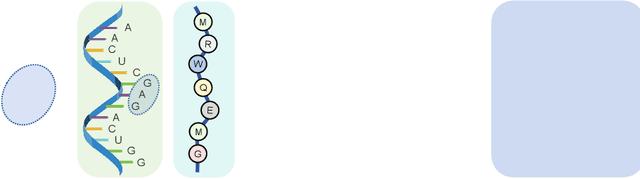
Large Language Models (LLMs) have emerged as a transformative power in enhancing natural language comprehension, representing a significant stride toward artificial general intelligence. The application of LLMs extends beyond conventional linguistic boundaries, encompassing specialized linguistic systems developed within various scientific disciplines. This growing interest has led to the advent of scientific LLMs, a novel subclass specifically engineered for facilitating scientific discovery. As a burgeoning area in the community of AI for Science, scientific LLMs warrant comprehensive exploration. However, a systematic and up-to-date survey introducing them is currently lacking. In this paper, we endeavor to methodically delineate the concept of "scientific language", whilst providing a thorough review of the latest advancements in scientific LLMs. Given the expansive realm of scientific disciplines, our analysis adopts a focused lens, concentrating on the biological and chemical domains. This includes an in-depth examination of LLMs for textual knowledge, small molecules, macromolecular proteins, genomic sequences, and their combinations, analyzing them in terms of model architectures, capabilities, datasets, and evaluation. Finally, we critically examine the prevailing challenges and point out promising research directions along with the advances of LLMs. By offering a comprehensive overview of technical developments in this field, this survey aspires to be an invaluable resource for researchers navigating the intricate landscape of scientific LLMs.