 Add to Chrome
 Add to Firefox
 Add to Edge
Variational Feature Compression for Model-Specific Representations
Apr 08, 2026
As deep learning inference is increasingly deployed in shared and cloud-based settings, a growing concern is input repurposing, in which data submitted for one task is reused by unauthorized models for another. Existing privacy defenses largely focus on restricting data access, but provide limited control over what downstream uses a released representation can still support. We propose a feature extraction framework that suppresses cross-model transfer while preserving accuracy for a designated classifier. The framework employs a variational latent bottleneck, trained with a task-driven cross-entropy objective and KL regularization, but without any pixel-level reconstruction loss, to encode inputs into a compact latent space. A dynamic binary mask, computed from per-dimension KL divergence and gradient-based saliency with respect to the frozen target model, suppresses latent dimensions that are uninformative for the intended task. Because saliency computation requires gradient access, the encoder is trained in a white-box setting, whereas inference requires only a forward pass through the frozen target model. On CIFAR-100, the processed representations retain strong utility for the designated classifier while reducing the accuracy of all unintended classifiers to below 2%, yielding a suppression ratio exceeding 45 times relative to unintended models. Preliminary experiments on CIFAR-10, Tiny ImageNet, and Pascal VOC provide exploratory evidence that the approach extends across task settings, although further evaluation is needed to assess robustness against adaptive adversaries.

Speed by Simplicity: A Single-Stream Architecture for Fast Audio-Video Generative Foundation Model
Mar 23, 2026We present daVinci-MagiHuman, an open-source audio-video generative foundation model for human-centric generation. daVinci-MagiHuman jointly generates synchronized video and audio using a single-stream Transformer that processes text, video, and audio within a unified token sequence via self-attention only. This single-stream design avoids the complexity of multi-stream or cross-attention architectures while remaining easy to optimize with standard training and inference infrastructure. The model is particularly strong in human-centric scenarios, producing expressive facial performance, natural speech-expression coordination, realistic body motion, and precise audio-video synchronization. It supports multilingual spoken generation across Chinese (Mandarin and Cantonese), English, Japanese, Korean, German, and French. For efficient inference, we combine the single-stream backbone with model distillation, latent-space super-resolution, and a Turbo VAE decoder, enabling generation of a 5-second 256p video in 2 seconds on a single H100 GPU. In automatic evaluation, daVinci-MagiHuman achieves the highest visual quality and text alignment among leading open models, along with the lowest word error rate (14.60%) for speech intelligibility. In pairwise human evaluation, it achieves win rates of 80.0% against Ovi 1.1 and 60.9% against LTX 2.3 over 2000 comparisons. We open-source the complete model stack, including the base model, the distilled model, the super-resolution model, and the inference codebase.
MUSAR: Exploring Multi-Subject Customization from Single-Subject Dataset via Attention Routing
May 05, 2025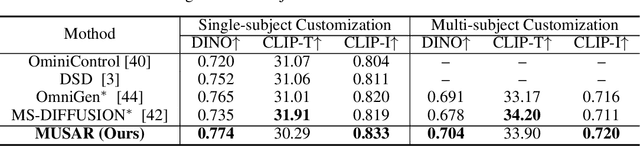
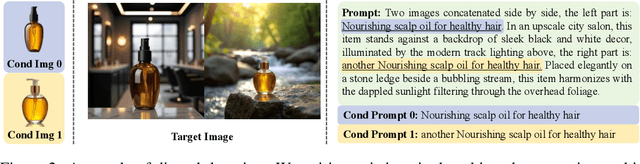
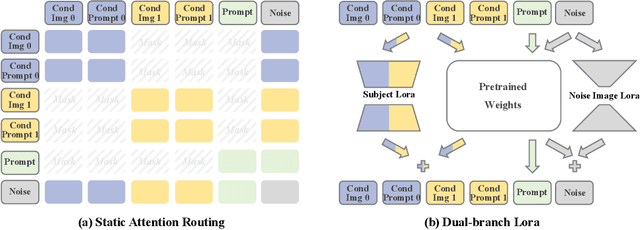
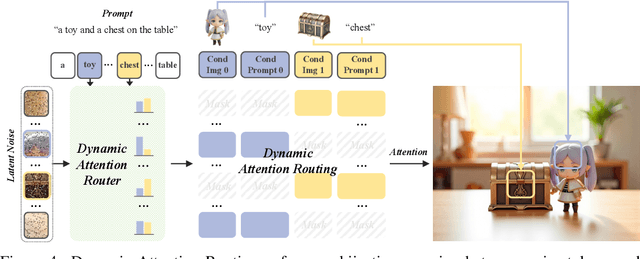
Current multi-subject customization approaches encounter two critical challenges: the difficulty in acquiring diverse multi-subject training data, and attribute entanglement across different subjects. To bridge these gaps, we propose MUSAR - a simple yet effective framework to achieve robust multi-subject customization while requiring only single-subject training data. Firstly, to break the data limitation, we introduce debiased diptych learning. It constructs diptych training pairs from single-subject images to facilitate multi-subject learning, while actively correcting the distribution bias introduced by diptych construction via static attention routing and dual-branch LoRA. Secondly, to eliminate cross-subject entanglement, we introduce dynamic attention routing mechanism, which adaptively establishes bijective mappings between generated images and conditional subjects. This design not only achieves decoupling of multi-subject representations but also maintains scalable generalization performance with increasing reference subjects. Comprehensive experiments demonstrate that our MUSAR outperforms existing methods - even those trained on multi-subject dataset - in image quality, subject consistency, and interaction naturalness, despite requiring only single-subject dataset.
DreamO: A Unified Framework for Image Customization
Apr 23, 2025Recently, extensive research on image customization (e.g., identity, subject, style, background, etc.) demonstrates strong customization capabilities in large-scale generative models. However, most approaches are designed for specific tasks, restricting their generalizability to combine different types of condition. Developing a unified framework for image customization remains an open challenge. In this paper, we present DreamO, an image customization framework designed to support a wide range of tasks while facilitating seamless integration of multiple conditions. Specifically, DreamO utilizes a diffusion transformer (DiT) framework to uniformly process input of different types. During training, we construct a large-scale training dataset that includes various customization tasks, and we introduce a feature routing constraint to facilitate the precise querying of relevant information from reference images. Additionally, we design a placeholder strategy that associates specific placeholders with conditions at particular positions, enabling control over the placement of conditions in the generated results. Moreover, we employ a progressive training strategy consisting of three stages: an initial stage focused on simple tasks with limited data to establish baseline consistency, a full-scale training stage to comprehensively enhance the customization capabilities, and a final quality alignment stage to correct quality biases introduced by low-quality data. Extensive experiments demonstrate that the proposed DreamO can effectively perform various image customization tasks with high quality and flexibly integrate different types of control conditions.
Non-Invasive Monitoring of Vital Signs in Calves Using Thermal Imaging Technology
May 19, 2024This study presents a non-invasive method using thermal imaging to estimate heart and respiration rates in calves, avoiding the stress from wearables. Using Kernelised Correlation Filters (KCF) for movement tracking and advanced signal processing, we targeted one ROI for respiration and four for heart rate based on their thermal correlation. Achieving Mean Absolute Percentage Errors (MAPE) of 3.08% for respiration and 3.15% for heart rate validates the efficacy of thermal imaging in vital signs monitoring, offering a practical, less intrusive tool for Precision Livestock Farming (PLF), improving animal welfare and management.
PuLID: Pure and Lightning ID Customization via Contrastive Alignment
Apr 24, 2024
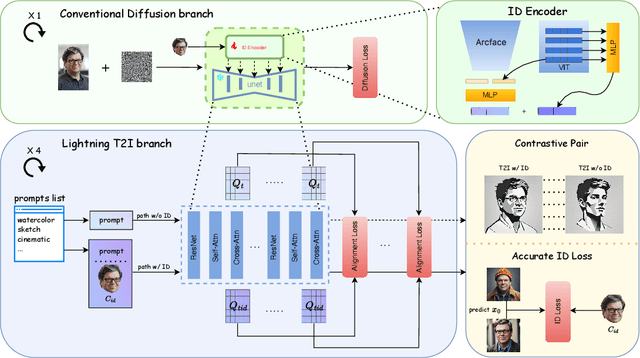

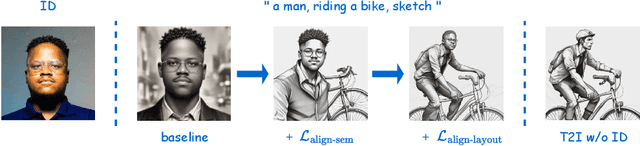
We propose Pure and Lightning ID customization (PuLID), a novel tuning-free ID customization method for text-to-image generation. By incorporating a Lightning T2I branch with a standard diffusion one, PuLID introduces both contrastive alignment loss and accurate ID loss, minimizing disruption to the original model and ensuring high ID fidelity. Experiments show that PuLID achieves superior performance in both ID fidelity and editability. Another attractive property of PuLID is that the image elements (e.g., background, lighting, composition, and style) before and after the ID insertion are kept as consistent as possible. Codes and models will be available at https://github.com/ToTheBeginning/PuLID