 Add to Chrome
 Add to Firefox
 Add to Edge
UXBench: Benchmarking User Experience in AI Assistants
Jun 09, 2026
As AI assistants serve millions of users daily, evaluating user experience (UX) beyond general model capability has become increasingly important. We present UXBench, the first user-centric benchmark grounded in real user feedback signals for evaluating preference alignment and dialogue generation. The benchmark consists of three interconnected tasks, UX Judge, UX Eval, and UX Recovery, with 7,400 test instances extracted from over 70K interaction logs of a mainstream Chinese AI assistant. The dataset closely reflects real user distributions, covering 8 scenarios, 83 domains, and diverse failure patterns that pose severe challenges. Extensive experiments on 26 frontier language models provide novel insights into how well models perceive user experience and how improvements in model capability contribute to better dialogue engagement. Through comprehensive analysis of model behavior and performance gaps, we show that user feedback prediction is a learnable capability, where a reward model trained from in-the-wild feedback signals can achieve well-calibrated accuracy. We further document the systematic biases of LLM-as-a-judge evaluation protocols and compare typical response strategies that directly affect user experience. UXBench establishes a new evaluation landscape and calls for greater attention to tailored UX optimization, contributing to a user-centric scaling law that shapes the success of AI assistants.

Why Supervised Fine-Tuning Fails to Learn: A Systematic Study of Incomplete Learning in Large Language Models
Apr 11, 2026Supervised Fine-Tuning (SFT) is the standard approach for adapting large language models (LLMs) to downstream tasks. However, we observe a persistent failure mode: even after convergence, models often fail to correctly reproduce a subset of their own supervised training data. We refer to this behavior as the Incomplete Learning Phenomenon(ILP). This paper presents the first systematic study of ILP in LLM fine-tuning. We formalize ILP as post-training failure to internalize supervised instances and demonstrate its prevalence across multiple model families, domains, and datasets. Through controlled analyses, we identify five recurrent sources of incomplete learning: (1) missing prerequisite knowledge in the pre-trained model, (2) conflicts between SFT supervision and pre-training knowledge, (3) internal inconsistencies within SFT data, (4) left-side forgetting during sequential fine-tuning, and (5) insufficient optimization for rare or complex patterns. We introduce a diagnostic-first framework that maps unlearned samples to these causes using observable training and inference signals, and study several targeted mitigation strategies as causal interventions. Experiments on Qwen, LLaMA, and OLMo2 show that incomplete learning is widespread and heterogeneous, and that improvements in aggregate metrics can mask persistent unlearned subsets. The findings highlight the need for fine-grained diagnosis of what supervised fine-tuning fails to learn, and why.
Reason Only When Needed: Efficient Generative Reward Modeling via Model-Internal Uncertainty
Apr 11, 2026Recent advancements in the Generative Reward Model (GRM) have demonstrated its potential to enhance the reasoning abilities of LLMs through Chain-of-Thought (CoT) prompting. Despite these gains, existing implementations of GRM suffer from two critical limitations. First, CoT prompting is applied indiscriminately to all inputs regardless of their inherent complexity. This introduces unnecessary computational costs for tasks amenable to fast, direct inference. Second, existing approaches primarily rely on voting-based mechanisms to evaluate CoT outputs, which often lack granularity and precision in assessing reasoning quality. In this paper, we propose E-GRM, an efficient generative reward modeling framework grounded in model-internal uncertainty. E-GRM leverages the convergence behavior of parallel model generations to estimate uncertainty and selectively trigger CoT reasoning only when needed, without relying on handcrafted features or task-dependent signals. To improve reward fidelity, we introduce a lightweight discriminative scorer trained with a hybrid regression--ranking objective to provide fine-grained evaluation of reasoning paths. Experiments on multiple reasoning benchmarks show that E-GRM substantially reduces inference cost while consistently improving answer accuracy, demonstrating that model-internal uncertainty is an effective and general signal for efficient reasoning-aware reward modeling.
Affordance-Aware Interactive Decision-Making and Execution for Ambiguous Instructions
Feb 05, 2026Enabling robots to explore and act in unfamiliar environments under ambiguous human instructions by interactively identifying task-relevant objects (e.g., identifying cups or beverages for "I'm thirsty") remains challenging for existing vision-language model (VLM)-based methods. This challenge stems from inefficient reasoning and the lack of environmental interaction, which hinder real-time task planning and execution. To address this, We propose Affordance-Aware Interactive Decision-Making and Execution for Ambiguous Instructions (AIDE), a dual-stream framework that integrates interactive exploration with vision-language reasoning, where Multi-Stage Inference (MSI) serves as the decision-making stream and Accelerated Decision-Making (ADM) as the execution stream, enabling zero-shot affordance analysis and interpretation of ambiguous instructions. Extensive experiments in simulation and real-world environments show that AIDE achieves the task planning success rate of over 80\% and more than 95\% accuracy in closed-loop continuous execution at 10 Hz, outperforming existing VLM-based methods in diverse open-world scenarios.
JPDS-NN: Reinforcement Learning-Based Dynamic Task Allocation for Agricultural Vehicle Routing Optimization
Mar 04, 2025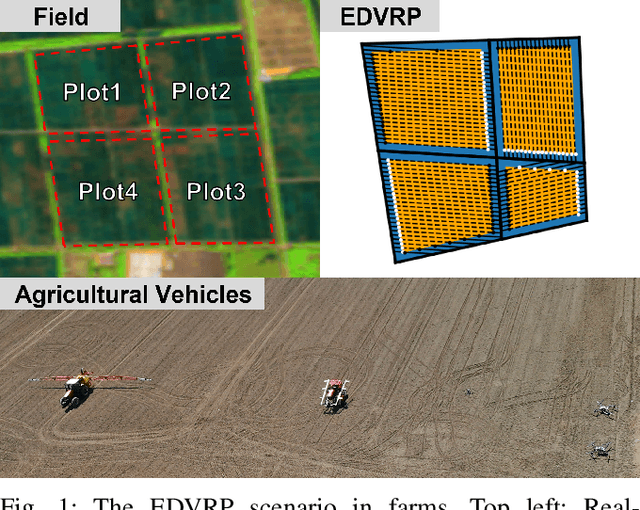
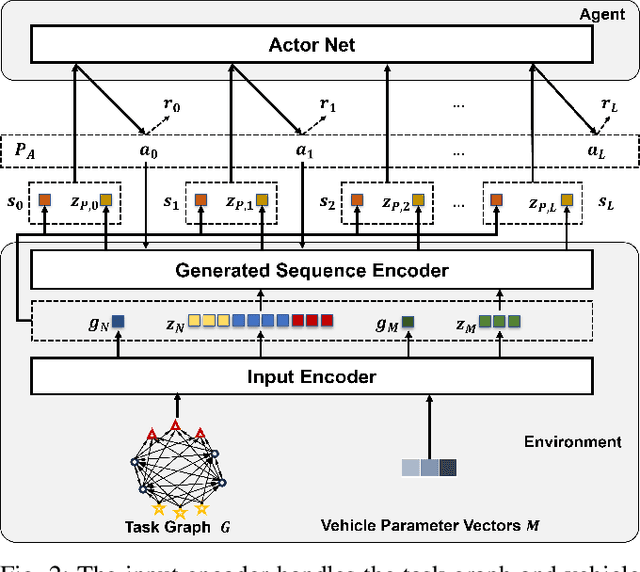
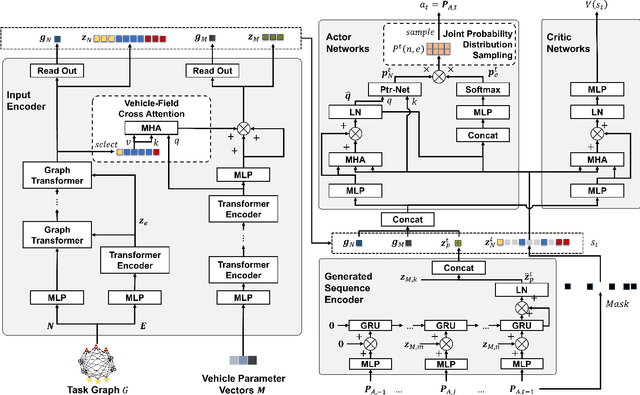
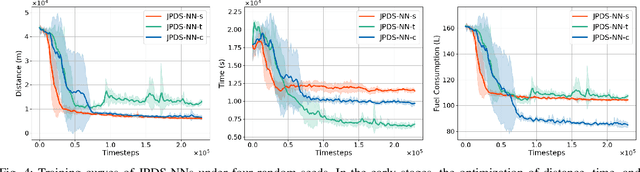
The Entrance Dependent Vehicle Routing Problem (EDVRP) is a variant of the Vehicle Routing Problem (VRP) where the scale of cities influences routing outcomes, necessitating consideration of their entrances. This paper addresses EDVRP in agriculture, focusing on multi-parameter vehicle planning for irregularly shaped fields. To address the limitations of traditional methods, such as heuristic approaches, which often overlook field geometry and entrance constraints, we propose a Joint Probability Distribution Sampling Neural Network (JPDS-NN) to effectively solve the EDVRP. The network uses an encoder-decoder architecture with graph transformers and attention mechanisms to model routing as a Markov Decision Process, and is trained via reinforcement learning for efficient and rapid end-to-end planning. Experimental results indicate that JPDS-NN reduces travel distances by 48.4-65.4%, lowers fuel consumption by 14.0-17.6%, and computes two orders of magnitude faster than baseline methods, while demonstrating 15-25% superior performance in dynamic arrangement scenarios. Ablation studies validate the necessity of cross-attention and pre-training. The framework enables scalable, intelligent routing for large-scale farming under dynamic constraints.
Understand User Opinions of Large Language Models via LLM-Powered In-the-Moment User Experience Interviews
Feb 21, 2025


Which large language model (LLM) is better? Every evaluation tells a story, but what do users really think about current LLMs? This paper presents CLUE, an LLM-powered interviewer that conducts in-the-moment user experience interviews, right after users interacted with LLMs, and automatically gathers insights about user opinions from massive interview logs. We conduct a study with thousands of users to understand user opinions on mainstream LLMs, recruiting users to first chat with a target LLM and then interviewed by CLUE. Our experiments demonstrate that CLUE captures interesting user opinions, for example, the bipolar views on the displayed reasoning process of DeepSeek-R1 and demands for information freshness and multi-modality. Our collected chat-and-interview logs will be released.