 Add to Chrome
 Add to Firefox
 Add to Edge
SciForge: An AI-Native, Multimodal Workbench for Scientific Discovery
Jul 17, 2026
Scientific work increasingly spans heterogeneous artifacts -- papers, code, datasets, scientific file formats, model outputs, figures, manuscripts, and team decisions -- yet general-purpose AI assistants rarely preserve these objects as a coherent, auditable research state. We present SciForge, a multimodal research-native AI workbench that reserves the graphical interface for human judgment while search, parsing, model routing, workflow execution, plotting, writing, and presentation generation run as modular agent-accessible services. SciForge is built around five pillars: (i) \emph{goal-scoped scientific decision governance} for \textbf{goal-oriented} research, with review gates and shared review surfaces; (ii) \emph{translate-then-reason} for \textbf{multimodal} input, routing scientific objects through domain translators before the agent reasons; (iii) \emph{evidence governance} for \textbf{auditable} traceability, linking claims to provenance chains and audit findings; (iv) \emph{collaborative team science} for \textbf{collaborative} research, enabling multi-role decision governance, with shared team workspaces planned for future releases; and (v) \emph{real-world application scenarios} for \textbf{practical} impact, demonstrated through eight end-to-end user cases, with flagship demonstrations including multi-day agentic research sprints for gene discovery, AI-guided de novo protein design, molecular optimization, and genome-to-BGC discovery. The system combines a thin interaction layer, contextual research capability patterns, an Agent Runtime and Workflow Engine, an Evidence-DAG audit sidecar and a Scientific Model Router. SciForge currently runs as a desktop application, with mobile supervision support; future releases will deepen team collaboration. The system is open-source and available at https://github.com/AGI4Sci/SciForge

Unlabeled Cross-Center Automatic Analysis for TAAD: An Integrated Framework from Segmentation to Clinical Features
Mar 27, 2026Type A Aortic Dissection (TAAD) is a life-threatening cardiovascular emergency that demands rapid and precise preoperative evaluation. While key anatomical and pathological features are decisive for surgical planning, current research focuses predominantly on improving segmentation accuracy, leaving the reliable, quantitative extraction of clinically actionable features largely under-explored. Furthermore, constructing comprehensive TAAD datasets requires labor-intensive, expert level pixel-wise annotations, which is impractical for most clinical institutions. Due to significant domain shift, models trained on a single center dataset also suffer from severe performance degradation during cross-institutional deployment. This study addresses a clinically critical challenge: the accurate extraction of key TAAD clinical features during cross-institutional deployment in the total absence of target-domain annotations. To this end, we propose an unsupervised domain adaptation (UDA)-driven framework for the automated extraction of TAAD clinical features. The framework leverages limited source-domain labels while effectively adapting to unlabeled data from target domains. Tailored for real-world emergency workflows, our framework aims to achieve stable cross-institutional multi-class segmentation, reliable and quantifiable clinical feature extraction, and practical deployability independent of high-cost annotations. Extensive experiments demonstrate that our method significantly improves cross-domain segmentation performance compared to existing state-of-the-art approaches. More importantly, a reader study involving multiple cardiovascular surgeons confirms that the automatically extracted clinical features provide meaningful assistance for preoperative assessment, highlighting the practical utility of the proposed end-to-end segmentation-to-feature pipeline.
LensWalk: Agentic Video Understanding by Planning How You See in Videos
Mar 25, 2026The dense, temporal nature of video presents a profound challenge for automated analysis. Despite the use of powerful Vision-Language Models, prevailing methods for video understanding are limited by the inherent disconnect between reasoning and perception: they rely on static, pre-processed information and cannot actively seek raw evidence from video as their understanding evolves. To address this, we introduce LensWalk, a flexible agentic framework that empowers a Large Language Model reasoner to control its own visual observation actively. LensWalk establishes a tight reason-plan-observe loop where the agent dynamically specifies, at each step, the temporal scope and sampling density of the video it observes. Using a suite of versatile, Vision-Language Model based tools parameterized by these specifications, the agent can perform broad scans for cues, focus on specific segments for fact extraction, and stitch evidence from multiple moments for holistic verification. This design allows for progressive, on-demand evidence gathering that directly serves the agent's evolving chain of thought. Without requiring any model fine-tuning, LensWalk delivers substantial, plug-and-play performance gains on multiple model recipes, boosting their accuracy by over 5\% on challenging long-video benchmarks like LVBench and Video-MME. Our analysis reveals that enabling an agent to control how it sees is key to unlocking more accurate, robust, and interpretable video reasoning.
Lost in Tokenization: Context as the Key to Unlocking Biomolecular Understanding in Scientific LLMs
Oct 27, 2025Scientific Large Language Models (Sci-LLMs) have emerged as a promising frontier for accelerating biological discovery. However, these models face a fundamental challenge when processing raw biomolecular sequences: the tokenization dilemma. Whether treating sequences as a specialized language, risking the loss of functional motif information, or as a separate modality, introducing formidable alignment challenges, current strategies fundamentally limit their reasoning capacity. We challenge this sequence-centric paradigm by positing that a more effective strategy is to provide Sci-LLMs with high-level structured context derived from established bioinformatics tools, thereby bypassing the need to interpret low-level noisy sequence data directly. Through a systematic comparison of leading Sci-LLMs on biological reasoning tasks, we tested three input modes: sequence-only, context-only, and a combination of both. Our findings are striking: the context-only approach consistently and substantially outperforms all other modes. Even more revealing, the inclusion of the raw sequence alongside its high-level context consistently degrades performance, indicating that raw sequences act as informational noise, even for models with specialized tokenization schemes. These results suggest that the primary strength of existing Sci-LLMs lies not in their nascent ability to interpret biomolecular syntax from scratch, but in their profound capacity for reasoning over structured, human-readable knowledge. Therefore, we argue for reframing Sci-LLMs not as sequence decoders, but as powerful reasoning engines over expert knowledge. This work lays the foundation for a new class of hybrid scientific AI agents, repositioning the developmental focus from direct sequence interpretation towards high-level knowledge synthesis. The code is available at github.com/opendatalab-raise-dev/CoKE.
G2PDiffusion: Genotype-to-Phenotype Prediction with Diffusion Models
Feb 07, 2025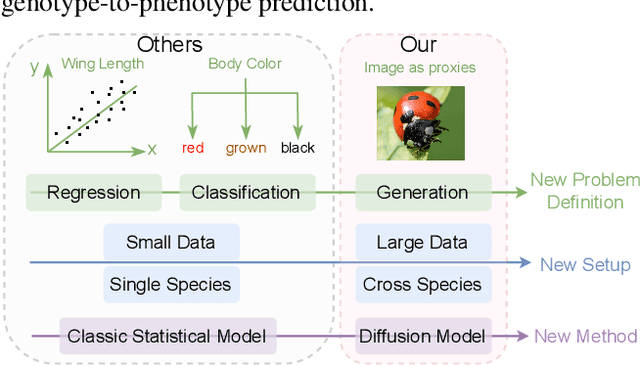
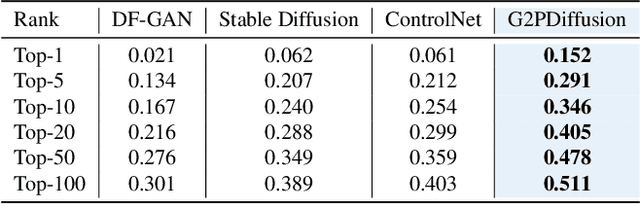
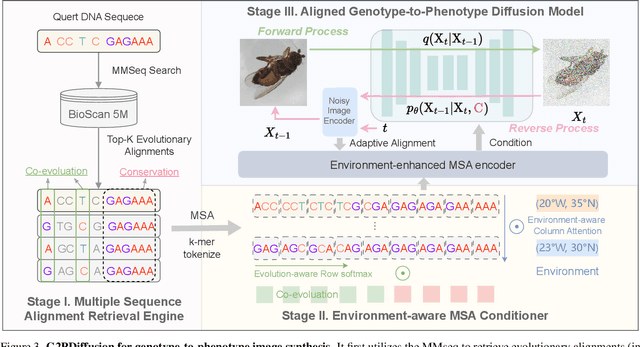

Discovering the genotype-phenotype relationship is crucial for genetic engineering, which will facilitate advances in fields such as crop breeding, conservation biology, and personalized medicine. Current research usually focuses on single species and small datasets due to limitations in phenotypic data collection, especially for traits that require visual assessments or physical measurements. Deciphering complex and composite phenotypes, such as morphology, from genetic data at scale remains an open question. To break through traditional generic models that rely on simplified assumptions, this paper introduces G2PDiffusion, the first-of-its-kind diffusion model designed for genotype-to-phenotype generation across multiple species. Specifically, we use images to represent morphological phenotypes across species and redefine phenotype prediction as conditional image generation. To this end, this paper introduces an environment-enhanced DNA sequence conditioner and trains a stable diffusion model with a novel alignment method to improve genotype-to-phenotype consistency. Extensive experiments demonstrate that our approach enhances phenotype prediction accuracy across species, capturing subtle genetic variations that contribute to observable traits.
CP-DETR: Concept Prompt Guide DETR Toward Stronger Universal Object Detection
Dec 13, 2024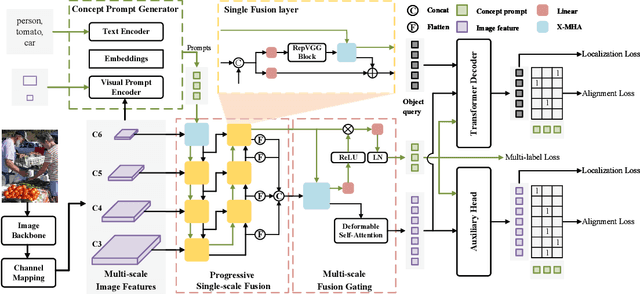


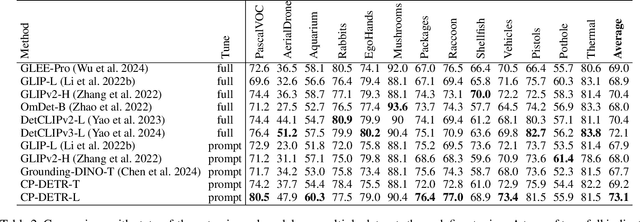
Recent research on universal object detection aims to introduce language in a SoTA closed-set detector and then generalize the open-set concepts by constructing large-scale (text-region) datasets for training. However, these methods face two main challenges: (i) how to efficiently use the prior information in the prompts to genericise objects and (ii) how to reduce alignment bias in the downstream tasks, both leading to sub-optimal performance in some scenarios beyond pre-training. To address these challenges, we propose a strong universal detection foundation model called CP-DETR, which is competitive in almost all scenarios, with only one pre-training weight. Specifically, we design an efficient prompt visual hybrid encoder that enhances the information interaction between prompt and visual through scale-by-scale and multi-scale fusion modules. Then, the hybrid encoder is facilitated to fully utilize the prompted information by prompt multi-label loss and auxiliary detection head. In addition to text prompts, we have designed two practical concept prompt generation methods, visual prompt and optimized prompt, to extract abstract concepts through concrete visual examples and stably reduce alignment bias in downstream tasks. With these effective designs, CP-DETR demonstrates superior universal detection performance in a broad spectrum of scenarios. For example, our Swin-T backbone model achieves 47.6 zero-shot AP on LVIS, and the Swin-L backbone model achieves 32.2 zero-shot AP on ODinW35. Furthermore, our visual prompt generation method achieves 68.4 AP on COCO val by interactive detection, and the optimized prompt achieves 73.1 fully-shot AP on ODinW13.
Exploration of visual prompt in Grounded pre-trained open-set detection
Dec 14, 2023


Text prompts are crucial for generalizing pre-trained open-set object detection models to new categories. However, current methods for text prompts are limited as they require manual feedback when generalizing to new categories, which restricts their ability to model complex scenes, often leading to incorrect detection results. To address this limitation, we propose a novel visual prompt method that learns new category knowledge from a few labeled images, which generalizes the pre-trained detection model to the new category. To allow visual prompts to represent new categories adequately, we propose a statistical-based prompt construction module that is not limited by predefined vocabulary lengths, thus allowing more vectors to be used when representing categories. We further utilize the category dictionaries in the pre-training dataset to design task-specific similarity dictionaries, which make visual prompts more discriminative. We evaluate the method on the ODinW dataset and show that it outperforms existing prompt learning methods and performs more consistently in combinatorial inference.