 Add to Chrome
 Add to Firefox
 Add to Edge
VeriAct: Beyond Verifiability -- Agentic Synthesis of Correct and Complete Formal Specifications
Mar 31, 2026
Formal specifications play a central role in ensuring software reliability and correctness. However, automatically synthesizing high-quality formal specifications remains a challenging task, often requiring domain expertise. Recent work has applied large language models to generate specifications in Java Modeling Language (JML), reporting high verification pass rates. But does passing a verifier mean that the specification is actually correct and complete? In this work, we first conduct a comprehensive evaluation comparing classical and prompt-based approaches for automated JML specification synthesis. We then investigate whether prompt optimization can push synthesis quality further by evolving prompts through structured verification feedback. While optimization improves verifier pass rates, we find a clear performance ceiling. More critically, we propose Spec-Harness, an evaluation framework that measures specification correctness and completeness through symbolic verification, revealing that a large fraction of verifier-accepted specifications, including optimized ones, are in fact incorrect or incomplete, over- or under-constraining both inputs and outputs in ways invisible to the verifier. To push beyond this ceiling, we propose VeriAct, a verification-guided agentic framework that iteratively synthesizes and repairs specifications through a closed loop of LLM-driven planning, code execution, verification, and Spec-Harness feedback. Our experiments on two benchmark datasets show that VeriAct outperforms both prompt-based and prompt-optimized baselines, producing specifications that are not only verifiable but also correct and complete.

Automated Proof Generation for Rust Code via Self-Evolution
Oct 21, 2024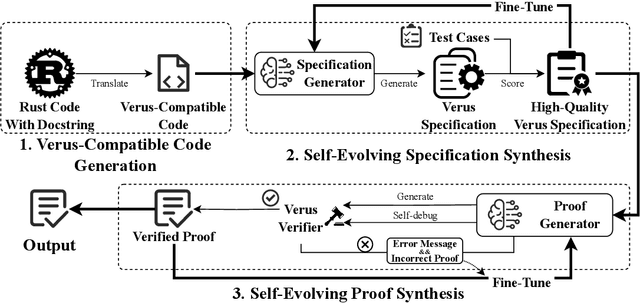
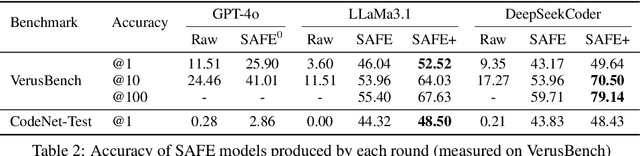
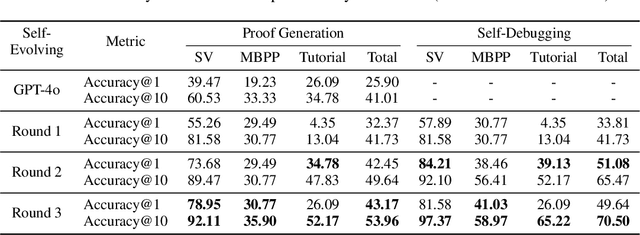
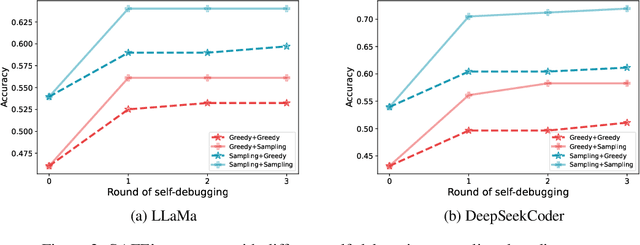
Ensuring correctness is crucial for code generation. Formal verification offers a definitive assurance of correctness, but demands substantial human effort in proof construction and hence raises a pressing need for automation. The primary obstacle lies in the severe lack of data - there is much less proof than code for LLMs to train upon. In this paper, we introduce SAFE, a novel framework that overcomes the lack of human-written proof to enable automated proof generation of Rust code. SAFE establishes a self-evolving cycle where data synthesis and fine-tuning collaborate to enhance the model capability, leveraging the definitive power of a symbolic verifier in telling correct proof from incorrect ones. SAFE also re-purposes the large number of synthesized incorrect proofs to train the self-debugging capability of the fine-tuned models, empowering them to fix incorrect proofs based on the verifier's feedback. SAFE demonstrates superior efficiency and precision compared to GPT-4o. Through tens of thousands of synthesized proofs and the self-debugging mechanism, we improve the capability of open-source models, initially unacquainted with formal verification, to automatically write proof for Rust code. This advancement leads to a significant improvement in performance, achieving a 70.50% accuracy rate in a benchmark crafted by human experts, a significant leap over GPT-4o's performance of 24.46%.
DafnyBench: A Benchmark for Formal Software Verification
Jun 12, 2024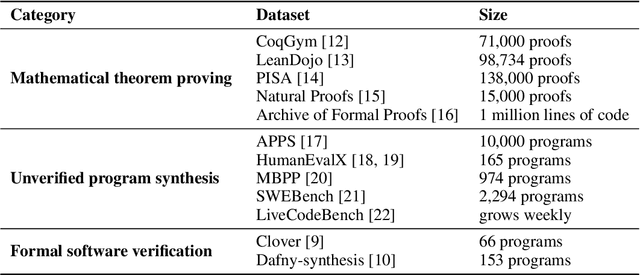
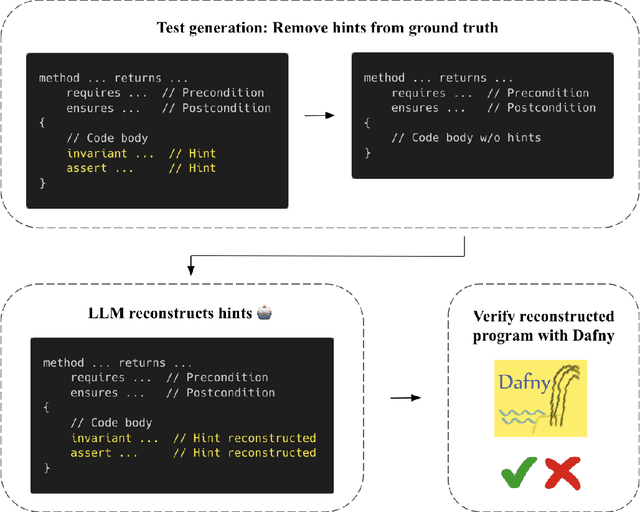
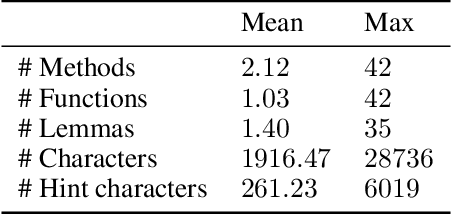
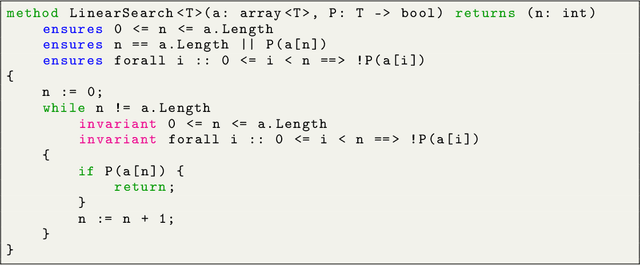
We introduce DafnyBench, the largest benchmark of its kind for training and evaluating machine learning systems for formal software verification. We test the ability of LLMs such as GPT-4 and Claude 3 to auto-generate enough hints for the Dafny formal verification engine to successfully verify over 750 programs with about 53,000 lines of code. The best model and prompting scheme achieved 68% success rate, and we quantify how this rate improves when retrying with error message feedback and how it deteriorates with the amount of required code and hints. We hope that DafnyBench will enable rapid improvements from this baseline as LLMs and verification techniques grow in quality.