 Add to Chrome
 Add to Firefox
 Add to Edge
HorizonWeaver: Generalizable Multi-Level Semantic Editing for Driving Scenes
Apr 06, 2026
Ensuring safety in autonomous driving requires scalable generation of realistic, controllable driving scenes beyond what real-world testing provides. Yet existing instruction guided image editors, trained on object-centric or artistic data, struggle with dense, safety-critical driving layouts. We propose HorizonWeaver, which tackles three fundamental challenges in driving scene editing: (1) multi-level granularity, requiring coherent object- and scene-level edits in dense environments; (2) rich high-level semantics, preserving diverse objects while following detailed instructions; and (3) ubiquitous domain shifts, handling changes in climate, layout, and traffic across unseen environments. The core of HorizonWeaver is a set of complementary contributions across data, model, and training: (1) Data: Large-scale dataset generation, where we build a paired real/synthetic dataset from Boreas, nuScenes, and Argoverse2 to improve generalization; (2) Model: Language-Guided Masks for fine-grained editing, where semantics-enriched masks and prompts enable precise, language-guided edits; and (3) Training: Content preservation and instruction alignment, where joint losses enforce scene consistency and instruction fidelity. Together, HorizonWeaver provides a scalable framework for photorealistic, instruction-driven editing of complex driving scenes, collecting 255K images across 13 editing categories and outperforming prior methods in L1, CLIP, and DINO metrics, achieving +46.4% user preference and improving BEV segmentation IoU by +33%. Project page: https://msoroco.github.io/horizonweaver/

Learning Data-Efficient and Generalizable Neural Operators via Fundamental Physics Knowledge
Feb 16, 2026Recent advances in scientific machine learning (SciML) have enabled neural operators (NOs) to serve as powerful surrogates for modeling the dynamic evolution of physical systems governed by partial differential equations (PDEs). While existing approaches focus primarily on learning simulations from the target PDE, they often overlook more fundamental physical principles underlying these equations. Inspired by how numerical solvers are compatible with simulations of different settings of PDEs, we propose a multiphysics training framework that jointly learns from both the original PDEs and their simplified basic forms. Our framework enhances data efficiency, reduces predictive errors, and improves out-of-distribution (OOD) generalization, particularly in scenarios involving shifts of physical parameters and synthetic-to-real transfer. Our method is architecture-agnostic and demonstrates consistent improvements in normalized root mean square error (nRMSE) across a wide range of 1D/2D/3D PDE problems. Through extensive experiments, we show that explicit incorporation of fundamental physics knowledge significantly strengthens the generalization ability of neural operators. We will release models and codes at https://sites.google.com/view/sciml-fundemental-pde.
PDE-Controller: LLMs for Autoformalization and Reasoning of PDEs
Feb 03, 2025
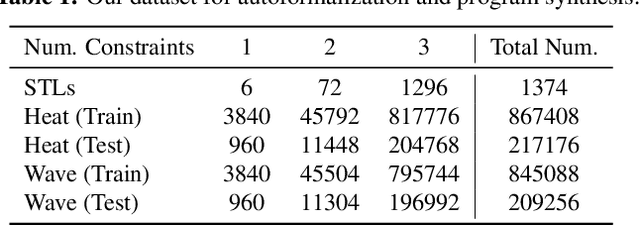
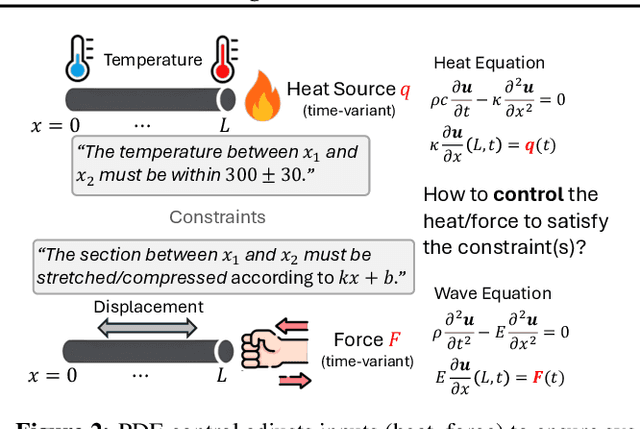
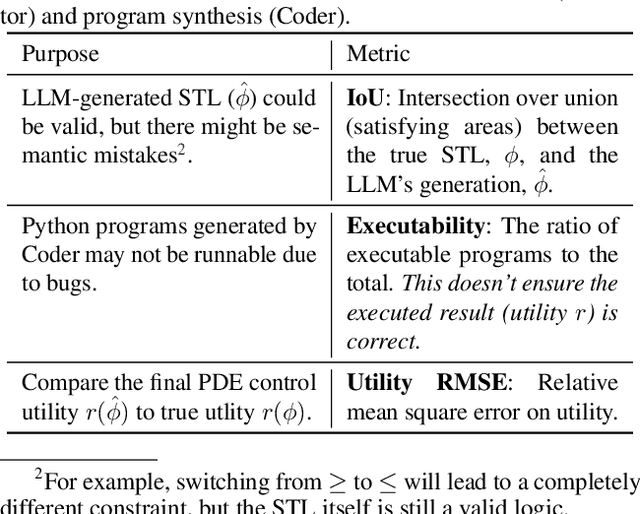
While recent AI-for-math has made strides in pure mathematics, areas of applied mathematics, particularly PDEs, remain underexplored despite their significant real-world applications. We present PDE-Controller, a framework that enables large language models (LLMs) to control systems governed by partial differential equations (PDEs). Our approach enables LLMs to transform informal natural language instructions into formal specifications, and then execute reasoning and planning steps to improve the utility of PDE control. We build a holistic solution comprising datasets (both human-written cases and 2 million synthetic samples), math-reasoning models, and novel evaluation metrics, all of which require significant effort. Our PDE-Controller significantly outperforms prompting the latest open-source and GPT models in reasoning, autoformalization, and program synthesis, achieving up to a 62% improvement in utility gain for PDE control. By bridging the gap between language generation and PDE systems, we demonstrate the potential of LLMs in addressing complex scientific and engineering challenges. We will release all data, model checkpoints, and code at https://pde-controller.github.io/.
Data-Efficient Inference of Neural Fluid Fields via SciML Foundation Model
Dec 18, 2024
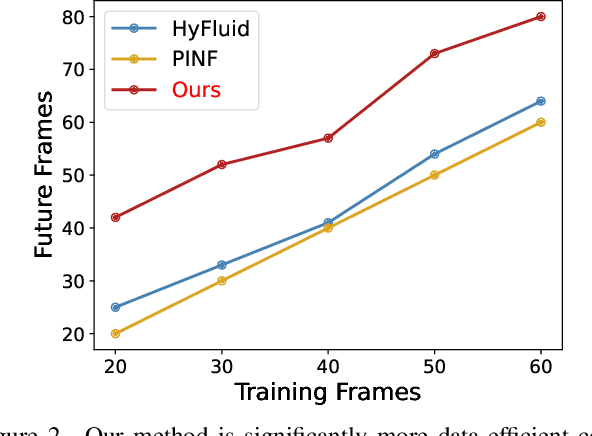


Recent developments in 3D vision have enabled successful progress in inferring neural fluid fields and realistic rendering of fluid dynamics. However, these methods require real-world flow captures, which demand dense video sequences and specialized lab setups, making the process costly and challenging. Scientific machine learning (SciML) foundation models, which are pretrained on extensive simulations of partial differential equations (PDEs), encode rich multiphysics knowledge and thus provide promising sources of domain priors for inferring fluid fields. Nevertheless, their potential to advance real-world vision problems remains largely underexplored, raising questions about the transferability and practical utility of these foundation models. In this work, we demonstrate that SciML foundation model can significantly improve the data efficiency of inferring real-world 3D fluid dynamics with improved generalization. At the core of our method is leveraging the strong forecasting capabilities and meaningful representations of SciML foundation models. We equip neural fluid fields with a novel collaborative training approach that utilizes augmented views and fluid features extracted by our foundation model. Our method demonstrates significant improvements in both quantitative metrics and visual quality, showcasing the practical applicability of SciML foundation models in real-world fluid dynamics.
PANORAMIA: Privacy Auditing of Machine Learning Models without Retraining
Feb 12, 2024


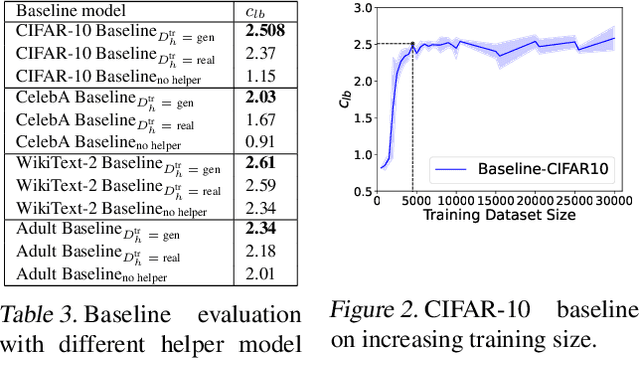
We introduce a privacy auditing scheme for ML models that relies on membership inference attacks using generated data as "non-members". This scheme, which we call PANORAMIA, quantifies the privacy leakage for large-scale ML models without control of the training process or model re-training and only requires access to a subset of the training data. To demonstrate its applicability, we evaluate our auditing scheme across multiple ML domains, ranging from image and tabular data classification to large-scale language models.