 Add to Chrome
 Add to Firefox
 Add to Edge
Hard to See, Hard to Label: Generative and Symbolic Acquisition for Subtle Visual Phenomena
Apr 28, 2026
Subtle visual anomalies such as hairline cracks, sub-millimeter voids, and low-contrast inclusions are structurally atypical yet visually ambiguous, making them both difficult to annotate and easy to overlook during active learning. Standard acquisition heuristics based on discriminative uncertainty or feature diversity often overselect dominant patterns while underexploring sparse yet important regions of the data space. This failure mode is especially severe in industrial defect inspection, where anomalies may be both low-prevalence and difficult to distinguish from surrounding structure. To resolve this, we propose GSAL, an active learning framework for object detection that combines a diffusion-based difficulty signal with a hierarchical semantic coverage prior. The diffusion component scores images and proposals using reconstruction discrepancy and denoising variability, prioritizing visually atypical or ambiguous examples. However, diffusion alone does not prevent acquisition from repeatedly favoring hard samples within dominant semantic modes. The semantic component therefore organizes candidate samples in a three-level concept graph and promotes coverage of underrepresented semantic regions while providing interpretable acquisition rationales. By balancing visual difficulty with semantic coverage, GSAL improves retrieval of subtle and rare targets that are often missed by uncertainty-only selection. Experiments on a proprietary thin-film defect, Pascal VOC and MS COCO dataset show consistent gains in label efficiency and rare-class retrieval over uncertainty-, diversity-, and hybrid-based baselines

Erasing CLIP Memories: Non-Destructive, Data-Free Zero-Shot class Unlearning in CLIP Models
Dec 16, 2025We introduce a novel, closed-form approach for selective unlearning in multimodal models, specifically targeting pretrained models such as CLIP. Our method leverages nullspace projection to erase the target class information embedded in the final projection layer, without requiring any retraining or the use of images from the forget set. By computing an orthonormal basis for the subspace spanned by target text embeddings and projecting these directions, we dramatically reduce the alignment between image features and undesired classes. Unlike traditional unlearning techniques that rely on iterative fine-tuning and extensive data curation, our approach is both computationally efficient and surgically precise. This leads to a pronounced drop in zero-shot performance for the target classes while preserving the overall multimodal knowledge of the model. Our experiments demonstrate that even a partial projection can balance between complete unlearning and retaining useful information, addressing key challenges in model decontamination and privacy preservation.
Selective, Controlled and Domain-Agnostic Unlearning in Pretrained CLIP: A Training- and Data-Free Approach
Dec 16, 2025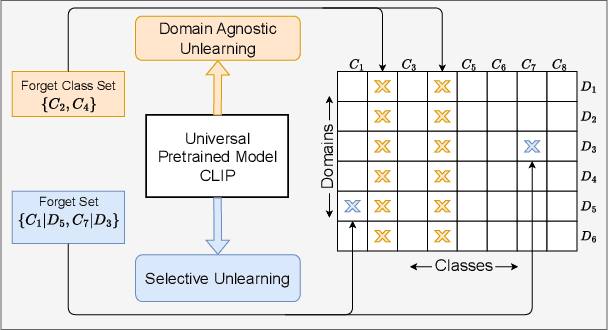
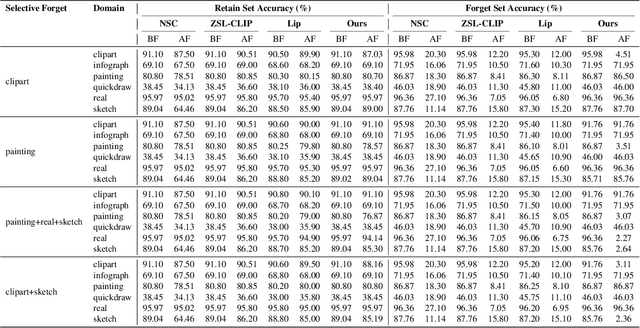
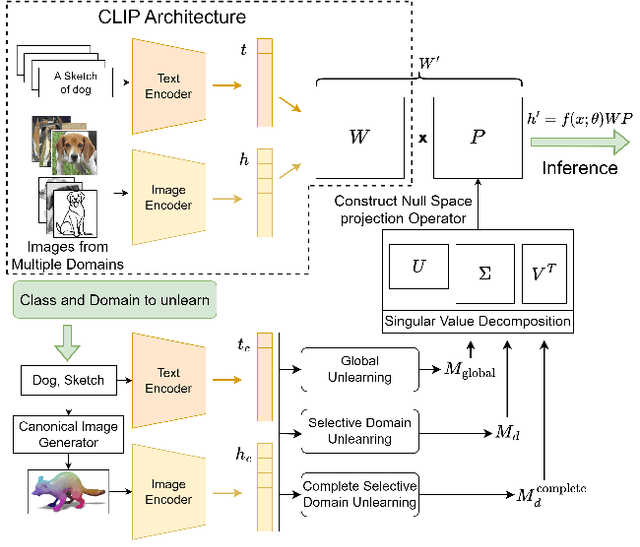
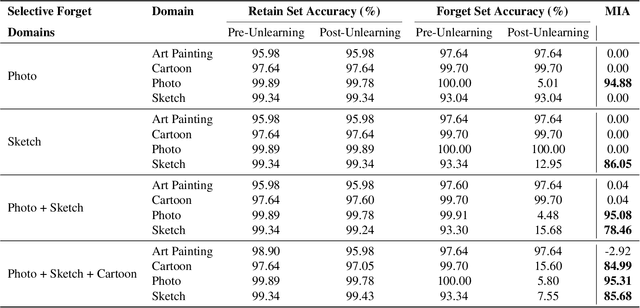
Pretrained models like CLIP have demonstrated impressive zero-shot classification capabilities across diverse visual domains, spanning natural images, artistic renderings, and abstract representations. However, real-world applications often demand the removal (or "unlearning") of specific object classes without requiring additional data or retraining, or affecting the model's performance on unrelated tasks. In this paper, we propose a novel training- and data-free unlearning framework that enables three distinct forgetting paradigms: (1) global unlearning of selected objects across all domains, (2) domain-specific knowledge removal (e.g., eliminating sketch representations while preserving photo recognition), and (3) complete unlearning in selective domains. By leveraging a multimodal nullspace through synergistic integration of text prompts and synthesized visual prototypes derived from CLIP's joint embedding space, our method efficiently removes undesired class information while preserving the remaining knowledge. This approach overcomes the limitations of existing retraining-based methods and offers a flexible and computationally efficient solution for controlled model forgetting.
The Data Fusion Labeler (dFL): Challenges and Solutions to Data Harmonization, Labeling, and Provenance in Fusion Energy
Nov 12, 2025Fusion energy research increasingly depends on the ability to integrate heterogeneous, multimodal datasets from high-resolution diagnostics, control systems, and multiscale simulations. The sheer volume and complexity of these datasets demand the development of new tools capable of systematically harmonizing and extracting knowledge across diverse modalities. The Data Fusion Labeler (dFL) is introduced as a unified workflow instrument that performs uncertainty-aware data harmonization, schema-compliant data fusion, and provenance-rich manual and automated labeling at scale. By embedding alignment, normalization, and labeling within a reproducible, operator-order-aware framework, dFL reduces time-to-analysis by greater than 50X (e.g., enabling >200 shots/hour to be consistently labeled rather than a handful per day), enhances label (and subsequently training) quality, and enables cross-device comparability. Case studies from DIII-D demonstrate its application to automated ELM detection and confinement regime classification, illustrating its potential as a core component of data-driven discovery, model validation, and real-time control in future burning plasma devices.
X-TIME: An in-memory engine for accelerating machine learning on tabular data with CAMs
Apr 05, 2023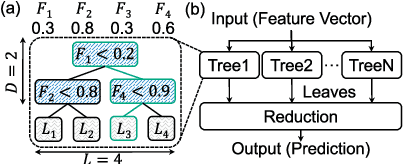
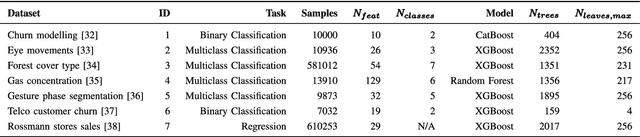
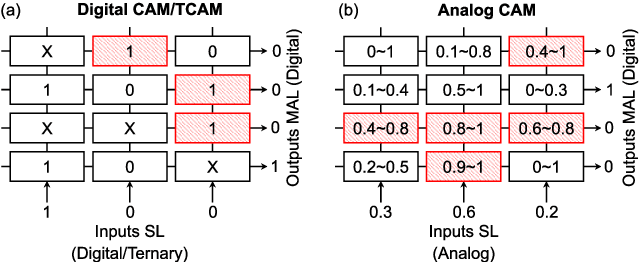

Structured, or tabular, data is the most common format in data science. While deep learning models have proven formidable in learning from unstructured data such as images or speech, they are less accurate than simpler approaches when learning from tabular data. In contrast, modern tree-based Machine Learning (ML) models shine in extracting relevant information from structured data. An essential requirement in data science is to reduce model inference latency in cases where, for example, models are used in a closed loop with simulation to accelerate scientific discovery. However, the hardware acceleration community has mostly focused on deep neural networks and largely ignored other forms of machine learning. Previous work has described the use of an analog content addressable memory (CAM) component for efficiently mapping random forests. In this work, we focus on an overall analog-digital architecture implementing a novel increased precision analog CAM and a programmable network on chip allowing the inference of state-of-the-art tree-based ML models, such as XGBoost and CatBoost. Results evaluated in a single chip at 16nm technology show 119x lower latency at 9740x higher throughput compared with a state-of-the-art GPU, with a 19W peak power consumption.