 Add to Chrome
 Add to Firefox
 Add to Edge
Graph-Regularized Deep Learning for EEG-Based Emotion Recognition with Psychologically-Grounded Label Structure
Jul 08, 2026
EEG-based emotion recognition is critical for mental health monitoring and affective brain-computer interfaces, yet existing deep learning approaches often treat emotion classes as isolated labels, ignoring their psychological interdependencies. We propose a graph-regularized learning framework that conceptualizes emotions as nodes in a graph where edges encode proximity based on dimensional emotion theories. We adapt three complementary regularization strategies--Graph Label Smoothing (intuitive soft labeling), Commuting distance on graph via Graph Laplacian (spectral graph theory), and Sliced Wasserstein Distance (optimal transport on graph)--ordered by increasing computational complexity. These strategies penalize model predictions that deviate from the established emotion topology. Our framework is evaluated across three representative backbone architectures: AudioTransformer (pure transformer), Conformer (CNN-transformer hybrid), and DCGNN (causal graph neural network), demonstrating architecture-agnostic benefits. Experiments on SEED-IV (4 classes) and SEED-V (5 classes) datasets show consistent improvements: best case up to +5.42% accuracy and 39% reduction in psychologically implausible misclassifications. Ultimately, our framework help raise the upper bound of performance achievable with standard approaches. Code will be released.

CSympNet-ID: conformal-symplectic map learning for linearly damped Hamiltonian systems
Jul 03, 2026Learning dissipative dynamics from discrete observations is essential for reliable long-horizon prediction and physically meaningful parameter identification. For linearly damped Hamiltonian systems, the exact flow is generally not symplectic but conformally symplectic, contracting the canonical symplectic form by a scalar factor that reflects the net dissipation. We propose Conformal Symplectic Networks with damping identification (CSympNet-ID), a discrete-time map-learning framework that learns the one-step flow map directly from snapshot pairs while enforcing exact discrete conformal symplecticity by construction, without penalty terms or projection. The architecture composes an exact symplectic neural core with explicit diagonal scaling layers whose factors are parameterized exponentially by a scalar damping-rate parameter, thereby guaranteeing positivity and interpretability of the learned dissipation factor. We establish a scaling-conjugacy factorization for conformal symplectic maps and derive a pointwise-in-step density result for CSympNet-ID. We evaluate an irregular-step damped oscillator, a damped spring-mass chain, a damped nonlinear cubic oscillator, and additional high-dimensional extensions. CSympNet-ID gives the most favorable overall results among the compared models in the reported experiments, particularly in data-scarce regimes, target contraction-law recovery, and high-dimensional tests where unstructured baselines degrade rapidly.
GL-LFGNN:A Global-Local Dual-branch Causal Graph Neural Network Based on Liang-Kleeman Information Flow for EEG Emotion Recognition
May 24, 2026EEG-based emotion recognition holds significant promise for objective diagnosis of mood disorders. Graph neural networks (GNNs) have emerged as the dominant paradigm for modeling inter-channel dependencies in EEG, yet existing approaches rely on symmetric adjacency matrices derived from spatial proximity or functional correlations that fundamentally capture statistical associations rather than directed causal influences, which conflicts with the inherently asymmetric, causally-driven nature of neural information flow. To bridge this gap, we propose GL-LFGNN, a Global-Local Dual-branch Causal Graph Neural Network grounded in Liang-Kleeman information flow theory. Unlike Granger causality that merely assesses temporal precedence, our approach rigorously quantifies causal strength from a dynamical systems perspective, yielding neurophysiologically interpretable directed graphs. A dual-branch architecture further integrates whole-brain connectivity with region-specific processing aligned to established functional neuroanatomy. On the MEEG dataset, GL-LFGNN achieves 86.17% (Arousal) and 86.71% (Valence) accuracy with only 37K parameters -- approximately 10% of the current state-of-the-art -- demonstrating that principled causal modeling can simultaneously enhance interpretability, generalization, and computational efficiency. Code will be released.
The Data Fusion Labeler (dFL): Challenges and Solutions to Data Harmonization, Labeling, and Provenance in Fusion Energy
Nov 12, 2025Fusion energy research increasingly depends on the ability to integrate heterogeneous, multimodal datasets from high-resolution diagnostics, control systems, and multiscale simulations. The sheer volume and complexity of these datasets demand the development of new tools capable of systematically harmonizing and extracting knowledge across diverse modalities. The Data Fusion Labeler (dFL) is introduced as a unified workflow instrument that performs uncertainty-aware data harmonization, schema-compliant data fusion, and provenance-rich manual and automated labeling at scale. By embedding alignment, normalization, and labeling within a reproducible, operator-order-aware framework, dFL reduces time-to-analysis by greater than 50X (e.g., enabling >200 shots/hour to be consistently labeled rather than a handful per day), enhances label (and subsequently training) quality, and enables cross-device comparability. Case studies from DIII-D demonstrate its application to automated ELM detection and confinement regime classification, illustrating its potential as a core component of data-driven discovery, model validation, and real-time control in future burning plasma devices.
KAM -- a Kernel Attention Module for Emotion Classification with EEG Data
Aug 17, 2022
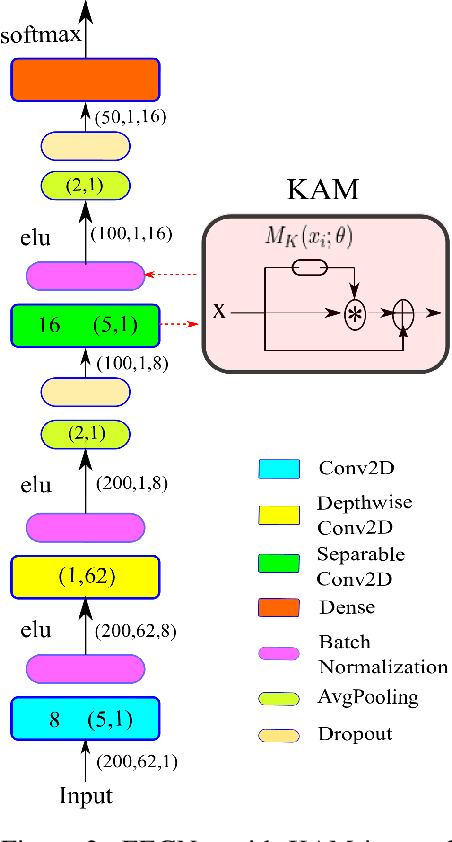
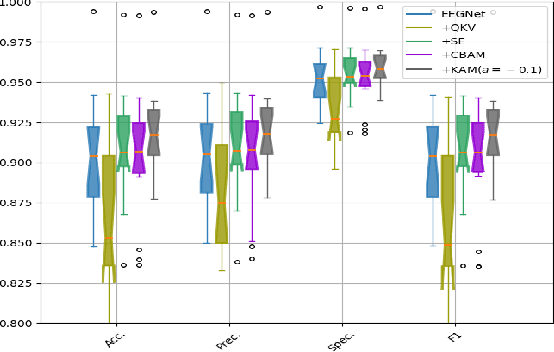
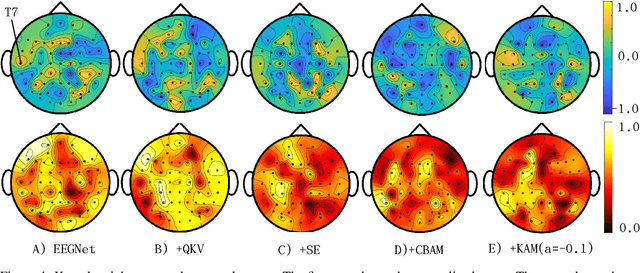
In this work, a kernel attention module is presented for the task of EEG-based emotion classification with neural networks. The proposed module utilizes a self-attention mechanism by performing a kernel trick, demanding significantly fewer trainable parameters and computations than standard attention modules. The design also provides a scalar for quantitatively examining the amount of attention assigned during deep feature refinement, hence help better interpret a trained model. Using EEGNet as the backbone model, extensive experiments are conducted on the SEED dataset to assess the module's performance on within-subject classification tasks compared to other SOTA attention modules. Requiring only one extra parameter, the inserted module is shown to boost the base model's mean prediction accuracy up to more than 1\% across 15 subjects. A key component of the method is the interpretability of solutions, which is addressed using several different techniques, and is included throughout as part of the dependency analysis.
A Monotonicity Constrained Attention Module for Emotion Classification with Limited EEG Data
Aug 17, 2022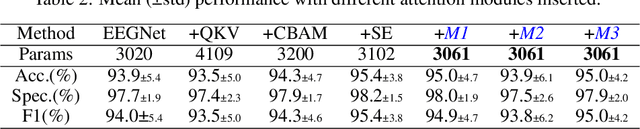
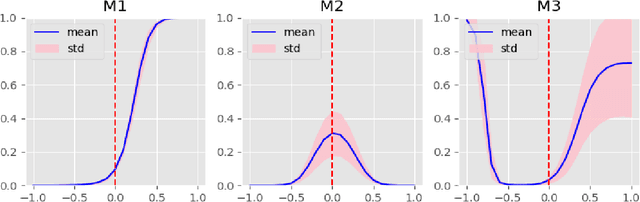
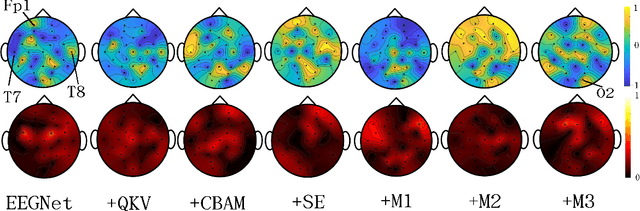
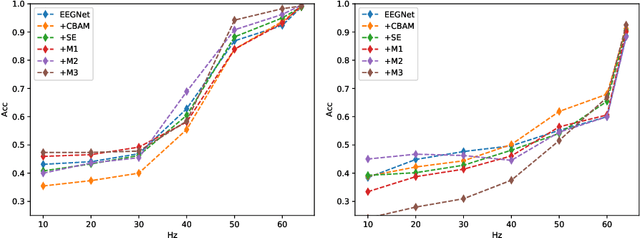
In this work, a parameter-efficient attention module is presented for emotion classification using a limited, or relatively small, number of electroencephalogram (EEG) signals. This module is called the Monotonicity Constrained Attention Module (MCAM) due to its capability of incorporating priors on the monotonicity when converting features' Gram matrices into attention matrices for better feature refinement. Our experiments have shown that MCAM's effectiveness is comparable to state-of-the-art attention modules in boosting the backbone network's performance in prediction while requiring less parameters. Several accompanying sensitivity analyses on trained models' prediction concerning different attacks are also performed. These attacks include various frequency domain filtering levels and gradually morphing between samples associated with multiple labels. Our results can help better understand different modules' behaviour in prediction and can provide guidance in applications where data is limited and are with noises.
A 1d convolutional network for leaf and time series classification
Jun 28, 2019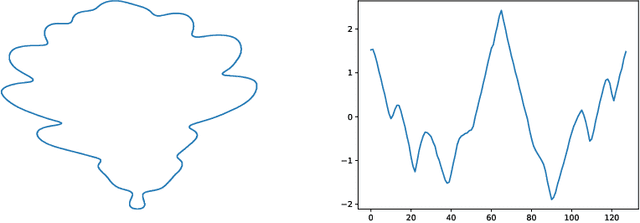
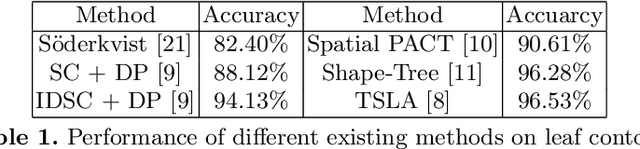
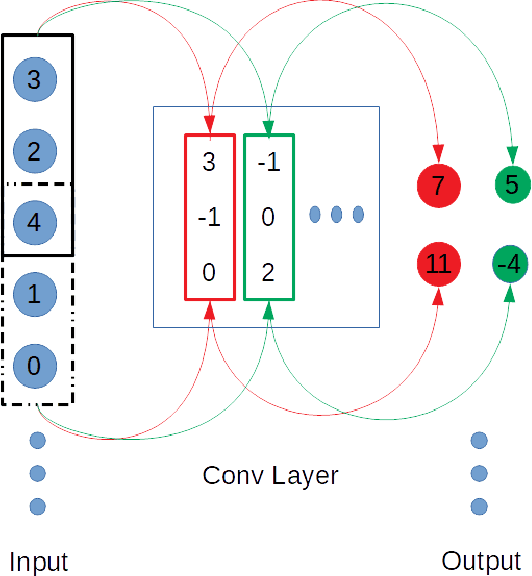
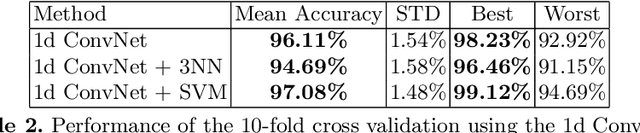
In this paper, a 1d convolutional neural network is designed for classification tasks of leaves with centroid contour distance curve (CCDC) as the single feature. With this classifier, simple feature as CCDC shows more discriminating power than people thought previously. The same architecture can also be applied for classifying 1 dimensional time series with little changes. Experiments on some benchmark datasets shows this architecture can provide classification accuracies that are higher than some existing methods. Code for the paper is available at https://github.com/dykuang/Leaf Project.
On Reducing Negative Jacobian Determinant of the Deformation Predicted by Deep Registration Networks
Jun 28, 2019
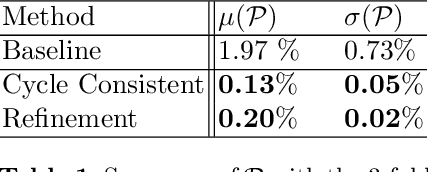
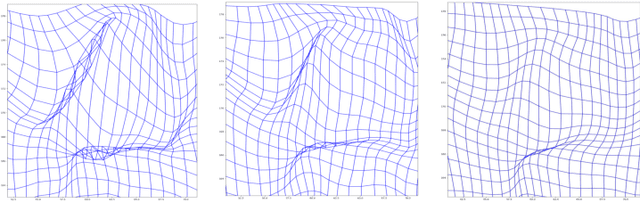
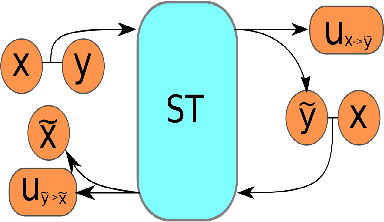
Image registration is a fundamental step in medical image analysis. Ideally, the transformation that registers one image to another should be a diffeomorphism that is both invertible and smooth. Traditional methods like geodesic shooting approach the problem via differential geometry, with theoretical guarantees that the resulting transformation will be smooth and invertible. Most previous research using unsupervised deep neural networks for registration have used a local smoothness constraint (typically, a spatial variation loss) to address the smoothness issue. These networks usually produce non-invertible transformations with ``folding'' in multiple voxel locations, indicated by a negative determinant of the Jacobian matrix of the transformation. While using a loss function that specifically penalizes the folding is a straightforward solution, this usually requires carefully tuning the regularization strength, especially when there are also other losses. In this paper we address this problem from a different angle, by investigating possible training mechanisms that will help the network avoid negative Jacobians and produce smoother deformations. We contribute two independent ideas in this direction. Both ideas greatly reduce the number of folding locations in the predicted deformation, without making changes to the hyperparameters or the architecture used in the existing baseline registration network.
FAIM -- A ConvNet Method for Unsupervised 3D Medical Image Registration
Nov 22, 2018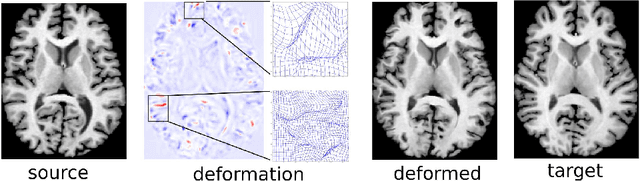
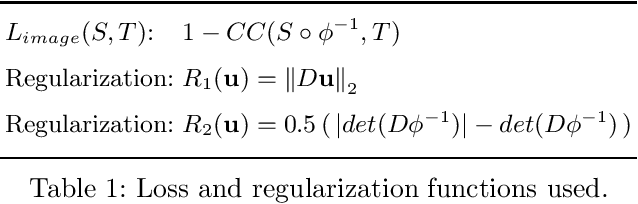
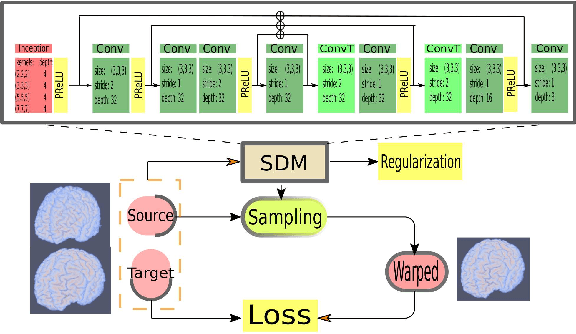
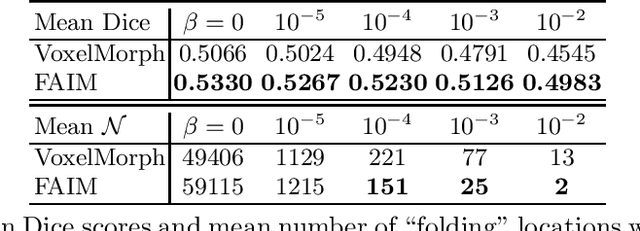
We present a new unsupervised learning algorithm, "FAIM", for 3D medical image registration. Based on a convolutional neural net, FAIM learns from a training set of pairs of images, without needing ground truth information such as landmarks or dense registrations. Once trained, FAIM can register a new pair of images in less than a second, with competitive quality. We compared FAIM with a similar method, VoxelMorph, as well as a diffeomorphic method, uTIlzReg GeoShoot, on the LPBA40 and Mindboggle101 datasets. Results for FAIM were comparable or better than the other methods on pairwise registrations. The effect of different regularization choices on the predicted deformations is briefly investigated. Finally, an application to fast construction of a template and atlas is demonstrated.
A landmark-based algorithm for automatic pattern recognition and abnormality detection
May 11, 2017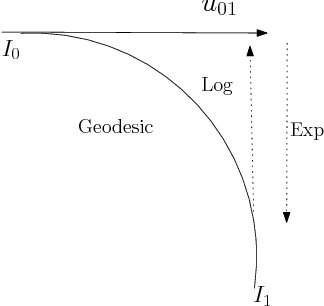

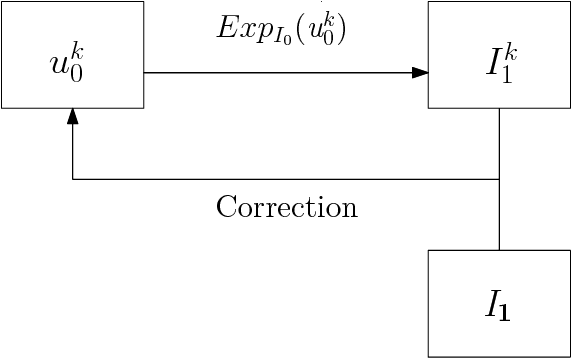
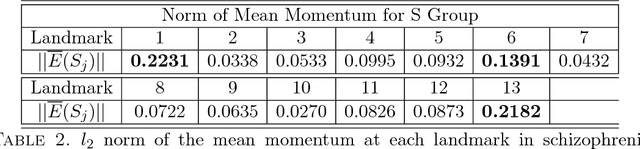
We study a class of mathematical and statistical algorithms with the aim of establishing a computer-based framework for fast and reliable automatic abnormality detection on landmark represented image templates. Under this framework, we apply a landmark-based algorithm for finding a group average as an estimator that is said to best represent the common features of the group in study. This algorithm extracts information of momentum at each landmark through the process of template matching. If ever converges, the proposed algorithm produces a local coordinate system for each member of the observing group, in terms of the residual momentum. We use a Bayesian approach on the collected residual momentum representations for making inference. For illustration, we apply this framework to a small database of brain images for detecting structure abnormality. The brain structure changes identified by our framework are highly consistent with studies in the literature.