 Add to Chrome
 Add to Firefox
 Add to Edge
NIFA: Nonlinear IMC enhanced FPGA for efficient ML inference
Jul 16, 2026
Recent FPGAs have improved deep learning (DL) inference efficiency through dedicated tensor blocks and in-BRAM computation. ReRAM-based analog in-memory computing (IMC) pushes efficiency further, offering an order-of-magnitude improvement in compute density and energy efficiency over conventional digital logic by performing vector-matrix multiplication (VMM) directly within the ReRAM crossbar; prior work has integrated such IMC blocks into FPGAs for DL inference. However, conventional IMC designs support only static-weight VMM, leaving nonlinear operations and dynamic matrix-matrix multiplication (DIMM) to the FPGA fabric. As a result, the benefits of IMC are largely confined to static-weight models, whereas Transformer-based models, which rely on frequent nonlinear and DIMM operations, gain only limited improvement. Moreover, the ADCs within each IMC block consume more than 70% of its area and power, further limiting system efficiency and scalability. To address these limitations, we propose a novel FPGA architecture that integrates an ADC-free IMC block, replacing the conventional ADC with analog content-addressable memories (ACAMs) that natively perform nonlinear operations inside the block. To fully exploit this block, we conduct an FPGA-aware design-space exploration that determines optimal crossbar dimensions while balancing FPGA area, flexibility, and DL performance, and we develop an efficient mapping that leverages ACAMs to carry out DIMM operations, extending the applicability of IMC to attention computation. On CNN and Transformer-based benchmarks, the proposed architecture achieves up to 40x and 1.9x higher energy efficiency and 4.1x and 2.5x higher area efficiency, respectively. Overall, it significantly improves FPGA DL inference efficiency and sustains robust gains on Transformer-based workloads across long input sequences, advancing domain-specialized FPGA design.

A Fast and Energy-Efficient Latch-Based Memristive Analog Content-Addressable Memory
May 12, 2026Analog content-addressable memories (aCAMs) based on memristors provide a promising pathway toward energy-efficient large-scale associative computing for Edge AI and embedded intelligence applications. They have been successfully applied to decision-tree inference and extend the capabilities of compute-in-memory (CIM) architectures beyond conventional vector-matrix multiplication. However, conventional designs such as the 6T2M architecture suffer from static search power, limited voltage gain, and pronounced match-line crosstalk, constraining analog precision and scalability. We introduce a strong-arm latched memristor (SALM) aCAM cell that replaces static voltage division with a dynamic current-race comparator, enabling high regenerative gain, intrinsic result latching, and near-zero static search power. Compared to 6T2M, SALM reduces read energy by 33% at identical latency while eliminating the gain and crosstalk limitations that prevent 6T2M from scaling to large arrays. SALM further enables scalable sequential and parallel latch sharing, and a dataset-aware optimization framework exposes an explicit energy-latency tradeoff, achieving up to 50% energy reduction at 3x latency across representative workloads. To enable architectural exploration, we develop a circuit-accurate behavioral model derived from SPICE lookup tables in 22 nm FD-SOI technology, capturing match-line dynamics and crosstalk. Integrated into the X-TIME decision-tree compiler, this framework demonstrates that SALM maintains near-software accuracy for high-dimensional datasets, whereas baseline designs degrade due to limited gain and cumulative crosstalk.
X-TIME: An in-memory engine for accelerating machine learning on tabular data with CAMs
Apr 05, 2023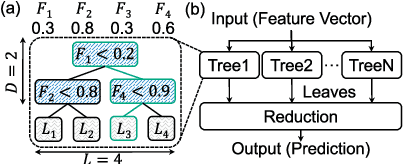
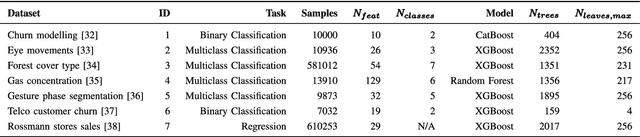
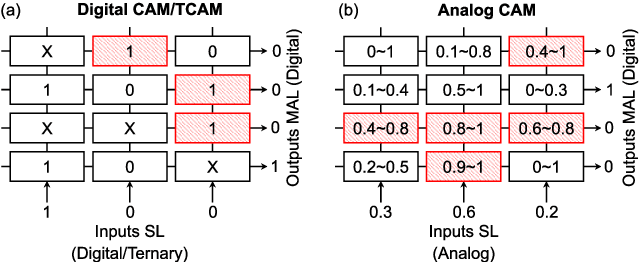

Structured, or tabular, data is the most common format in data science. While deep learning models have proven formidable in learning from unstructured data such as images or speech, they are less accurate than simpler approaches when learning from tabular data. In contrast, modern tree-based Machine Learning (ML) models shine in extracting relevant information from structured data. An essential requirement in data science is to reduce model inference latency in cases where, for example, models are used in a closed loop with simulation to accelerate scientific discovery. However, the hardware acceleration community has mostly focused on deep neural networks and largely ignored other forms of machine learning. Previous work has described the use of an analog content addressable memory (CAM) component for efficiently mapping random forests. In this work, we focus on an overall analog-digital architecture implementing a novel increased precision analog CAM and a programmable network on chip allowing the inference of state-of-the-art tree-based ML models, such as XGBoost and CatBoost. Results evaluated in a single chip at 16nm technology show 119x lower latency at 9740x higher throughput compared with a state-of-the-art GPU, with a 19W peak power consumption.