 Add to Chrome
 Add to Firefox
 Add to Edge
AI+HW 2035: Shaping the Next Decade
Mar 05, 2026
Artificial intelligence (AI) and hardware (HW) are advancing at unprecedented rates, yet their trajectories have become inseparably intertwined. The global research community lacks a cohesive, long-term vision to strategically coordinate the development of AI and HW. This fragmentation constrains progress toward holistic, sustainable, and adaptive AI systems capable of learning, reasoning, and operating efficiently across cloud, edge, and physical environments. The future of AI depends not only on scaling intelligence, but on scaling efficiency, achieving exponential gains in intelligence per joule, rather than unbounded compute consumption. Addressing this grand challenge requires rethinking the entire computing stack. This vision paper lays out a 10-year roadmap for AI+HW co-design and co-development, spanning algorithms, architectures, systems, and sustainability. We articulate key insights that redefine scaling around energy efficiency, system-level integration, and cross-layer optimization. We identify key challenges and opportunities, candidly assess potential obstacles and pitfalls, and propose integrated solutions grounded in algorithmic innovation, hardware advances, and software abstraction. Looking ahead, we define what success means in 10 years: achieving a 1000x improvement in efficiency for AI training and inference; enabling energy-aware, self-optimizing systems that seamlessly span cloud, edge, and physical AI; democratizing access to advanced AI infrastructure; and embedding human-centric principles into the design of intelligent systems. Finally, we outline concrete action items for academia, industry, government, and the broader community, calling for coordinated national initiatives, shared infrastructure, workforce development, cross-agency collaboration, and sustained public-private partnerships to ensure that AI+HW co-design becomes a unifying long-term mission.

MAPS: Multi-Fidelity AI-Augmented Photonic Simulation and Inverse Design Infrastructure
Mar 02, 2025

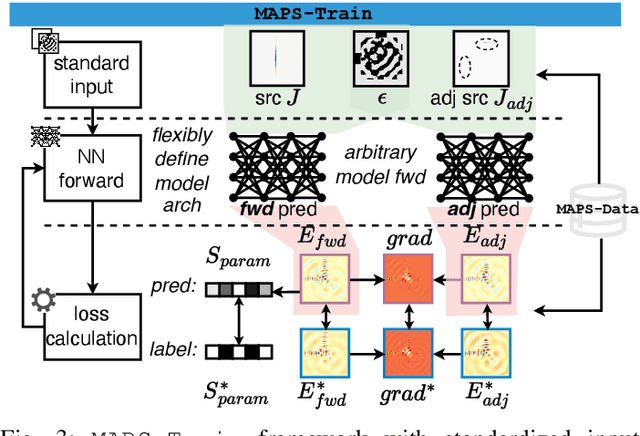

Inverse design has emerged as a transformative approach for photonic device optimization, enabling the exploration of high-dimensional, non-intuitive design spaces to create ultra-compact devices and advance photonic integrated circuits (PICs) in computing and interconnects. However, practical challenges, such as suboptimal device performance, limited manufacturability, high sensitivity to variations, computational inefficiency, and lack of interpretability, have hindered its adoption in commercial hardware. Recent advancements in AI-assisted photonic simulation and design offer transformative potential, accelerating simulations and design generation by orders of magnitude over traditional numerical methods. Despite these breakthroughs, the lack of an open-source, standardized infrastructure and evaluation benchmark limits accessibility and cross-disciplinary collaboration. To address this, we introduce MAPS, a multi-fidelity AI-augmented photonic simulation and inverse design infrastructure designed to bridge this gap. MAPS features three synergistic components: (1) MAPS-Data: A dataset acquisition framework for generating multi-fidelity, richly labeled devices, providing high-quality data for AI-for-optics research. (2) MAPS-Train: A flexible AI-for-photonics training framework offering a hierarchical data loading pipeline, customizable model construction, support for data- and physics-driven losses, and comprehensive evaluations. (3) MAPS-InvDes: An advanced adjoint inverse design toolkit that abstracts complex physics but exposes flexible optimization steps, integrates pre-trained AI models, and incorporates fabrication variation models. This infrastructure MAPS provides a unified, open-source platform for developing, benchmarking, and advancing AI-assisted photonic design workflows, accelerating innovation in photonic hardware optimization and scientific machine learning.