 Add to Chrome
 Add to Firefox
 Add to Edge
MAUPITI: On-Device Prototype-Based Learning on a Smart Infrared Sensor
Aug 07, 2026
Low-resolution infrared (IR) array sensors represent an interesting solution for privacy-preserving human sensing in embedded systems. In this letter, we describe a smart multi-pixel IR sensor integrating a 16$\times$16 thermal MOSFET (TMOS) array and a RISC-V microcontroller extended with low-precision SIMD instructions, capable of on-device learning and continual adaptation for pose and gesture recognition tasks under tight memory and power constraints ($<$32kB on-chip memory, $\approx$1.5mW). To avoid the memory overheads of backpropagation and replay buffers, we adopt a prototype-based Nearest Class Mean (NCM) classifier in which a simple Convolutional Neural Network (CNN) encoder is trained and quantized offline, while class prototypes are stored and updated on the device in streaming mode. With experiments on two datasets, we show that this approach yields accuracy on par with a conventional classifier, with negligible latency overheads in both the classification and the prototype update ($<$0.29% considering both phases), effectively enabling online adaptation of the perception framework.

Persona-as-Configuration: Generative Stakeholder Reporting for Agricultural Floods
Jul 20, 2026Cyber-physical systems built on deterministic edge inference, such as on-vehicle flood detection for agricultural fields, produce structured decision logs that must be interpreted differently by heterogeneous stakeholders. Pairing such systems with large language models (LLMs) to generate stakeholder-specific reports introduces a tension: the generative layer is non-deterministic, while the edge plane must remain replayable and auditable. We propose an architectural pattern resting on two invariants: unidirectional consumption, in which the generative layer is a strict read-only consumer of the deterministic plane and never writes back, and persona-as-configuration, in which stakeholder adaptation is a versioned prompt-template artifact rather than runtime improvisation. We instantiate the pattern as a context-aware dashboard layer over the JSON decision logs of a previously published edge-based standing-water detection system, and analyse how the integration boundary admits standard generative-reliability mitigations as configuration- or middleware-level extension points. A structured expert review rated the pattern favourably across five ISO/IEC 25010-aligned quality dimensions, with strongest agreement on separation of concerns. End-user evaluation with agricultural stakeholders is planned for future work.
SAKE: Software Architectural Knowledge Evaluation Benchmark for Large Language Models
Jun 28, 2026Large Language Models (LLMs) are increasingly used as assistants across the software development lifecycle, yet their ability to reason about software architecture remains largely unmeasured. Architectural decision-making depends on quality attribute trade-offs, design patterns, and system-level constraints, none of which are exercised by benchmarks that target syntactic or algorithmic tasks. We introduce SAKE (Software Architectural Knowledge Evaluation), a standardized and reproducible benchmark for assessing software architectural knowledge in LLMs. SAKE comprises 2154 expert-curated multiple-choice questions, each with four options, stratified across eight architectural categories and four context-length levels. We evaluate 11 proprietary and open-weight models in zero-shot and five-shot settings. Overall accuracy is high, but performance varies markedly across categories, revealing competency gaps in areas central to professional practice. SAKE, its evaluation scripts, and all results are released as open source to give the community a baseline for tracking architectural reasoning in LLMs.
Lightweight Software Kernels and Hardware Extensions for Efficient Sparse Deep Neural Networks on Microcontrollers
Mar 08, 2025The acceleration of pruned Deep Neural Networks (DNNs) on edge devices such as Microcontrollers (MCUs) is a challenging task, given the tight area- and power-constraints of these devices. In this work, we propose a three-fold contribution to address this problem. First, we design a set of optimized software kernels for N:M pruned layers, targeting ultra-low-power, multicore RISC-V MCUs, which are up to 2.1x and 3.4x faster than their dense counterparts at 1:8 and 1:16 sparsity, respectively. Then, we implement a lightweight Instruction-Set Architecture (ISA) extension to accelerate the indirect load and non-zero indices decompression operations required by our kernels, obtaining up to 1.9x extra speedup, at the cost of a 5% area overhead. Lastly, we extend an open-source DNN compiler to utilize our sparse kernels for complete networks, showing speedups of 3.21x and 1.81x on a ResNet18 and a Vision Transformer (ViT), with less than 1.5% accuracy drop compared to a dense baseline.
MATCH: Model-Aware TVM-based Compilation for Heterogeneous Edge Devices
Oct 11, 2024
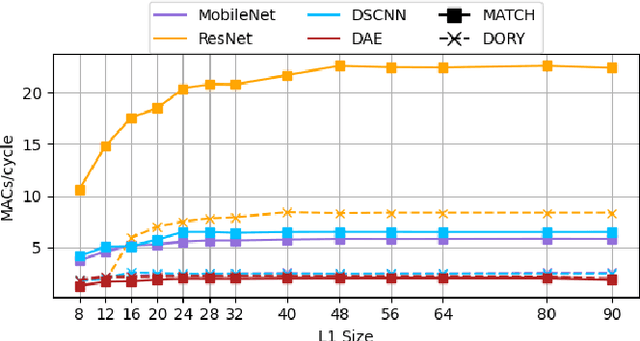
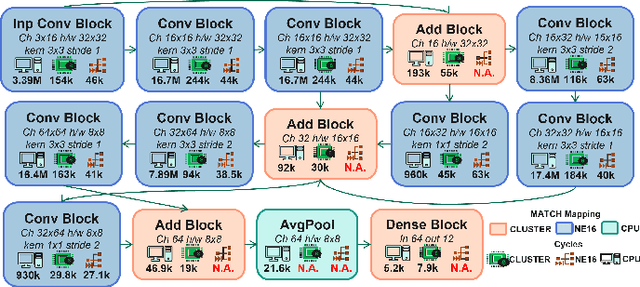
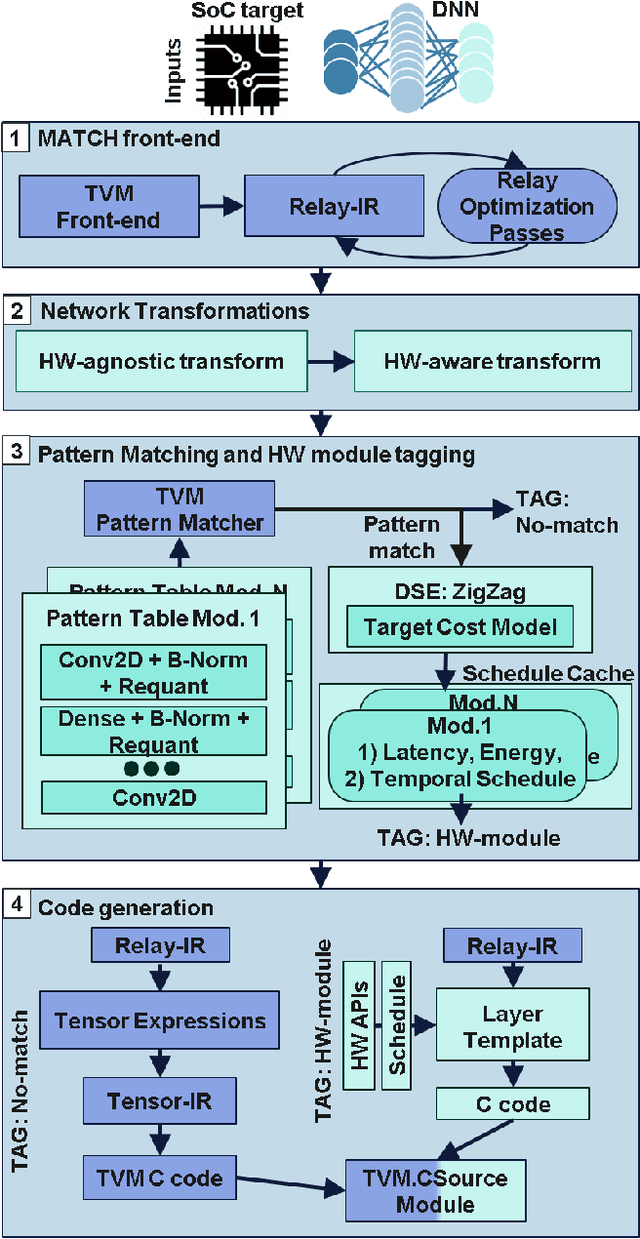
Streamlining the deployment of Deep Neural Networks (DNNs) on heterogeneous edge platforms, coupling within the same micro-controller unit (MCU) instruction processors and hardware accelerators for tensor computations, is becoming one of the crucial challenges of the TinyML field. The best-performing DNN compilation toolchains are usually deeply customized for a single MCU family, and porting to a different heterogeneous MCU family implies labor-intensive re-development of almost the entire compiler. On the opposite side, retargetable toolchains, such as TVM, fail to exploit the capabilities of custom accelerators, resulting in the generation of general but unoptimized code. To overcome this duality, we introduce MATCH, a novel TVM-based DNN deployment framework designed for easy agile retargeting across different MCU processors and accelerators, thanks to a customizable model-based hardware abstraction. We show that a general and retargetable mapping framework enhanced with hardware cost models can compete with and even outperform custom toolchains on diverse targets while only needing the definition of an abstract hardware model and a SoC-specific API. We tested MATCH on two state-of-the-art heterogeneous MCUs, GAP9 and DIANA. On the four DNN models of the MLPerf Tiny suite MATCH reduces inference latency by up to 60.88 times on DIANA, compared to using the plain TVM, thanks to the exploitation of the on-board HW accelerator. Compared to HTVM, a fully customized toolchain for DIANA, we still reduce the latency by 16.94%. On GAP9, using the same benchmarks, we improve the latency by 2.15 times compared to the dedicated DORY compiler, thanks to our heterogeneous DNN mapping approach that synergically exploits the DNN accelerator and the eight-cores cluster available on board.
Machine Learning-based feasibility estimation of digital blocks in BCD technology
Oct 10, 2024
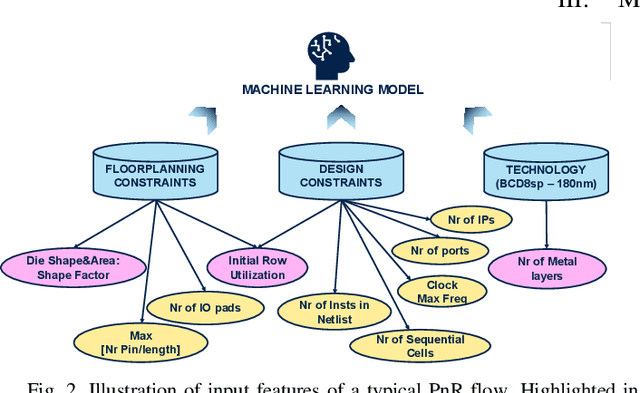
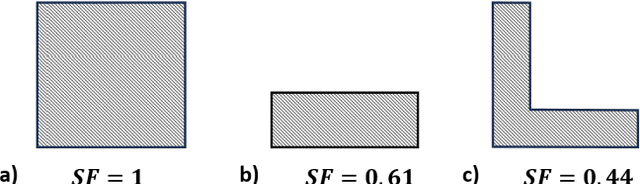
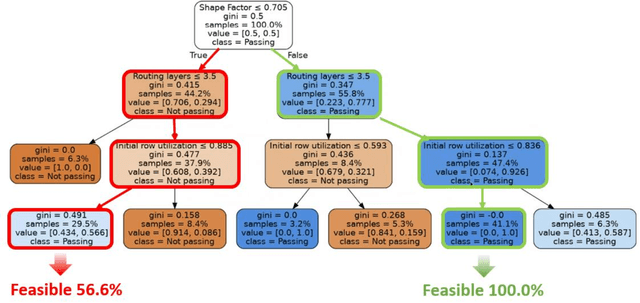
Analog-on-Top Mixed Signal (AMS) Integrated Circuit (IC) design is a time-consuming process predominantly carried out by hand. Within this flow, usually, some area is reserved by the top-level integrator for the placement of digital blocks. Specific features of the area, such as size and shape, have a relevant impact on the possibility of implementing the digital logic with the required functionality. We present a Machine Learning (ML)-based evaluation methodology for predicting the feasibility of digital implementation using a set of high-level features. This approach aims to avoid time-consuming Place-and-Route trials, enabling rapid feedback between Digital and Analog Back-End designers during top-level placement.
Accelerating Depthwise Separable Convolutions on Ultra-Low-Power Devices
Jun 18, 2024Depthwise separable convolutions are a fundamental component in efficient Deep Neural Networks, as they reduce the number of parameters and operations compared to traditional convolutions while maintaining comparable accuracy. However, their low data reuse opportunities make deploying them notoriously difficult. In this work, we perform an extensive exploration of alternatives to fuse the depthwise and pointwise kernels that constitute the separable convolutional block. Our approach aims to minimize time-consuming memory transfers by combining different data layouts. When targeting a commercial ultra-low-power device with a three-level memory hierarchy, the GreenWaves GAP8 SoC, we reduce the latency of end-to-end network execution by up to 11.40%. Furthermore, our kernels reduce activation data movements between L2 and L1 memories by up to 52.97%.
Optimized Deployment of Deep Neural Networks for Visual Pose Estimation on Nano-drones
Feb 23, 2024Miniaturized autonomous unmanned aerial vehicles (UAVs) are gaining popularity due to their small size, enabling new tasks such as indoor navigation or people monitoring. Nonetheless, their size and simple electronics pose severe challenges in implementing advanced onboard intelligence. This work proposes a new automatic optimization pipeline for visual pose estimation tasks using Deep Neural Networks (DNNs). The pipeline leverages two different Neural Architecture Search (NAS) algorithms to pursue a vast complexity-driven exploration in the DNNs' architectural space. The obtained networks are then deployed on an off-the-shelf nano-drone equipped with a parallel ultra-low power System-on-Chip leveraging a set of novel software kernels for the efficient fused execution of critical DNN layer sequences. Our results improve the state-of-the-art reducing inference latency by up to 3.22x at iso-error.
HW-SW Optimization of DNNs for Privacy-preserving People Counting on Low-resolution Infrared Arrays
Feb 02, 2024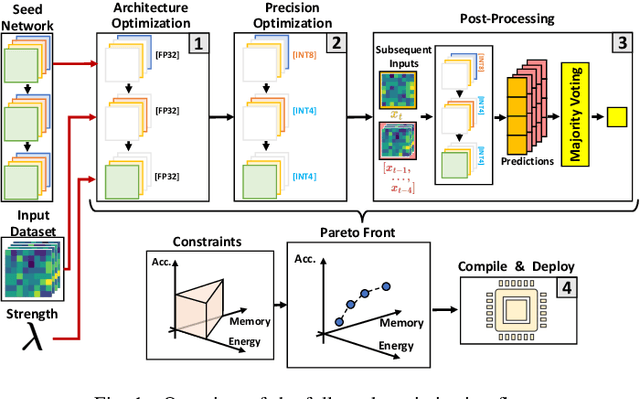
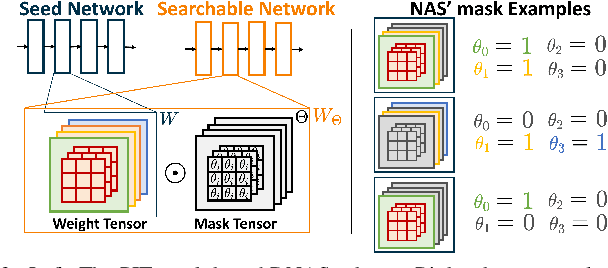
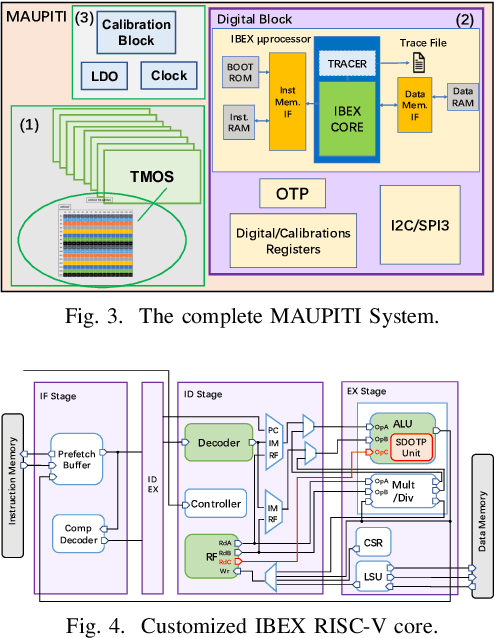
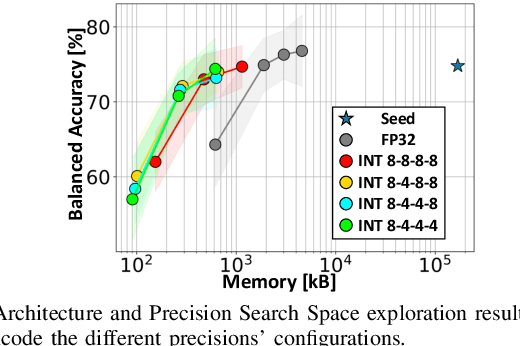
Low-resolution infrared (IR) array sensors enable people counting applications such as monitoring the occupancy of spaces and people flows while preserving privacy and minimizing energy consumption. Deep Neural Networks (DNNs) have been shown to be well-suited to process these sensor data in an accurate and efficient manner. Nevertheless, the space of DNNs' architectures is huge and its manual exploration is burdensome and often leads to sub-optimal solutions. To overcome this problem, in this work, we propose a highly automated full-stack optimization flow for DNNs that goes from neural architecture search, mixed-precision quantization, and post-processing, down to the realization of a new smart sensor prototype, including a Microcontroller with a customized instruction set. Integrating these cross-layer optimizations, we obtain a large set of Pareto-optimal solutions in the 3D-space of energy, memory, and accuracy. Deploying such solutions on our hardware platform, we improve the state-of-the-art achieving up to 4.2x model size reduction, 23.8x code size reduction, and 15.38x energy reduction at iso-accuracy.
Model-Driven Dataset Generation for Data-Driven Battery SOH Models
Jan 10, 2024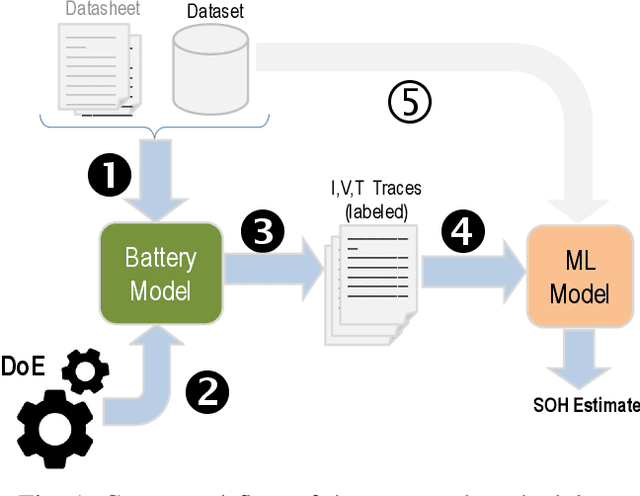
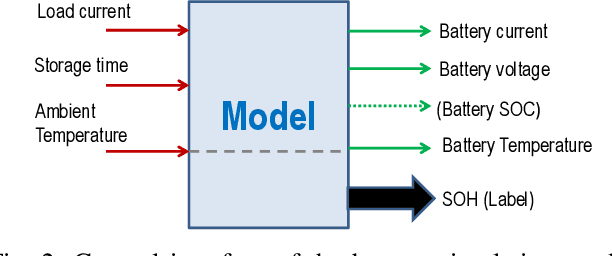
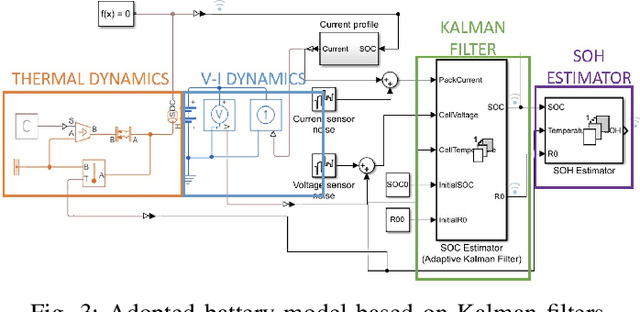
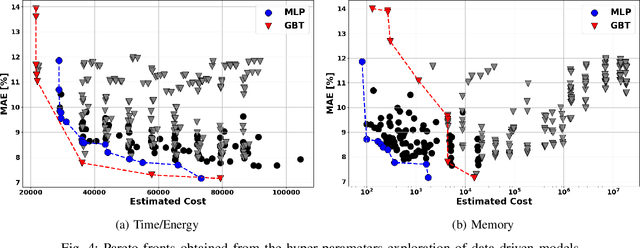
Estimating the State of Health (SOH) of batteries is crucial for ensuring the reliable operation of battery systems. Since there is no practical way to instantaneously measure it at run time, a model is required for its estimation. Recently, several data-driven SOH models have been proposed, whose accuracy heavily relies on the quality of the datasets used for their training. Since these datasets are obtained from measurements, they are limited in the variety of the charge/discharge profiles. To address this scarcity issue, we propose generating datasets by simulating a traditional battery model (e.g., a circuit-equivalent one). The primary advantage of this approach is the ability to use a simulatable battery model to evaluate a potentially infinite number of workload profiles for training the data-driven model. Furthermore, this general concept can be applied using any simulatable battery model, providing a fine spectrum of accuracy/complexity tradeoffs. Our results indicate that using simulated data achieves reasonable accuracy in SOH estimation, with a 7.2% error relative to the simulated model, in exchange for a 27X memory reduction and a =2000X speedup.