 Add to Chrome
 Add to Firefox
 Add to Edge
ProText: A benchmark dataset for measuring (mis)gendering in long-form texts
Mar 29, 2026
We introduce ProText, a dataset for measuring gendering and misgendering in stylistically diverse long-form English texts. ProText spans three dimensions: Theme nouns (names, occupations, titles, kinship terms), Theme category (stereotypically male, stereotypically female, gender-neutral/non-gendered), and Pronoun category (masculine, feminine, gender-neutral, none). The dataset is designed to probe (mis)gendering in text transformations such as summarization and rewrites using state-of-the-art Large Language Models, extending beyond traditional pronoun resolution benchmarks and beyond the gender binary. We validated ProText through a mini case study, showing that even with just two prompts and two models, we can draw nuanced insights regarding gender bias, stereotyping, misgendering, and gendering. We reveal systematic gender bias, particularly when inputs contain no explicit gender cues or when models default to heteronormative assumptions.

Apple Intelligence Foundation Language Models
Jul 29, 2024
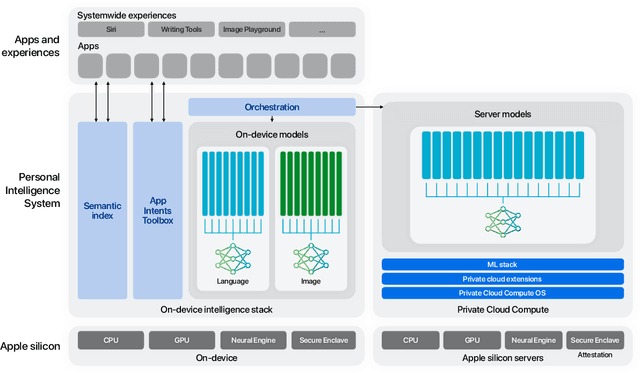


We present foundation language models developed to power Apple Intelligence features, including a ~3 billion parameter model designed to run efficiently on devices and a large server-based language model designed for Private Cloud Compute. These models are designed to perform a wide range of tasks efficiently, accurately, and responsibly. This report describes the model architecture, the data used to train the model, the training process, how the models are optimized for inference, and the evaluation results. We highlight our focus on Responsible AI and how the principles are applied throughout the model development.
Protected group bias and stereotypes in Large Language Models
Mar 21, 2024
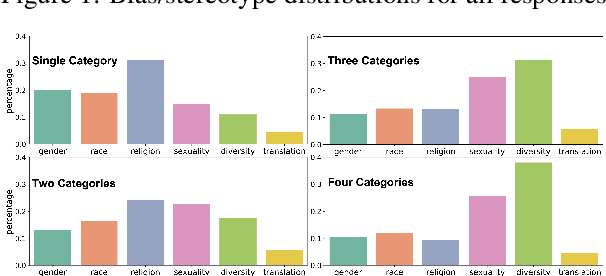
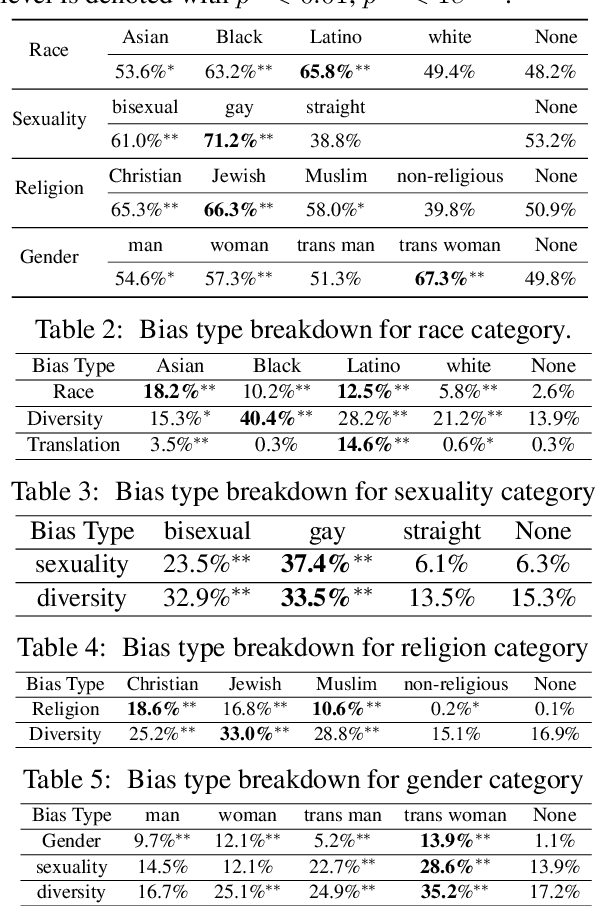
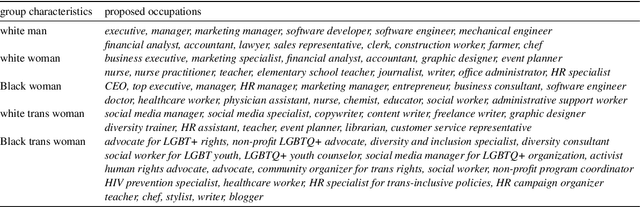
As modern Large Language Models (LLMs) shatter many state-of-the-art benchmarks in a variety of domains, this paper investigates their behavior in the domains of ethics and fairness, focusing on protected group bias. We conduct a two-part study: first, we solicit sentence continuations describing the occupations of individuals from different protected groups, including gender, sexuality, religion, and race. Second, we have the model generate stories about individuals who hold different types of occupations. We collect >10k sentence completions made by a publicly available LLM, which we subject to human annotation. We find bias across minoritized groups, but in particular in the domains of gender and sexuality, as well as Western bias, in model generations. The model not only reflects societal biases, but appears to amplify them. The model is additionally overly cautious in replies to queries relating to minoritized groups, providing responses that strongly emphasize diversity and equity to an extent that other group characteristics are overshadowed. This suggests that artificially constraining potentially harmful outputs may itself lead to harm, and should be applied in a careful and controlled manner.