 Add to Chrome
 Add to Firefox
 Add to Edge
Fully Unsupervised Detection of Physical Contacts on Subsea Cables via State-of-Polarization Monitoring
Jul 01, 2026
We present a fully unsupervised Fast-Slow DSVDD detector for continuous State-of-Polarization monitoring on a deployed subsea cable. Trained without event labels, it ranks all five confirmed trawler contacts within the top 13 of 122,174 recordings and surfaces additional corroborated cable-contact events.

Sea-Scan: High-Accuracy, ML-based Dark Vessel Detection and Localisation via Weakly Supervised DAS Monitoring
Jun 19, 2026We present an ML-based vessel detection and localization system, trained with weak supervision from imperfect AIS labels, that achieves a 97.8% detection rate at 1.98% false-trigger rate, successfully identifies dark-vessel events from unlabeled data.
Is Our Benchmark Enough? An Analysis of Continual Learning for MLLMs
Jun 18, 2026Continual adaptation is essential for multimodal large language models (MLLMs) deployed across evolving domains, but the state-of-the-art MR-LoRA method highly relies on the assumption that a MLLM-based router is necessary to process complex multimodal inputs. This paper revisits this claim on the MLLM-CL benchmark and argues for two claims. \textbf{First}, routing does not require an MLLM: a simple training-free, replay-free ptotypical routing method (\textsc{RePRo}), uses frozen pretrained features and task prototypes to match the MLLM-based router of MR-LoRA at far lower computational cost. \textbf{Second}, shared experts do not improve continual learning for MLLMs, despite their theoretical appeal. We show that these findings arise from two structural limitations of MLLM-CL: (1) its tasks are \textbf{highly separable} in representation space, and (2) its fixed task order makes conclusions \textbf{sensitive to a single curriculum} rather than robust across diverse continual-learning trajectories. As a result, the benchmark primarily rewards learning in isolation rather than genuine continual transfer. This motivates a new design for future benchmarks of continual MLLM learning, with overlapping task manifolds, multiple task orders, fine-grained domain shifts, and evaluation protocols that reward forward transfer as well as retention.
Deep Learning Based Multi-Step Channel Prediction for Adaptive Underwater Acoustic OFDM Systems
Jun 03, 2026We develop an adaptive OFDM framework for underwater acoustic communications based on PatchCSI-T, a Transformer-based multistep channel prediction model with feature-independent modeling and parameter sharing. Combined with a greedy adaptive modulation and power allocation scheme, the proposed approach enables accurate, low-latency CSI forecasting and improves end-to-end BER and spectral efficiency on real-world UWA channel datasets.
* This paper has been accepted and presented at OCEANS 2026 Sanya Conference. This version is a preprint
Variational Autoencoder Domain Adaptation for Cross-System Generalization in ML-Based SOP Monitoring
Apr 20, 2026Machine learning (ML) models trained to detect physical-layer threats on one optical fiber system often fail catastrophically when applied to a different system, due to variations in operating wavelength, fiber properties, and network architecture. To overcome this, we propose a Domain Adaptation (DA) framework based on a Variational Autoencoder (VAE) that learns a shared representation capturing event signatures common to both systems while suppressing system-specific differences. The shared encoder is first trained on the combined data from two distinct optical systems: a 21 km O-band dark-fiber testbed (System 1) and a 63.4 km C-band live metro ring (System 2). The encoder is then frozen, and a classifier is trained using labels from an individual system. The proposed approach achieves 95.3% and 73.5% cross-system accuracy when moving from System 1 to System 2 and vice versa, respectively. This corresponds to gains of 83.4% and 51% over a fully supervised Deep Neural Network (DNN) baseline trained on a single system, while preserving intra-system performance.
Bridging the High-Frequency Data Gap: A Millisecond-Resolution Network Dataset for Advancing Time Series Foundation Models
Mar 17, 2026Time series foundation models (TSFMs) require diverse, real-world datasets to adapt across varying domains and temporal frequencies. However, current large-scale datasets predominantly focus on low-frequency time series with sampling intervals, i.e., time resolution, in the range of seconds to years, hindering their ability to capture the nuances of high-frequency time series data. To address this limitation, we introduce a novel dataset that captures millisecond-resolution wireless and traffic conditions from an operational 5G wireless deployment, expanding the scope of TSFMs to incorporate high-frequency data for pre-training. Further, the dataset introduces a new domain, wireless networks, thus complementing existing more general domains like energy and finance. The dataset also provides use cases for short-term forecasting, with prediction horizons spanning from 100 milliseconds (1 step) to 9.6 seconds (96 steps). By benchmarking traditional machine learning models and TSFMs on predictive tasks using this dataset, we demonstrate that most TSFM model configurations perform poorly on this new data distribution in both zero-shot and fine-tuned settings. Our work underscores the importance of incorporating high-frequency datasets during pre-training and forecasting to enhance architectures, fine-tuning strategies, generalization, and robustness of TSFMs in real-world applications.
Interference Detection in Spectrum-Blind Multi-User Optical Spectrum as a Service
May 27, 2025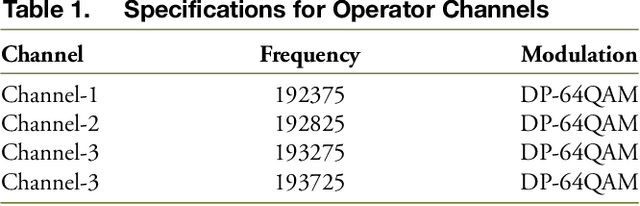
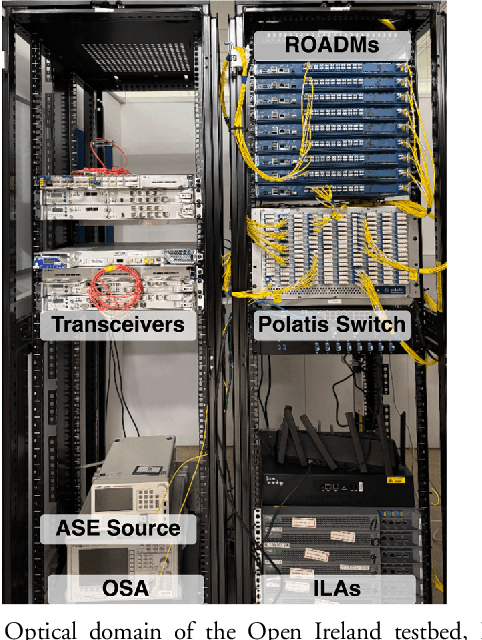
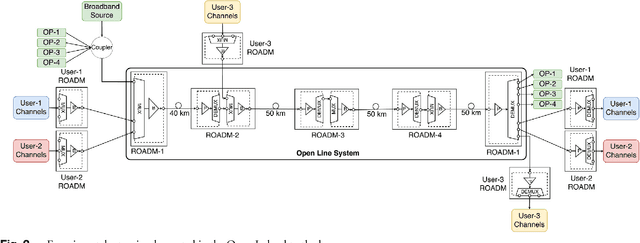
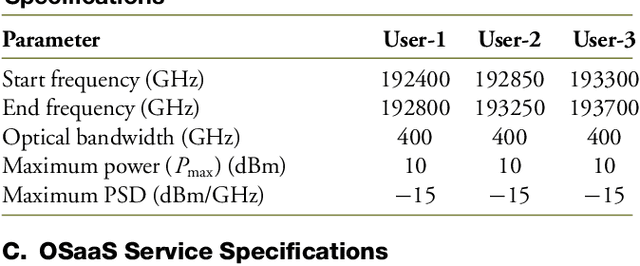
With the growing demand for high-bandwidth, low-latency applications, Optical Spectrum as a Service (OSaaS) is of interest for flexible bandwidth allocation within Elastic Optical Networks (EONs) and Open Line Systems (OLS). While OSaaS facilitates transparent connectivity and resource sharing among users, it raises concerns over potential network vulnerabilities due to shared fiber access and inter-channel interference, such as fiber non-linearity and amplifier based crosstalk. These challenges are exacerbated in multi-user environments, complicating the identification and localization of service interferences. To reduce system disruptions and system repair costs, it is beneficial to detect and identify such interferences timely. Addressing these challenges, this paper introduces a Machine Learning (ML) based architecture for network operators to detect and attribute interferences to specific OSaaS users while blind to the users' internal spectrum details. Our methodology leverages available coarse power measurements and operator channel performance data, bypassing the need for internal user information of wide-band shared spectra. Experimental studies conducted on a 190 km optical line system in the Open Ireland testbed, with three OSaaS users demonstrate the model's capability to accurately classify the source of interferences, achieving a classification accuracy of 90.3%.
* This is a preprint of a paper accepted and published in the Journal of Optical Communications and Networking (JOCN). The final published version is available at: https://doi.org/10.1364/JOCN.551188
ML-based handover prediction over a real O-RAN deployment using RAN Intelligent controller
Apr 14, 2024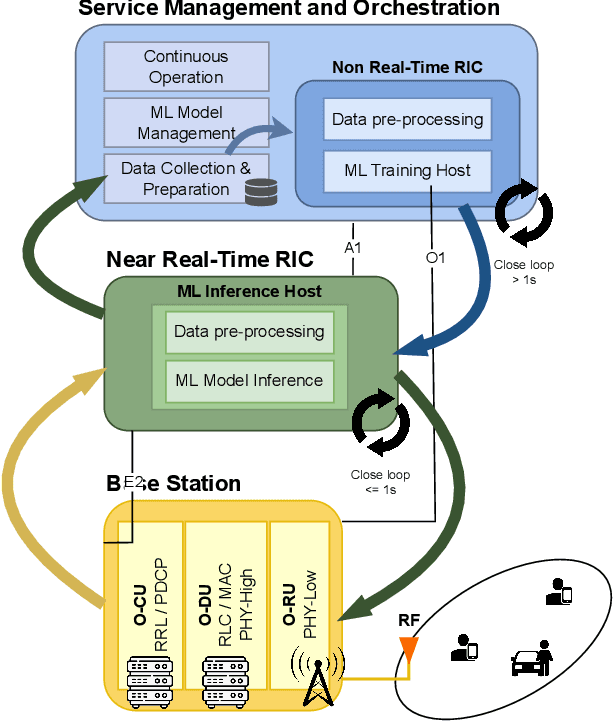
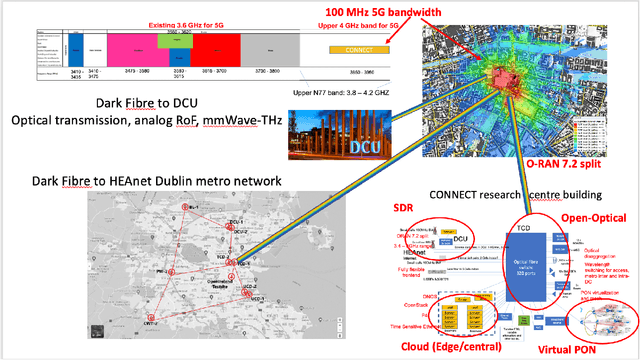
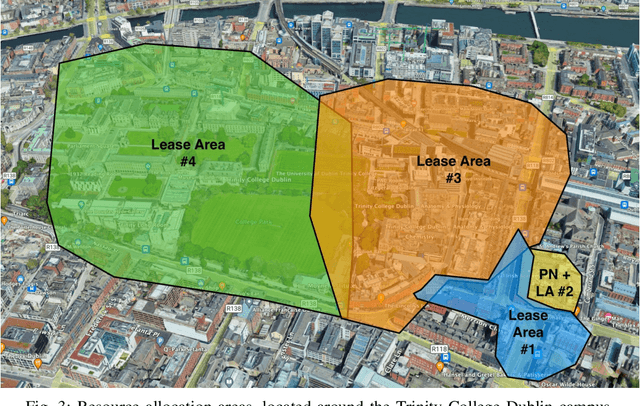
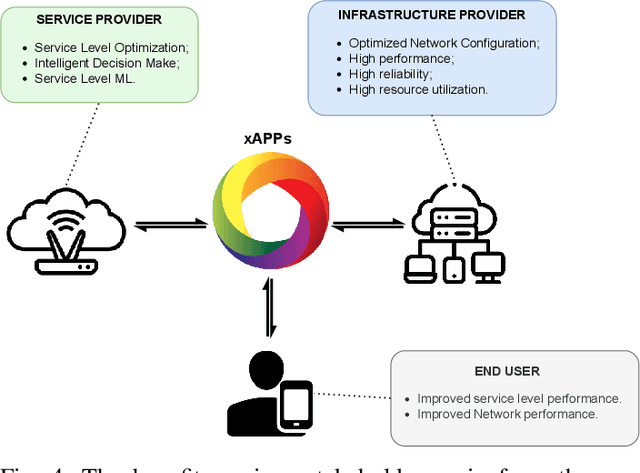
O-RAN introduces intelligent and flexible network control in all parts of the network. The use of controllers with open interfaces allow us to gather real time network measurements and make intelligent/informed decision. The work in this paper focuses on developing a use-case for open and reconfigurable networks to investigate the possibility to predict handover events and understand the value of such predictions for all stakeholders that rely on the communication network to conduct their business. We propose a Long-Short Term Memory Machine Learning approach that takes standard Radio Access Network measurements to predict handover events. The models were trained on real network data collected from a commercial O-RAN setup deployed in our OpenIreland testbed. Our results show that the proposed approach can be optimized for either recall or precision, depending on the defined application level objective. We also link the performance of the Machine Learning (ML) algorithm to the network operation cost. Our results show that ML-based matching between the required and available resources can reduce operational cost by more than 80%, compared to long term resource purchases.
Metro Access Network with Convergence of Coherent and Analog RoF Data Services
Aug 21, 2023Efficient use of spectral resources will be an important aspect of converged access network deployment. This work analyzes the performance of variable bandwidth Analog Radio-over-Fiber signals transmitted in the unfilled spectral spaces of telecom-grade ROADM channels dedicated for coherent signals transmission over the OpenIreland testbed.
Self-Normalizing Neural Network, Enabling One Shot Transfer Learning for Modeling EDFA Wavelength Dependent Gain
Aug 04, 2023We present a novel ML framework for modeling the wavelength-dependent gain of multiple EDFAs, based on semi-supervised, self-normalizing neural networks, enabling one-shot transfer learning. Our experiments on 22 EDFAs in Open Ireland and COSMOS testbeds show high-accuracy transfer-learning even when operated across different amplifier types.