 Add to Chrome
 Add to Firefox
 Add to Edge
Cross-Domain Generalization in Optical Networks via Joint Contrastive and Classification Learning
Jul 22, 2026
The robustness of machine learning techniques across heterogeneous network domains remains an open challenge in optical networks. Models trained on data from a specific topology or operational configuration often exhibit degraded performance when deployed in unseen networks. In this work, we address this challenge by proposing a representation learning technique aimed at capturing task-relevant relationships that remain stable across domains. The proposed technique is based on a novel joint contrastive and classification learning approach in which representation learning and task optimization are performed simultaneously, allowing both objectives to shape the latent space. Experimental results on a representative use case, namely, lightpath quality of transmission estimation, demonstrate the effectiveness of our approach compared to baseline approaches, and highlight its capacity for rapid adaptation, providing excellent performance even with limited fine-tuning.

Explanation-Based Runtime Verification for Trustworthy ML-driven Optical Networks
Jul 22, 2026Machine learning (ML) models are increasingly integrated into optical network automation frameworks to support tasks such as failure management, performance monitoring and resource allocation. In these environments, ML-driven predictions may be directly coupled with control-plane actions where incorrect decisions can immediately impact service quality, resource efficiency, and network stability. As automation levels increase, ensuring the reliability of individual decisions at deployment time becomes a critical requirement. Explainable artificial intelligence (XAI) techniques have emerged to improve transparency by highlighting the factors influencing ML predictions. In addition to identifying influential features, they provide insights into the underlying reasoning process of the model, revealing how different input variables contribute to the final outcome and how feature interactions shape the decision boundary. In this work, we introduce explanation-based runtime verification, an approach that exploits model explanations to assess the soundness of individual ML decisions before they are executed in the network control loop. The proposed approach evaluates explanation coherence and physics grounding consistency at runtime, enabling the system to defer or reject decisions flagged as uncertain. We demonstrate the effectiveness of our approach on a representative use case of lightpath quality of transmission classification. Experimental results show that explanation-based verification can intercept a significant fraction of erroneous decisions while preserving high automation rate.
Human Grounded Evaluation of Large Language Models for Optical Network Automation
Jul 21, 2026Large language models (LLMs) are increasingly adopted for network automation, yet their output quality and inference cost can vary substantially across LLM families. We present HuGLEN, a stepwise evaluation pipeline that uses an LLM-as-a-judge together with a small set of expert ratings to enable scalable and reproducible comparison of candidate LLMs, and to rank them using a quality efficiency score (QES). We demonstrate HuGLEN for translating outputs from an explainable artificial intelligence (XAI) model for the optical network quality of transmission (QoT) estimation task into operator-friendly explanations. Our results show that a medium-sized LLM (12B parameters) achieves the highest QES, indicating the best trade-off between explanation quality and efficiency. Overall, HuGLEN reduces the human-labeling burden while supporting consistent model selection for operator-facing automation tasks.
A T-API-Compliant ReAct Agentic Loop for Optical Networks: Generic vs. Domain-Specific Tool Abstractions
Jun 16, 2026Optical networks need intent-driven, closed-loop agentic management, a key enabler for higher autonomy levels. We present the first T-API-compliant reasoning and act (ReAct) loop. We show that domain-specific composite tools achieve 90% oracle-validated correctness with threefold token savings compared to generic tools.
Policy-driven Conformal Prediction for Trustworthy QoT Estimation
Jun 10, 2026We propose Conformal QoT, a policy-driven framework that combines statistically guaranteed QoT estimation with operational decision policies, enabling reliable lightpath-feasibility predictions under domain shift and improving accuracy from 92\% to 99.6\% on open datasets.
Generative Explainability for Next-Generation Networks: LLM-Augmented XAI with Mutual Feature Interactions
Jun 09, 2026As artificial intelligence and machine learning (AI/ML) models become integral to network operations, their lack of transparency poses a significant barrier to operator trust. Existing explainable artificial intelligence (XAI) techniques often fail to bridge this gap for non-specialists, producing technical outputs that are difficult to translate into actionable insights. This paper presents a framework specifically designed to address this shortcoming. It leverages a moderately sized large language model (LLM) and extends beyond the standard use of SHapley Additive exPlanations (SHAP) feature influence values. The framework employs a structured prompt enriched with mutual feature interaction data to generate human-understandable natural language explanations. To validate our framework, we performed an empirical evaluation on an optical quality of transmission (QoT) estimation use case with human evaluators. We collected independent performance evaluations from specialists, which showed a high inter-evaluator agreement. Compared to a state-of-the-art baseline that uses only SHAP feature influence values in a straightforward prompt, our approach improves the explanation usefulness and scope by 12.2% and 6.2%, while achieving 97.5% correctness.
* 7 pages, with one page for appendix. Accepted for publication at the 2025 21th International Conference on Wireless and Mobile Computing, Networking and Communications (WiMob)
A Unified Siamese Learning Framework for Zero-Day Anomaly Detection and Classification in Optical Networks
Jun 09, 2026A multi-similarity Siamese neural network unifies zero-day anomaly detection and one-shot classification in optical networks, achieving over 99% accuracy and instant adaptability across lightpaths and unseen anomaly types without any retraining.
* Authors' version of the manuscript accepted and published at the Optical Fiber Communication Conference (OFC) 2026. 4 pages, 3 figures
Variational Autoencoder Domain Adaptation for Cross-System Generalization in ML-Based SOP Monitoring
Apr 20, 2026Machine learning (ML) models trained to detect physical-layer threats on one optical fiber system often fail catastrophically when applied to a different system, due to variations in operating wavelength, fiber properties, and network architecture. To overcome this, we propose a Domain Adaptation (DA) framework based on a Variational Autoencoder (VAE) that learns a shared representation capturing event signatures common to both systems while suppressing system-specific differences. The shared encoder is first trained on the combined data from two distinct optical systems: a 21 km O-band dark-fiber testbed (System 1) and a 63.4 km C-band live metro ring (System 2). The encoder is then frozen, and a classifier is trained using labels from an individual system. The proposed approach achieves 95.3% and 73.5% cross-system accuracy when moving from System 1 to System 2 and vice versa, respectively. This corresponds to gains of 83.4% and 51% over a fully supervised Deep Neural Network (DNN) baseline trained on a single system, while preserving intra-system performance.
DRL-Assisted Dynamic QoT-Aware Service Provisioning in Multi-Band Elastic Optical Networks
Aug 06, 2024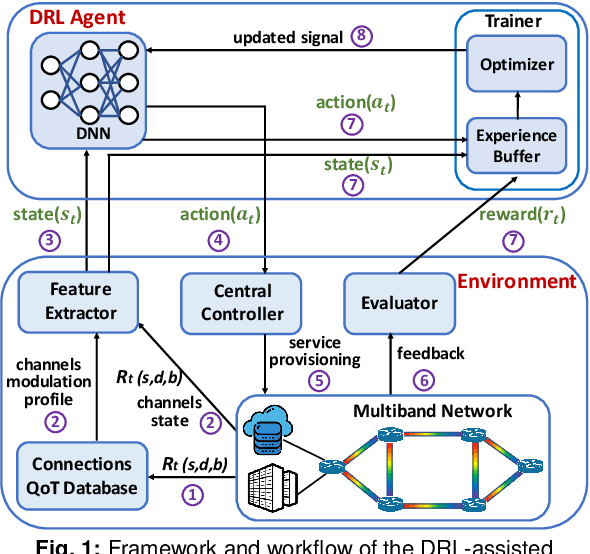
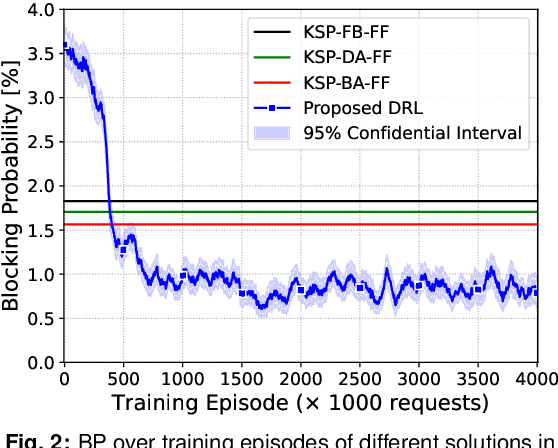
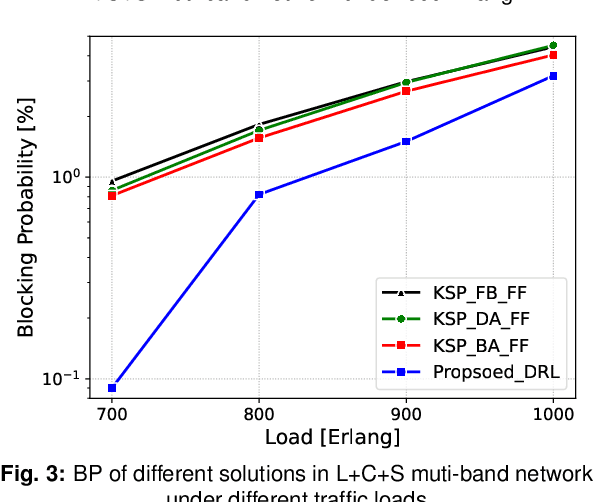
We propose a DRL-assisted approach for service provisioning in multi-band elastic optical networks. Our simulation environment uses an accurate QoT estimator based on the GN/EGN model. Results show that the proposed approach reduces request blocking by 50% compared with heuristics from the literature.