 Add to Chrome
 Add to Firefox
 Add to Edge
Bridging the High-Frequency Data Gap: A Millisecond-Resolution Network Dataset for Advancing Time Series Foundation Models
Mar 17, 2026
Time series foundation models (TSFMs) require diverse, real-world datasets to adapt across varying domains and temporal frequencies. However, current large-scale datasets predominantly focus on low-frequency time series with sampling intervals, i.e., time resolution, in the range of seconds to years, hindering their ability to capture the nuances of high-frequency time series data. To address this limitation, we introduce a novel dataset that captures millisecond-resolution wireless and traffic conditions from an operational 5G wireless deployment, expanding the scope of TSFMs to incorporate high-frequency data for pre-training. Further, the dataset introduces a new domain, wireless networks, thus complementing existing more general domains like energy and finance. The dataset also provides use cases for short-term forecasting, with prediction horizons spanning from 100 milliseconds (1 step) to 9.6 seconds (96 steps). By benchmarking traditional machine learning models and TSFMs on predictive tasks using this dataset, we demonstrate that most TSFM model configurations perform poorly on this new data distribution in both zero-shot and fine-tuned settings. Our work underscores the importance of incorporating high-frequency datasets during pre-training and forecasting to enhance architectures, fine-tuning strategies, generalization, and robustness of TSFMs in real-world applications.

ML-based handover prediction over a real O-RAN deployment using RAN Intelligent controller
Apr 14, 2024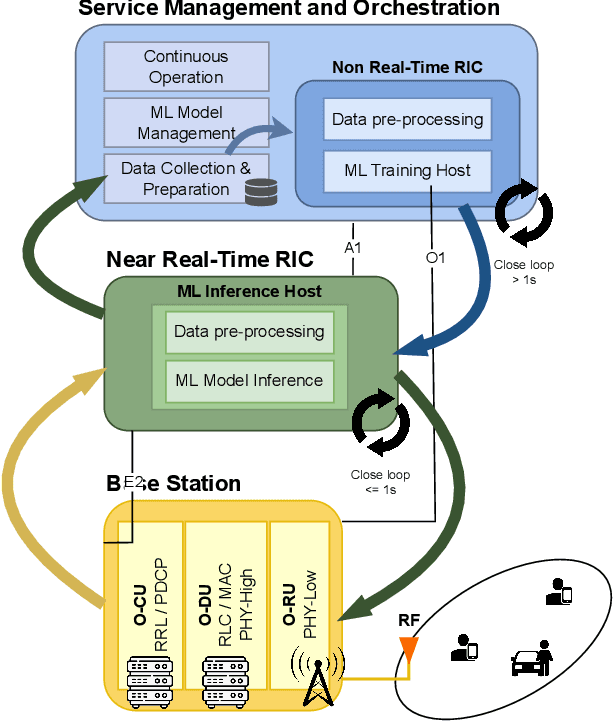
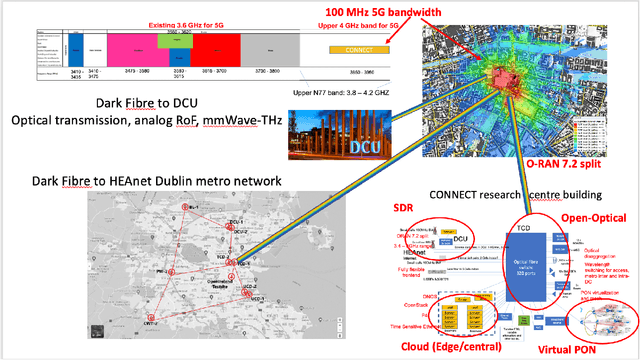
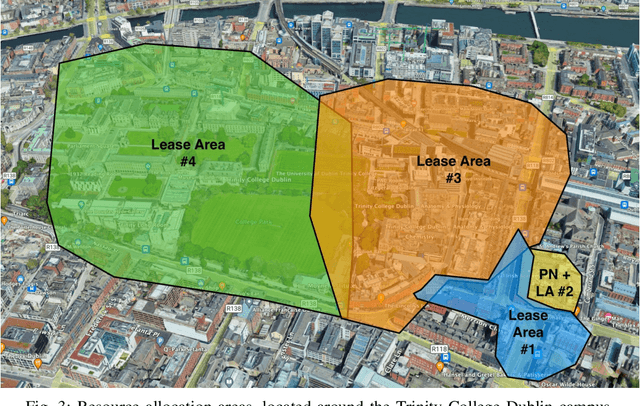
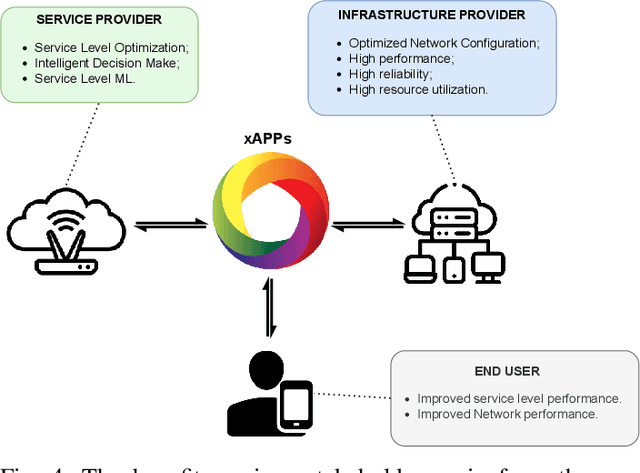
O-RAN introduces intelligent and flexible network control in all parts of the network. The use of controllers with open interfaces allow us to gather real time network measurements and make intelligent/informed decision. The work in this paper focuses on developing a use-case for open and reconfigurable networks to investigate the possibility to predict handover events and understand the value of such predictions for all stakeholders that rely on the communication network to conduct their business. We propose a Long-Short Term Memory Machine Learning approach that takes standard Radio Access Network measurements to predict handover events. The models were trained on real network data collected from a commercial O-RAN setup deployed in our OpenIreland testbed. Our results show that the proposed approach can be optimized for either recall or precision, depending on the defined application level objective. We also link the performance of the Machine Learning (ML) algorithm to the network operation cost. Our results show that ML-based matching between the required and available resources can reduce operational cost by more than 80%, compared to long term resource purchases.
ML Approach for Power Consumption Prediction in Virtualized Base Stations
Jan 13, 2023
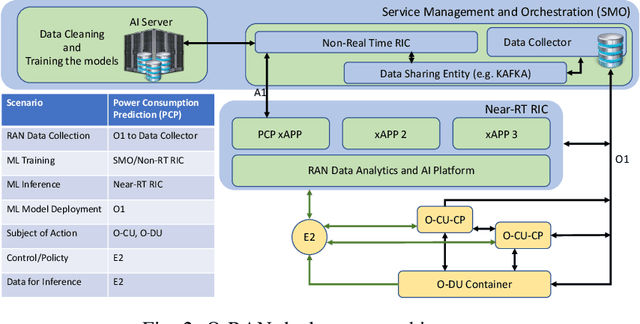
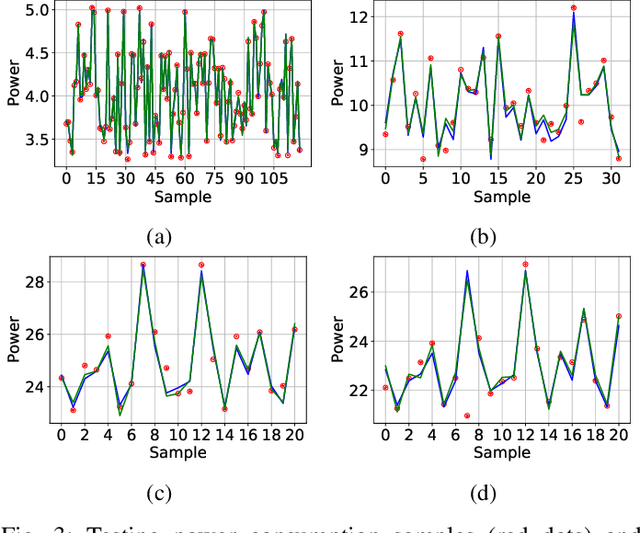

The flexibility introduced with the Open Radio Access Network (O-RAN) architecture allows us to think beyond static configurations in all parts of the network. This paper addresses the issue related to predicting the power consumption of different radio schedulers, and the potential offered by O-RAN to collect data, train models, and deploy policies to control the power consumption. We propose a black-box (Neural Network) model to learn the power consumption function. We compare our approach with a known hand-crafted solution based on domain knowledge. Our solution reaches similar performance without any previous knowledge of the application and provides more flexibility in scenarios where the system behavior is not well understood or the domain knowledge is not available.
Near Real-Time Distributed State Estimation via AI/ML-Empowered 5G Networks
Jul 22, 2022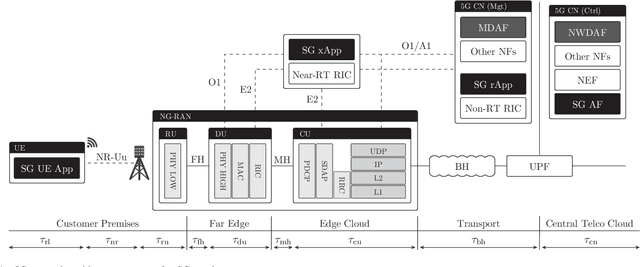
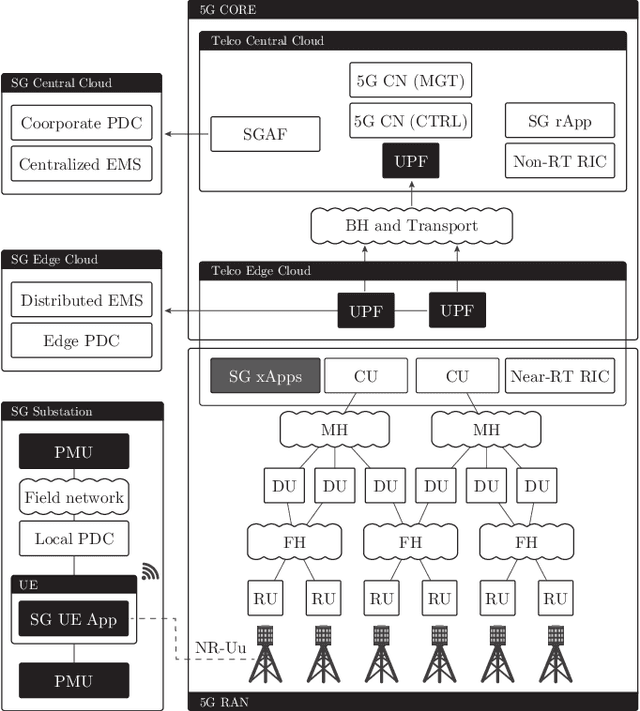
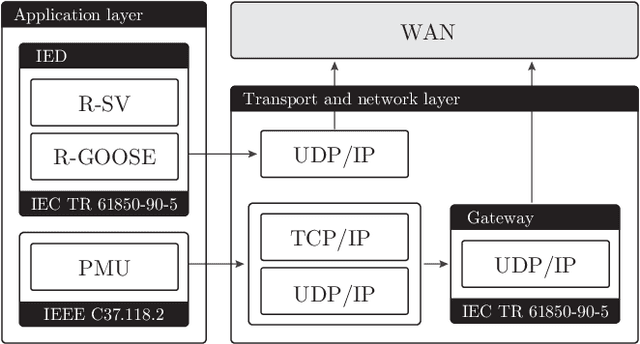
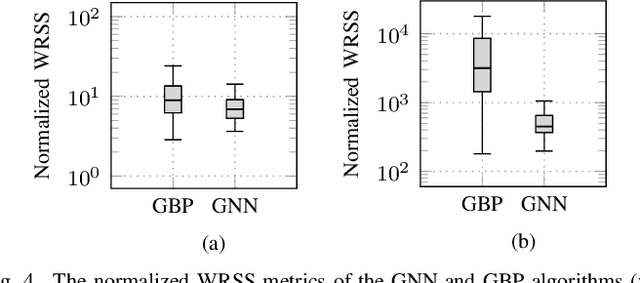
Fifth-Generation (5G) networks have a potential to accelerate power system transition to a flexible, softwarized, data-driven, and intelligent grid. With their evolving support for Machine Learning (ML)/Artificial Intelligence (AI) functions, 5G networks are expected to enable novel data-centric Smart Grid (SG) services. In this paper, we explore how data-driven SG services could be integrated with ML/AI-enabled 5G networks in a symbiotic relationship. We focus on the State Estimation (SE) function as a key element of the energy management system and focus on two main questions. Firstly, in a tutorial fashion, we present an overview on how distributed SE can be integrated with the elements of the 5G core network and radio access network architecture. Secondly, we present and compare two powerful distributed SE methods based on: i) graphical models and belief propagation, and ii) graph neural networks. We discuss their performance and capability to support a near real-time distributed SE via 5G network, taking into account communication delays.