 Add to Chrome
 Add to Firefox
 Add to Edge
Surprises in Proper Positive-Only Learning
Jun 26, 2026
Binary classification from positive-only samples is a variant of PAC learning in which the learner receives i.i.d. samples from the positive region of an unknown target concept, but is evaluated under the original distribution (which places mass on both positive and negative regions). This model dates back to Natarajan [1987, STOC], and the characterization of improper learning is well-known -- it even appears in textbooks. The characterization of proper positive-only learning, however, has long remained open. In this work, we revisit and settle this question: a concept class is properly learnable from positive-only samples if and only if it has finite VC dimension and satisfies a new combinatorial condition, which we call uniform exterior separability. Together with several separation results, this characterization reveals a surprisingly rich landscape that differs sharply from standard PAC learning: proper and improper learning are separated, randomized and deterministic proper learning are separated, there are classes for which no ERM is a learner, and finite VC dimension does not suffice even for non-uniform learning. Along the way, we introduce new combinatorial dimensions that we believe can be of broader interest in learning theory.

Improved Guarantees for Heterogeneous Treatment-Effect Estimation via Matrix Completion
May 28, 2026A central goal of modern causal inference is estimating heterogeneous treatment effects to answer questions like "how does an intervention affect each unit," rather than only on average. We study this problem with panel-data where we observe $n$ units across $m$ times under unknown, non-uniform treatment assignments. The data in this setting is naturally represented as a matrix of all unit--time treatment effects. Estimating heterogeneous treatment effects can then be expressed as obtaining a good estimation of each row's average in this matrix. This allows us to formulate the problem as matrix completion, which can be solved under natural low-rankness assumptions. However, existing matrix-completion guarantees are not powerful enough to get meaningful bounds for the per-row guarantee required for estimating the heterogeneous treatment effect; roughly speaking, they are only useful for estimating average treatment effect bounds, as also illustrated in a recent line of work. We give a simple, computationally efficient estimator that, without knowledge of the propensities and under standard low-rankness and regularity assumptions, achieves a row-wise $\ell_2$ error of $\tilde{O}(\sqrt{\frac{1}{n} + \frac{n}{m^2}})$. Technically, our analysis establishes the first sharp row-wise $\ell_2$-perturbation bound for low-rank approximation, complementing existing spectral-, Frobenius-, and entrywise perturbation theory.
What is Learnable in Valiant's Theory of the Learnable?
May 13, 2026Valiant's 1984 paper is widely credited with introducing the PAC learning model, but it, in fact, introduced a different model: unlike PAC learning, the learner receives only positives, may issue membership queries, and must output a hypothesis with no false positives. Prior work characterized variants, including the case without queries. We revisit Valiant's original model and ask: *Which classes are learnable in it?* For every finite domain, including Valiant's Boolean-hypercube setting, we show that a class is learnable if and only if every realizable positive sample can be certified by a poly-size adaptive query-compression scheme. This is a new variant of sample compression where the learner certifies samples via a short interaction with the membership oracle. Our characterization shows that learnability in Valiant's model is strictly sandwiched between learnability in the PAC model and the variant of Valiant's model without membership queries. This is one of the rare cases where introducing membership queries changes the set of learnable classes, and not just the sample or computational complexity. Next, we study the natural extension of the model to arbitrary domains. While we do not obtain an exact characterization, our techniques readily generalize and show that the same strict sandwiching persists. Finally, we show that $d$-dimensional halfspaces, which are not learnable without queries, are learnable with queries: we give a $\mathrm{poly}(d) \tilde{O}(1/ε)$ sample and $\mathrm{poly}(d) \mathrm{polylog}(1/ε)$ query algorithm, and prove that at least $Ω(d)$ samples or queries are necessary. To our knowledge, this is the first algorithm for halfspaces in Valiant's model. Together, these results uncover a surprisingly rich theory behind Valiant's original notion of learnability and introduce ideas that may be of independent interest in learning theory.
Mean Estimation from Coarse Data: Characterizations and Efficient Algorithms
Feb 26, 2026Coarse data arise when learners observe only partial information about samples; namely, a set containing the sample rather than its exact value. This occurs naturally through measurement rounding, sensor limitations, and lag in economic systems. We study Gaussian mean estimation from coarse data, where each true sample $x$ is drawn from a $d$-dimensional Gaussian distribution with identity covariance, but is revealed only through the set of a partition containing $x$. When the coarse samples, roughly speaking, have ``low'' information, the mean cannot be uniquely recovered from observed samples (i.e., the problem is not identifiable). Recent work by Fotakis, Kalavasis, Kontonis, and Tzamos [FKKT21] established that sample-efficient mean estimation is possible when the unknown mean is identifiable and the partition consists of only convex sets. Moreover, they showed that without convexity, mean estimation becomes NP-hard. However, two fundamental questions remained open: (1) When is the mean identifiable under convex partitions? (2) Is computationally efficient estimation possible under identifiability and convex partitions? This work resolves both questions. [...]
Learning Mixture Models via Efficient High-dimensional Sparse Fourier Transforms
Jan 08, 2026In this work, we give a ${\rm poly}(d,k)$ time and sample algorithm for efficiently learning the parameters of a mixture of $k$ spherical distributions in $d$ dimensions. Unlike all previous methods, our techniques apply to heavy-tailed distributions and include examples that do not even have finite covariances. Our method succeeds whenever the cluster distributions have a characteristic function with sufficiently heavy tails. Such distributions include the Laplace distribution but crucially exclude Gaussians. All previous methods for learning mixture models relied implicitly or explicitly on the low-degree moments. Even for the case of Laplace distributions, we prove that any such algorithm must use super-polynomially many samples. Our method thus adds to the short list of techniques that bypass the limitations of the method of moments. Somewhat surprisingly, our algorithm does not require any minimum separation between the cluster means. This is in stark contrast to spherical Gaussian mixtures where a minimum $\ell_2$-separation is provably necessary even information-theoretically [Regev and Vijayaraghavan '17]. Our methods compose well with existing techniques and allow obtaining ''best of both worlds" guarantees for mixtures where every component either has a heavy-tailed characteristic function or has a sub-Gaussian tail with a light-tailed characteristic function. Our algorithm is based on a new approach to learning mixture models via efficient high-dimensional sparse Fourier transforms. We believe that this method will find more applications to statistical estimation. As an example, we give an algorithm for consistent robust mean estimation against noise-oblivious adversaries, a model practically motivated by the literature on multiple hypothesis testing. It was formally proposed in a recent Master's thesis by one of the authors, and has already inspired follow-up works.
What Makes Treatment Effects Identifiable? Characterizations and Estimators Beyond Unconfoundedness
Jun 04, 2025Most of the widely used estimators of the average treatment effect (ATE) in causal inference rely on the assumptions of unconfoundedness and overlap. Unconfoundedness requires that the observed covariates account for all correlations between the outcome and treatment. Overlap requires the existence of randomness in treatment decisions for all individuals. Nevertheless, many types of studies frequently violate unconfoundedness or overlap, for instance, observational studies with deterministic treatment decisions -- popularly known as Regression Discontinuity designs -- violate overlap. In this paper, we initiate the study of general conditions that enable the identification of the average treatment effect, extending beyond unconfoundedness and overlap. In particular, following the paradigm of statistical learning theory, we provide an interpretable condition that is sufficient and nearly necessary for the identification of ATE. Moreover, this condition characterizes the identification of the average treatment effect on the treated (ATT) and can be used to characterize other treatment effects as well. To illustrate the utility of our condition, we present several well-studied scenarios where our condition is satisfied and, hence, we prove that ATE can be identified in regimes that prior works could not capture. For example, under mild assumptions on the data distributions, this holds for the models proposed by Tan (2006) and Rosenbaum (2002), and the Regression Discontinuity design model introduced by Thistlethwaite and Campbell (1960). For each of these scenarios, we also show that, under natural additional assumptions, ATE can be estimated from finite samples. We believe these findings open new avenues for bridging learning-theoretic insights and causal inference methodologies, particularly in observational studies with complex treatment mechanisms.
Private Statistical Estimation via Truncation
May 18, 2025We introduce a novel framework for differentially private (DP) statistical estimation via data truncation, addressing a key challenge in DP estimation when the data support is unbounded. Traditional approaches rely on problem-specific sensitivity analysis, limiting their applicability. By leveraging techniques from truncated statistics, we develop computationally efficient DP estimators for exponential family distributions, including Gaussian mean and covariance estimation, achieving near-optimal sample complexity. Previous works on exponential families only consider bounded or one-dimensional families. Our approach mitigates sensitivity through truncation while carefully correcting for the introduced bias using maximum likelihood estimation and DP stochastic gradient descent. Along the way, we establish improved uniform convergence guarantees for the log-likelihood function of exponential families, which may be of independent interest. Our results provide a general blueprint for DP algorithm design via truncated statistics.
Learning with Positive and Imperfect Unlabeled Data
Apr 14, 2025
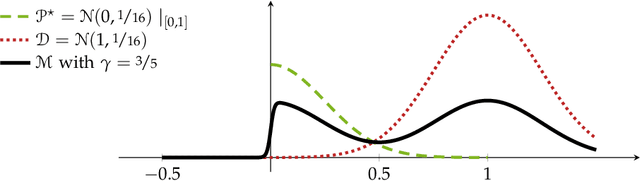
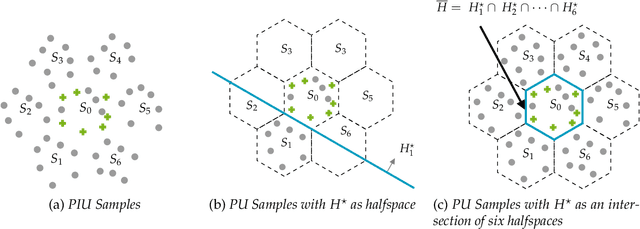
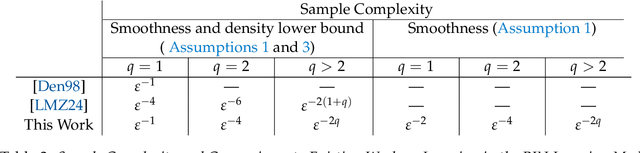
We study the problem of learning binary classifiers from positive and unlabeled data when the unlabeled data distribution is shifted, which we call Positive and Imperfect Unlabeled (PIU) Learning. In the absence of covariate shifts, i.e., with perfect unlabeled data, Denis (1998) reduced this problem to learning under Massart noise; however, that reduction fails under even slight shifts. Our main results on PIU learning are the characterizations of the sample complexity of PIU learning and a computationally and sample-efficient algorithm achieving a misclassification error $\varepsilon$. We further show that our results lead to new algorithms for several related problems. 1. Learning from smooth distributions: We give algorithms that learn interesting concept classes from only positive samples under smooth feature distributions, bypassing known existing impossibility results and contributing to recent advances in smoothened learning (Haghtalab et al, J.ACM'24) (Chandrasekaran et al., COLT'24). 2. Learning with a list of unlabeled distributions: We design new algorithms that apply to a broad class of concept classes under the assumption that we are given a list of unlabeled distributions, one of which--unknown to the learner--is $O(1)$-close to the true feature distribution. 3. Estimation in the presence of unknown truncation: We give the first polynomial sample and time algorithm for estimating the parameters of an exponential family distribution from samples truncated to an unknown set approximable by polynomials in $L_1$-norm. This improves the algorithm by Lee et al. (FOCS'24) that requires approximation in $L_2$-norm. 4. Detecting truncation: We present new algorithms for detecting whether given samples have been truncated (or not) for a broad class of non-product distributions, including non-product distributions, improving the algorithm by De et al. (STOC'24).
Fixed Point Computation: Beating Brute Force with Smoothed Analysis
Jan 18, 2025We propose a new algorithm that finds an $\varepsilon$-approximate fixed point of a smooth function from the $n$-dimensional $\ell_2$ unit ball to itself. We use the general framework of finding approximate solutions to a variational inequality, a problem that subsumes fixed point computation and the computation of a Nash Equilibrium. The algorithm's runtime is bounded by $e^{O(n)}/\varepsilon$, under the smoothed-analysis framework. This is the first known algorithm in such a generality whose runtime is faster than $(1/\varepsilon)^{O(n)}$, which is a time that suffices for an exhaustive search. We complement this result with a lower bound of $e^{\Omega(n)}$ on the query complexity for finding an $O(1)$-approximate fixed point on the unit ball, which holds even in the smoothed-analysis model, yet without the assumption that the function is smooth. Existing lower bounds are only known for the hypercube, and adapting them to the ball does not give non-trivial results even for finding $O(1/\sqrt{n})$-approximate fixed points.
On the Hardness of Learning One Hidden Layer Neural Networks
Oct 04, 2024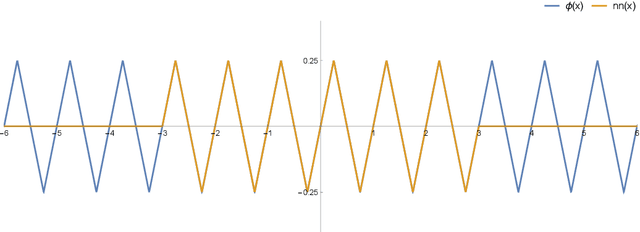
In this work, we consider the problem of learning one hidden layer ReLU neural networks with inputs from $\mathbb{R}^d$. We show that this learning problem is hard under standard cryptographic assumptions even when: (1) the size of the neural network is polynomial in $d$, (2) its input distribution is a standard Gaussian, and (3) the noise is Gaussian and polynomially small in $d$. Our hardness result is based on the hardness of the Continuous Learning with Errors (CLWE) problem, and in particular, is based on the largely believed worst-case hardness of approximately solving the shortest vector problem up to a multiplicative polynomial factor.