 Add to Chrome
 Add to Firefox
 Add to Edge
Adaptation of Embedding Models to Financial Filings via LLM Distillation
Dec 08, 2025
Despite advances in generative large language models (LLMs), practical application of specialized conversational AI agents remains constrained by computation costs, latency requirements, and the need for precise domain-specific relevance measures. While existing embedding models address the first two constraints, they underperform on information retrieval in specialized domains like finance. This paper introduces a scalable pipeline that trains specialized models from an unlabeled corpus using a general purpose retrieval embedding model as foundation. Our method yields an average of 27.7% improvement in MRR$\texttt{@}$5, 44.6% improvement in mean DCG$\texttt{@}$5 across 14 financial filing types measured over 21,800 query-document pairs, and improved NDCG on 3 of 4 document classes in FinanceBench. We adapt retrieval embeddings (bi-encoder) for RAG, not LLM generators, using LLM-judged relevance to distill domain knowledge into a compact retriever. There are prior works which pair synthetically generated queries with real passages to directly fine-tune the retrieval model. Our pipeline differs from these by introducing interaction between student and teacher models that interleaves retrieval-based mining of hard positive/negative examples from the unlabeled corpus with iterative retraining of the student model's weights using these examples. Each retrieval iteration uses the refined student model to mine the corpus for progressively harder training examples for the subsequent training iteration. The methodology provides a cost-effective solution to bridging the gap between general-purpose models and specialized domains without requiring labor-intensive human annotation.

Parameter-Efficient Instruction Tuning of Large Language Models For Extreme Financial Numeral Labelling
May 15, 2024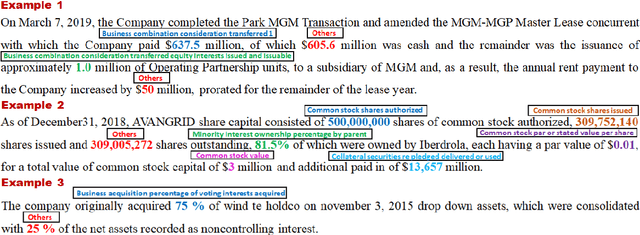

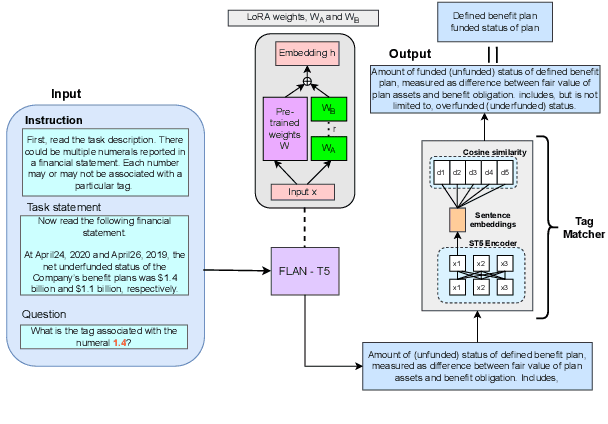
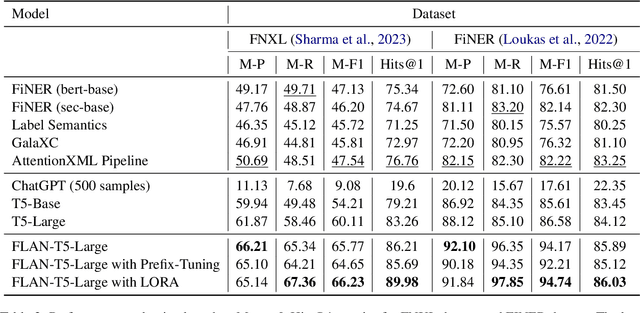
We study the problem of automatically annotating relevant numerals (GAAP metrics) occurring in the financial documents with their corresponding XBRL tags. Different from prior works, we investigate the feasibility of solving this extreme classification problem using a generative paradigm through instruction tuning of Large Language Models (LLMs). To this end, we leverage metric metadata information to frame our target outputs while proposing a parameter efficient solution for the task using LoRA. We perform experiments on two recently released financial numeric labeling datasets. Our proposed model, FLAN-FinXC, achieves new state-of-the-art performances on both the datasets, outperforming several strong baselines. We explain the better scores of our proposed model by demonstrating its capability for zero-shot as well as the least frequently occurring tags. Also, even when we fail to predict the XBRL tags correctly, our generated output has substantial overlap with the ground-truth in majority of the cases.
Financial Numeric Extreme Labelling: A Dataset and Benchmarking for XBRL Tagging
Jun 06, 2023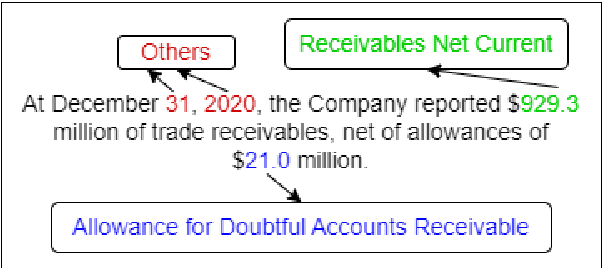
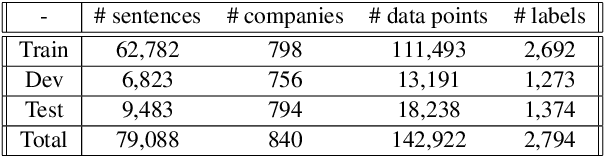
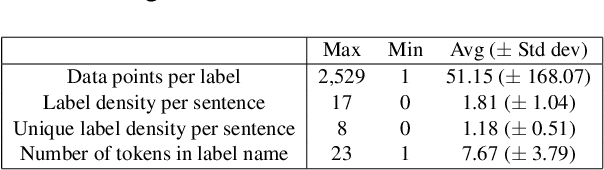
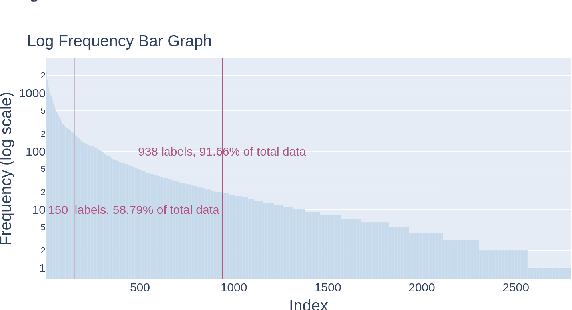
The U.S. Securities and Exchange Commission (SEC) mandates all public companies to file periodic financial statements that should contain numerals annotated with a particular label from a taxonomy. In this paper, we formulate the task of automating the assignment of a label to a particular numeral span in a sentence from an extremely large label set. Towards this task, we release a dataset, Financial Numeric Extreme Labelling (FNXL), annotated with 2,794 labels. We benchmark the performance of the FNXL dataset by formulating the task as (a) a sequence labelling problem and (b) a pipeline with span extraction followed by Extreme Classification. Although the two approaches perform comparably, the pipeline solution provides a slight edge for the least frequent labels.