 Add to Chrome
 Add to Firefox
 Add to Edge
NeuMoSync: End-to-End Neuromodulatory Control for Plasticity and Adaptability in Continual Learning
Aug 05, 2026
Continual learning (CL) requires models to learn tasks sequentially, yet deep neural networks often suffer from plasticity loss and poor knowledge transfer, which can impede their long-term adaptability. Drawing high-level inspiration from global neuromodulatory mechanisms in the brain, we introduce Neuromodulation and Synchronization (NeuMoSync), a novel architecture that integrates dynamic, neuron-specific modulation into deep neural networks to enhance their adaptability and plasticity. NeuMoSync extends standard neural network architectures with learnable feature vectors for each neuron that track network-wide historical context and with a module operating at a higher level of abstraction. This module synthesizes neuron-specific signals, conditioned on both current inputs and the network's evolving state, to adaptively regulate activation dynamics and synaptic plasticity. Evaluated on diverse CL benchmarks, including memorization (Random Label CIFAR-10 and Random Label MNIST), concept drift (Shuffle CIFAR-10 and Shuffle Mini-ImageNet), class-incremental learning (Class Split ImageNet and Class Split CIFAR-100), and domain-incremental learning (Permuted MNIST), NeuMoSync demonstrates strong performance in retaining plasticity and achieves improvements in both forward and backward adaptation compared with existing methods. Ablation studies validate the necessity of each component, while analysis of the learned modulatory signals reveals interpretable coordination patterns across tasks. Our work underscores the potential of integrating global coordination mechanisms into deep learning systems to advance robust, adaptive continual learning. The code is publicly available at https://github.com/RoozbehRazavi/NeuMoSync.

To Retain or to Adapt? Generalizing Continual Learning
Jul 06, 2026The Continual Learning (CL) literature has long been driven by the goal of mitigating catastrophic forgetting. This objective rests on a pervasive, often unstated assumption: that a lifelong learner should approximate the Joint-Task Learning (JTL) solution and retain all previously acquired knowledge. We challenge this retention-centered premise, arguing that in non-stationary environments prioritizing retention can impede real-time adaptation. Shifting the focus to the Average Lifelong Error (ALE), we formalize CL as an online optimization problem governed by the interaction between environmental and learning dynamics. We introduce Transfer Efficiency as a quantitative measure of the tension between Instability, the bias inherited from conflicting past experience, and Transient Error, the optimization cost of learning new tasks from scratch. Under mild convergence conditions, holding across linear and neural network models, this decomposition yields a Critical Task Duration: a closed-form threshold beyond which historical knowledge transitions from a warm-start advantage to an optimization liability whenever retention induces a positive stationary bias. We validate these theoretical predictions on continual image classification and reinforcement learning benchmarks. Finally, by connecting continual learning to the online learning framework of predictable sequences, we show that JTL is only one instance of a broader family of objectives, and we propose a new general class of continual learning algorithms, which we call Predictive Continual Learning. Predictive CL algorithms optimize expected future performance under an explicit, dynamically updated model of future tasks. As a proof of concept, we analyze a Window algorithm that interpolates between JTL and Independent-Task Learning (ITL), outperforming both under controlled distributional drift.
Human Adults and LLMs as Scientists: Who Benefits from Active Exploration?
Jun 04, 2026A long-standing finding in the causal learning literature is that adults struggle to identify conjunctive causal rules, where an effect requires the simultaneous presence of multiple causes, while performing better in disjunctive settings. However, most demonstrations of this ``conjunctive handicap'' rely on passive observation paradigms with limited evidence, where learners have no control over evidence generation. This paper asks whether this bias persists when adults are granted agency through active exploration. Using a modified ``blicket detector'' task, adult participants freely intervened to identify causal objects under conjunctive or disjunctive rule structures. We show that active exploration substantially improves adults' conjunctive causal reasoning, although conjunctive rules still require more tests to infer than disjunctive rules. We further compare human performance to a range of large language models in the same setting. While some state-of-the-art models approach human-level performance on hypothesis inference accuracy, they often exhibit less efficient exploration strategies and similar conjunctive-disjunctive performance gaps.
Language Agents Mirror Human Causal Reasoning Biases. How Can We Help Them Think Like Scientists?
May 14, 2025Language model (LM) agents are increasingly used as autonomous decision-makers who need to actively gather information to guide their decisions. A crucial cognitive skill for such agents is the efficient exploration and understanding of the causal structure of the world -- key to robust, scientifically grounded reasoning. Yet, it remains unclear whether LMs possess this capability or exhibit systematic biases leading to erroneous conclusions. In this work, we examine LMs' ability to explore and infer causal relationships, using the well-established "Blicket Test" paradigm from developmental psychology. We find that LMs reliably infer the common, intuitive disjunctive causal relationships but systematically struggle with the unusual, yet equally (or sometimes even more) evidenced conjunctive ones. This "disjunctive bias" persists across model families, sizes, and prompting strategies, and performance further declines as task complexity increases. Interestingly, an analogous bias appears in human adults, suggesting that LMs may have inherited deep-seated reasoning heuristics from their training data. To this end, we quantify similarities between LMs and humans, finding that LMs exhibit adult-like inference profiles (but not children-like). Finally, we propose a test-time sampling method which explicitly samples and eliminates hypotheses about causal relationships from the LM. This scalable approach significantly reduces the disjunctive bias and moves LMs closer to the goal of scientific, causally rigorous reasoning.
Convening during COVID-19: Lessons learnt from organizing virtual workshops in 2020
Nov 28, 2020This report is an account of the authors' experiences as organizers of WiML's "Un-Workshop" event at ICML 2020. Un-workshops focus on participant-driven structured discussions on a pre-selected topic. For clarity, this event was different from the "WiML Workshop", which is usually co-located with NeurIPS. In this manuscript, organizers, share their experiences with the hope that it will help future organizers to host a successful virtual event under similar conditions. Women in Machine Learning (WiML)'s mission is creating connections within a small community of women working in machine learning, in order to encourage mentorship, networking, and interchange of ideas and increase the impact of women in the community.
The TCGA Meta-Dataset Clinical Benchmark
Oct 18, 2019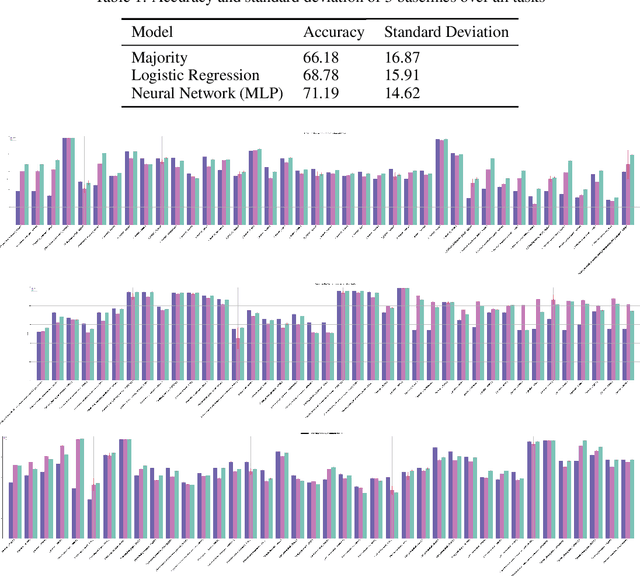
Machine learning is bringing a paradigm shift to healthcare by changing the process of disease diagnosis and prognosis in clinics and hospitals. This development equips doctors and medical staff with tools to evaluate their hypotheses and hence make more precise decisions. Although most current research in the literature seeks to develop techniques and methods for predicting one particular clinical outcome, this approach is far from the reality of clinical decision making in which you have to consider several factors simultaneously. In addition, it is difficult to follow the recent progress concretely as there is a lack of consistency in benchmark datasets and task definitions in the field of Genomics. To address the aforementioned issues, we provide a clinical Meta-Dataset derived from the publicly available data hub called The Cancer Genome Atlas Program (TCGA) that contains 174 tasks. We believe those tasks could be good proxy tasks to develop methods which can work on a few samples of gene expression data. Also, learning to predict multiple clinical variables using gene-expression data is an important task due to the variety of phenotypes in clinical problems and lack of samples for some of the rare variables. The defined tasks cover a wide range of clinical problems including predicting tumor tissue site, white cell count, histological type, family history of cancer, gender, and many others which we explain later in the paper. Each task represents an independent dataset. We use regression and neural network baselines for all the tasks using only 150 samples and compare their performance.
Torchmeta: A Meta-Learning library for PyTorch
Sep 14, 2019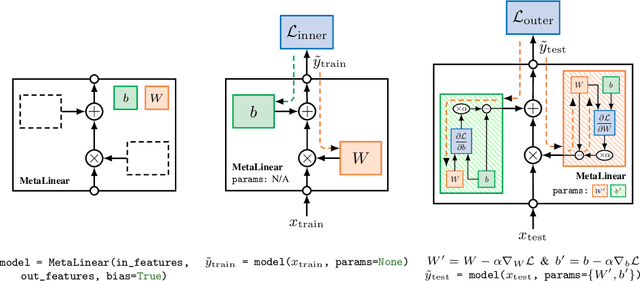
The constant introduction of standardized benchmarks in the literature has helped accelerating the recent advances in meta-learning research. They offer a way to get a fair comparison between different algorithms, and the wide range of datasets available allows full control over the complexity of this evaluation. However, for a large majority of code available online, the data pipeline is often specific to one dataset, and testing on another dataset requires significant rework. We introduce Torchmeta, a library built on top of PyTorch that enables seamless and consistent evaluation of meta-learning algorithms on multiple datasets, by providing data-loaders for most of the standard benchmarks in few-shot classification and regression, with a new meta-dataset abstraction. It also features some extensions for PyTorch to simplify the development of models compatible with meta-learning algorithms. The code is available here: https://github.com/tristandeleu/pytorch-meta