 Add to Chrome
 Add to Firefox
 Add to Edge
To Retain or to Adapt? Generalizing Continual Learning
Jul 06, 2026
The Continual Learning (CL) literature has long been driven by the goal of mitigating catastrophic forgetting. This objective rests on a pervasive, often unstated assumption: that a lifelong learner should approximate the Joint-Task Learning (JTL) solution and retain all previously acquired knowledge. We challenge this retention-centered premise, arguing that in non-stationary environments prioritizing retention can impede real-time adaptation. Shifting the focus to the Average Lifelong Error (ALE), we formalize CL as an online optimization problem governed by the interaction between environmental and learning dynamics. We introduce Transfer Efficiency as a quantitative measure of the tension between Instability, the bias inherited from conflicting past experience, and Transient Error, the optimization cost of learning new tasks from scratch. Under mild convergence conditions, holding across linear and neural network models, this decomposition yields a Critical Task Duration: a closed-form threshold beyond which historical knowledge transitions from a warm-start advantage to an optimization liability whenever retention induces a positive stationary bias. We validate these theoretical predictions on continual image classification and reinforcement learning benchmarks. Finally, by connecting continual learning to the online learning framework of predictable sequences, we show that JTL is only one instance of a broader family of objectives, and we propose a new general class of continual learning algorithms, which we call Predictive Continual Learning. Predictive CL algorithms optimize expected future performance under an explicit, dynamically updated model of future tasks. As a proof of concept, we analyze a Window algorithm that interpolates between JTL and Independent-Task Learning (ITL), outperforming both under controlled distributional drift.

Commit to the Bit: Reactive Reinforcement Learning Done Right
May 27, 2026Reinforcement learning algorithms are commonly analyzed (and designed) under the Markov assumption. This is unrealistic, as most environments encountered in practice are either partially observable, or require function approximation that restricts the agent to access non-Markovian state features. We consider the problem of learning an optimal reactive policy in a finite environment with deterministic observations (or equivalently, hard state aggregation). We introduce a new algorithm, Committed Q-learning, and prove almost-sure convergence to the optimal reactive policy under an intuitive assumption we call rewire-robustness. This assumption is strictly weaker than the $q_\star$-realizability condition used in prior work. Our algorithm is a variant of classical Q-learning in which the behavior policy commits to a single action upon entering a feature, and only resamples actions when the observed feature changes. A crucial part of our analysis is the introduction of quasi-Markov environments.
Tight Sample Complexity Bounds for Entropic Best Policy Identification
May 13, 2026We study best-policy identification for finite-horizon risk-sensitive reinforcement learning under the entropic risk measure. Recent work established a constant gap in the exponential horizon dependence between lower and upper bounds on the number of samples required to identify an approximately optimal policy. Precisely, known lower bounds scale in $Ω(e^{|β| H})$ where $H$ is the horizon of the MDP, while the state-of-the-art upper bound achieves at best $O(e^{2|β| H})$ (arXiv:2506.00286v2) using a generative model. We show that this extra exponential factor can be traced to overly loose concentration control for exponential utilities. To close this open gap, we revisit the analysis of this problem through a forward-model based algorithm building on KL-based exploration bonuses that we adapt to the entropic criterion. The improvement we get is due to two main novel technical innovations. We leverage the smoothness properties of the exponential utility to derive sharper concentration bounds, and we propose a new stopping rule that exploits further this tightness to obtain a sample complexity that matches the lower bound.
Split the Differences, Pool the Rest: Provably Efficient Multi-Objective Imitation
May 12, 2026This work investigates multi-objective imitation learning: the problem of recovering policies that lie on the Pareto front given demonstrations from multiple Pareto-optimal experts in a Multi-Objective Markov Decision Process (MOMDP). Standard imitation approaches are ill-equipped for this regime, as naively aggregating conflicting expert trajectories can result in dominated policies. To address this, we introduce Multi-Output Augmented Behavioral Cloning (MA-BC), an algorithm that systematically partitions divergent expert data while pooling state-action pairs where no behavior conflict is observed. Theoretically, we prove that MA-BC converges to Pareto-optimal policies at a faster statistical rate than any learner that considers each expert dataset independently. Furthermore, we establish a novel lower bound for multi-objective imitation learning, demonstrating that MA-BC is minimax optimal. Finally, we empirically validate our algorithm across diverse discrete environments and, guided by our theoretical insights, extend and evaluate MA-BC on a continuous Linear Quadratic Regulator (LQR) control task.
Non-Stationary Lipschitz Bandits
May 24, 2025We study the problem of non-stationary Lipschitz bandits, where the number of actions is infinite and the reward function, satisfying a Lipschitz assumption, can change arbitrarily over time. We design an algorithm that adaptively tracks the recently introduced notion of significant shifts, defined by large deviations of the cumulative reward function. To detect such reward changes, our algorithm leverages a hierarchical discretization of the action space. Without requiring any prior knowledge of the non-stationarity, our algorithm achieves a minimax-optimal dynamic regret bound of $\mathcal{\widetilde{O}}(\tilde{L}^{1/3}T^{2/3})$, where $\tilde{L}$ is the number of significant shifts and $T$ the horizon. This result provides the first optimal guarantee in this setting.
Put CASH on Bandits: A Max K-Armed Problem for Automated Machine Learning
May 08, 2025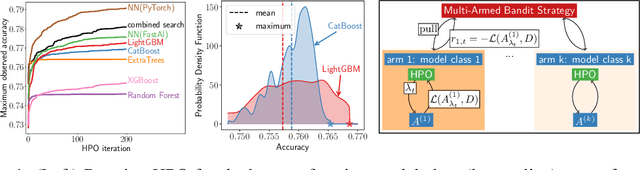

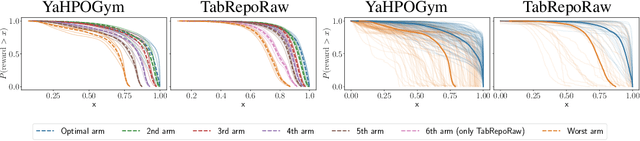
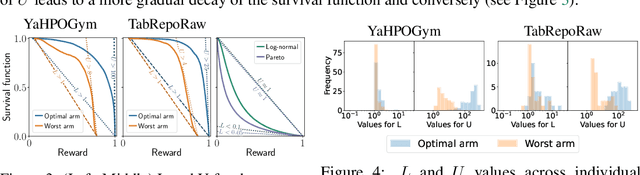
The Combined Algorithm Selection and Hyperparameter optimization (CASH) is a challenging resource allocation problem in the field of AutoML. We propose MaxUCB, a max $k$-armed bandit method to trade off exploring different model classes and conducting hyperparameter optimization. MaxUCB is specifically designed for the light-tailed and bounded reward distributions arising in this setting and, thus, provides an efficient alternative compared to classic max $k$-armed bandit methods assuming heavy-tailed reward distributions. We theoretically and empirically evaluate our method on four standard AutoML benchmarks, demonstrating superior performance over prior approaches.
Quantization-Free Autoregressive Action Transformer
Mar 18, 2025
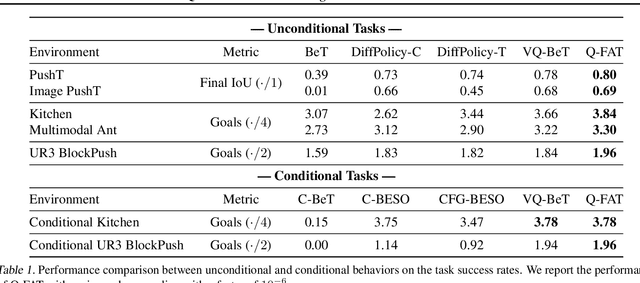
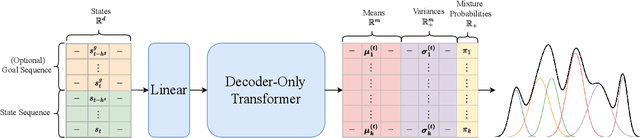
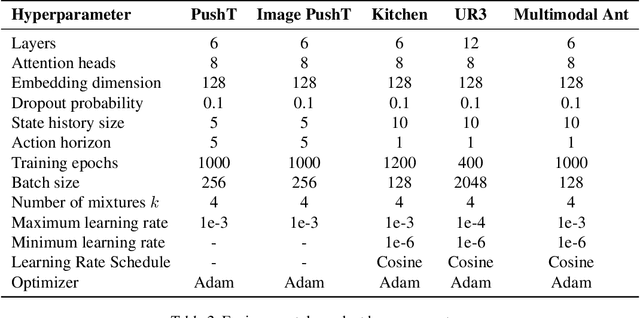
Current transformer-based imitation learning approaches introduce discrete action representations and train an autoregressive transformer decoder on the resulting latent code. However, the initial quantization breaks the continuous structure of the action space thereby limiting the capabilities of the generative model. We propose a quantization-free method instead that leverages Generative Infinite-Vocabulary Transformers (GIVT) as a direct, continuous policy parametrization for autoregressive transformers. This simplifies the imitation learning pipeline while achieving state-of-the-art performance on a variety of popular simulated robotics tasks. We enhance our policy roll-outs by carefully studying sampling algorithms, further improving the results.
Clustered KL-barycenter design for policy evaluation
Mar 04, 2025In the context of stochastic bandit models, this article examines how to design sample-efficient behavior policies for the importance sampling evaluation of multiple target policies. From importance sampling theory, it is well established that sample efficiency is highly sensitive to the KL divergence between the target and importance sampling distributions. We first analyze a single behavior policy defined as the KL-barycenter of the target policies. Then, we refine this approach by clustering the target policies into groups with small KL divergences and assigning each cluster its own KL-barycenter as a behavior policy. This clustered KL-based policy evaluation (CKL-PE) algorithm provides a novel perspective on optimal policy selection. We prove upper bounds on the sample complexity of our method and demonstrate its effectiveness with numerical validation.
Efficient Risk-sensitive Planning via Entropic Risk Measures
Feb 27, 2025Risk-sensitive planning aims to identify policies maximizing some tail-focused metrics in Markov Decision Processes (MDPs). Such an optimization task can be very costly for the most widely used and interpretable metrics such as threshold probabilities or (Conditional) Values at Risk. Indeed, previous work showed that only Entropic Risk Measures (EntRM) can be efficiently optimized through dynamic programming, leaving a hard-to-interpret parameter to choose. We show that the computation of the full set of optimal policies for EntRM across parameter values leads to tight approximations for the metrics of interest. We prove that this optimality front can be computed effectively thanks to a novel structural analysis and smoothness properties of entropic risks. Empirical results demonstrate that our approach achieves strong performance in a variety of decision-making scenarios.
Variational Bayes Portfolio Construction
Nov 09, 2024Portfolio construction is the science of balancing reward and risk; it is at the core of modern finance. In this paper, we tackle the question of optimal decision-making within a Bayesian paradigm, starting from a decision-theoretic formulation. Despite the inherent intractability of the optimal decision in any interesting scenarios, we manage to rewrite it as a saddle-point problem. Leveraging the literature on variational Bayes (VB), we propose a relaxation of the original problem. This novel methodology results in an efficient algorithm that not only performs well but is also provably convergent. Furthermore, we provide theoretical results on the statistical consistency of the resulting decision with the optimal Bayesian decision. Using real data, our proposal significantly enhances the speed and scalability of portfolio selection problems. We benchmark our results against state-of-the-art algorithms, as well as a Monte Carlo algorithm targeting the optimal decision.