 Add to Chrome
 Add to Firefox
 Add to Edge
To Retain or to Adapt? Generalizing Continual Learning
Jul 06, 2026
The Continual Learning (CL) literature has long been driven by the goal of mitigating catastrophic forgetting. This objective rests on a pervasive, often unstated assumption: that a lifelong learner should approximate the Joint-Task Learning (JTL) solution and retain all previously acquired knowledge. We challenge this retention-centered premise, arguing that in non-stationary environments prioritizing retention can impede real-time adaptation. Shifting the focus to the Average Lifelong Error (ALE), we formalize CL as an online optimization problem governed by the interaction between environmental and learning dynamics. We introduce Transfer Efficiency as a quantitative measure of the tension between Instability, the bias inherited from conflicting past experience, and Transient Error, the optimization cost of learning new tasks from scratch. Under mild convergence conditions, holding across linear and neural network models, this decomposition yields a Critical Task Duration: a closed-form threshold beyond which historical knowledge transitions from a warm-start advantage to an optimization liability whenever retention induces a positive stationary bias. We validate these theoretical predictions on continual image classification and reinforcement learning benchmarks. Finally, by connecting continual learning to the online learning framework of predictable sequences, we show that JTL is only one instance of a broader family of objectives, and we propose a new general class of continual learning algorithms, which we call Predictive Continual Learning. Predictive CL algorithms optimize expected future performance under an explicit, dynamically updated model of future tasks. As a proof of concept, we analyze a Window algorithm that interpolates between JTL and Independent-Task Learning (ITL), outperforming both under controlled distributional drift.

When One Adapter Speaks for Many: Discovering Low-Rank Redundancy in Continual Fine-Tuning
Jun 26, 2026Low-Rank Adaptation (LoRA) has become the standard tool for parameter-efficient fine-tuning of large pretrained models. When applied sequentially across tasks in Continual Learning (CL), the standard assumption is that each new task requires a dedicated low-rank adapter. In this work, we challenge this assumption empirically and structurally. We show that task-specific LoRA adapters in CL exhibit significant low-rank redundancy: the subspaces spanned by adapters trained on different tasks substantially overlap, and in many cases earlier adapters can faithfully represent later tasks. Building on this observation, we propose LiteLoRA, a plug-and-play gating mechanism that learns at train time whether to recruit a new adapter or reuse existing low-rank representations. Our method reduces the number of active adapters by 20-70% while matching or exceeding state-of-the-art performance on standard CL benchmarks, revealing that structural redundancy is pervasive and that selective learning is sufficient to achieve stability without sacrificing plasticity.
Asymptotic analysis of shallow and deep forgetting in replay with Neural Collapse
Dec 08, 2025A persistent paradox in continual learning (CL) is that neural networks often retain linearly separable representations of past tasks even when their output predictions fail. We formalize this distinction as the gap between deep feature-space and shallow classifier-level forgetting. We reveal a critical asymmetry in Experience Replay: while minimal buffers successfully anchor feature geometry and prevent deep forgetting, mitigating shallow forgetting typically requires substantially larger buffer capacities. To explain this, we extend the Neural Collapse framework to the sequential setting. We characterize deep forgetting as a geometric drift toward out-of-distribution subspaces and prove that any non-zero replay fraction asymptotically guarantees the retention of linear separability. Conversely, we identify that the "strong collapse" induced by small buffers leads to rank-deficient covariances and inflated class means, effectively blinding the classifier to true population boundaries. By unifying CL with out-of-distribution detection, our work challenges the prevailing reliance on large buffers, suggesting that explicitly correcting these statistical artifacts could unlock robust performance with minimal replay.
Local vs Global continual learning
Jul 23, 2024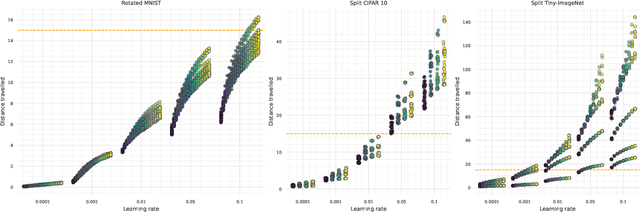
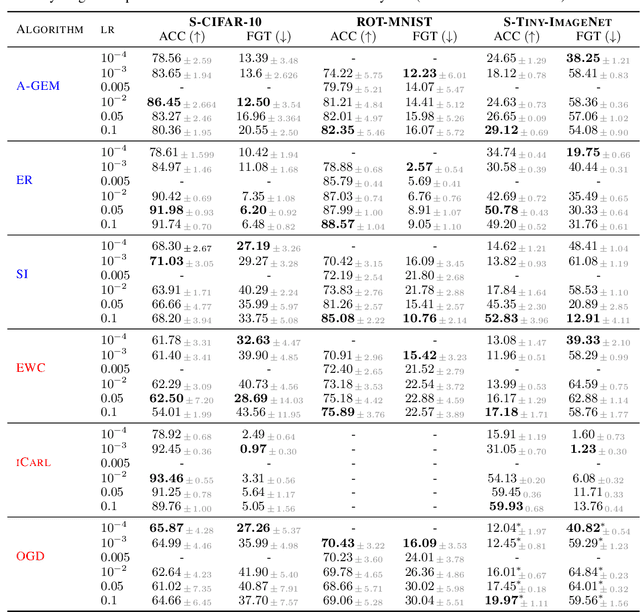
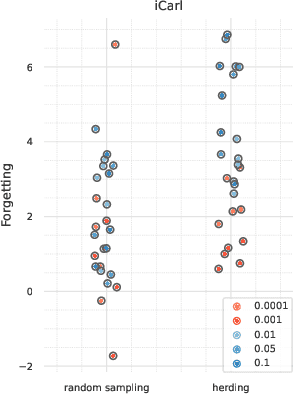

Continual learning is the problem of integrating new information in a model while retaining the knowledge acquired in the past. Despite the tangible improvements achieved in recent years, the problem of continual learning is still an open one. A better understanding of the mechanisms behind the successes and failures of existing continual learning algorithms can unlock the development of new successful strategies. In this work, we view continual learning from the perspective of the multi-task loss approximation, and we compare two alternative strategies, namely local and global approximations. We classify existing continual learning algorithms based on the approximation used, and we assess the practical effects of this distinction in common continual learning settings.Additionally, we study optimal continual learning objectives in the case of local polynomial approximations and we provide examples of existing algorithms implementing the optimal objectives
Towards guarantees for parameter isolation in continual learning
Oct 02, 2023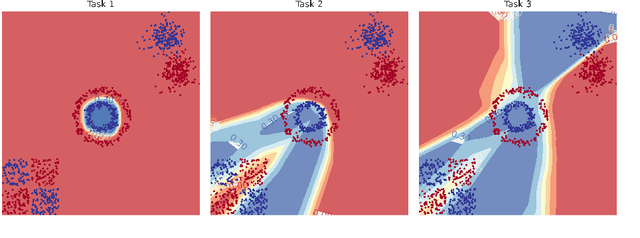

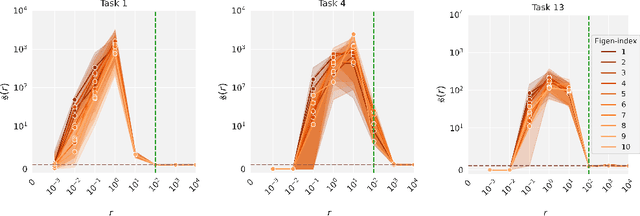
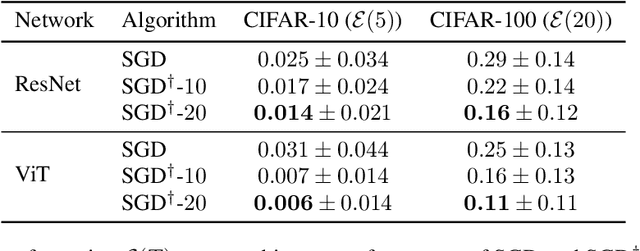
Deep learning has proved to be a successful paradigm for solving many challenges in machine learning. However, deep neural networks fail when trained sequentially on multiple tasks, a shortcoming known as catastrophic forgetting in the continual learning literature. Despite a recent flourish of learning algorithms successfully addressing this problem, we find that provable guarantees against catastrophic forgetting are lacking. In this work, we study the relationship between learning and forgetting by looking at the geometry of neural networks' loss landscape. We offer a unifying perspective on a family of continual learning algorithms, namely methods based on parameter isolation, and we establish guarantees on catastrophic forgetting for some of them.