 Add to Chrome
 Add to Firefox
 Add to Edge
Spline-Based Boundary Representations for Sparse View Reconstruction and Simulation Using Isogeometric Analysis
Jul 28, 2026
Image-based reconstruction aims to recover three-dimensional geometry from images. Recent advances have enabled the recovery of visually detailed models, yet their representations are not well-suited for numerical simulation. Simulation frameworks typically require explicit, watertight, and smooth geometries to ensure numerical robustness and accuracy, properties that surfaces extracted from image-based reconstructions lack. We propose FORGE-SIM, a method to directly reconstruct a multi-patch B-spline boundary representation from sparse posed RGB images without manual intervention. By optimizing the spline representation itself, our approach produces compact, smooth, and watertight geometries that are natively compatible with both Computer Aided Design and simulation workflows. Additionally, we introduce a strategy to project observation-derived fields, such as a thermal state and semantic information, onto the reconstructed models in the same spline basis, enabling immediate use in simulation. We demonstrate that the obtained models are of sufficiently high quality to enable thermal simulation and modal analysis. By unifying image-based reconstruction and simulation-ready modeling within a single optimization framework, this work removes a long-standing barrier between computer vision and numerical analysis. We anticipate that it will enable new workflows for simulation-driven design, inspection, and digital twin applications.

Beyond Thermal Imaging: Inferring Thermophysical Properties from Time-Resolved Thermal Observations
Jul 08, 2026Inferring latent physical properties from sensory observations is a fundamental challenge in machine perception. Among available sensing modalities, thermal imaging is particularly promising because temperature evolution is directly governed by heat-transfer physics and therefore encodes information about underlying thermophysical properties of a scene. Recovering spatially resolved thermophysical properties from thermal observations could transform applications ranging from digital twins and infrastructure monitoring to robotics and scientific imaging. However, existing thermal scene reconstruction methods can recover temperature fields in complex 3D environments without identifying the thermophyiscal properties that govern thermal evolution, whereas inverse methods provide physically interpretable parameter estimation but typically rely on simplified geometries and controlled experimental conditions. Here we introduce ThermoField, a framework that unifies thermal scene reconstruction and thermophysical parameter estimation through differentiable heat-transfer simulation. The proposed framework represents these quantities as spatially varying neural fields and constrains them through scene geometry, governing heat-transfer physics, and temporal thermal observations. We demonstrate that ThermoField jointly reconstructs geometry, estimates spatially varying thermal diffusivity, and predicts thermal evolution under previously unseen environmental conditions. By integrating neural scene representations with differentiable heat-transfer solver, the framework enables physically interpretable parameter inference in complex 3D scenes. Our results establish a bridge between thermal scene reconstruction and inverse heat-transfer analysis, providing a unified approach for geometry reconstruction, thermophysical property estimation, and predictive thermal simulation from thermal observations.
Unpaired RGB-Thermal Gaussian-Splatting Using Visual Geometric Transformers
Jun 03, 2026Multi-modal novel view synthesis (NVS) combining RGB and thermal imagery enables precise 3D scene reconstruction with visual and thermal information. However, existing methods typically rely on precisely calibrated RGB-thermal image pairs or stereo setups, limiting scalability and practical deployment. To address this, we introduce a framework for unpaired RGB-thermal NVS that leverages VGGT, a 3D feed-forward transformer architecture, to independently estimate camera poses for each modality. The pose sets are then aligned using the Procrustes algorithm with a cross-modal feature matcher, enabling joint registration without paired calibration. Building on this alignment, we further propose a multi-modal 3D Gaussian Splatting approach that learns directly from unpaired RGB and thermal images. Experiments on diverse scenes demonstrate that our method achieves competitive performance in thermal view synthesis while maintaining RGB fidelity. Moreover, we show that existing reconstruction approaches can produce modality-specific reconstructions that lack cross-modal consistency. We thus introduce a benchmarking framework to rigorously evaluate both per-modality image synthesis and the multi-modal coherence of reconstructed scenes.
SEAR: Simple and Efficient Adaptation of Visual Geometric Transformers for RGB+Thermal 3D Reconstruction
Mar 19, 2026Foundational feed-forward visual geometry models enable accurate and efficient camera pose estimation and scene reconstruction by learning strong scene priors from massive RGB datasets. However, their effectiveness drops when applied to mixed sensing modalities, such as RGB-thermal (RGB-T) images. We observe that while a visual geometry grounded transformer pretrained on RGB data generalizes well to thermal-only reconstruction, it struggles to align RGB and thermal modalities when processed jointly. To address this, we propose SEAR, a simple yet efficient fine-tuning strategy that adapts a pretrained geometry transformer to multimodal RGB-T inputs. Despite being trained on a relatively small RGB-T dataset, our approach significantly outperforms state-of-the-art methods for 3D reconstruction and camera pose estimation, achieving significant improvements over all metrics (e.g., over 29\% in AUC@30) and delivering higher detail and consistency between modalities with negligible overhead in inference time compared to the original pretrained model. Notably, SEAR enables reliable multimodal pose estimation and reconstruction even under challenging conditions, such as low lighting and dense smoke. We validate our architecture through extensive ablation studies, demonstrating how the model aligns both modalities. Additionally, we introduce a new dataset featuring RGB and thermal sequences captured at different times, viewpoints, and illumination conditions, providing a robust benchmark for future work in multimodal 3D scene reconstruction. Code and models are publicly available at https://www.github.com/Schindler-EPFL-Lab/SEAR.
Dense Dynamic Scene Reconstruction and Camera Pose Estimation from Multi-View Videos
Mar 12, 2026We address the challenging problem of dense dynamic scene reconstruction and camera pose estimation from multiple freely moving cameras -- a setting that arises naturally when multiple observers capture a shared event. Prior approaches either handle only single-camera input or require rigidly mounted, pre-calibrated camera rigs, limiting their practical applicability. We propose a two-stage optimization framework that decouples the task into robust camera tracking and dense depth refinement. In the first stage, we extend single-camera visual SLAM to the multi-camera setting by constructing a spatiotemporal connection graph that exploits both intra-camera temporal continuity and inter-camera spatial overlap, enabling consistent scale and robust tracking. To ensure robustness under limited overlap, we introduce a wide-baseline initialization strategy using feed-forward reconstruction models. In the second stage, we refine depth and camera poses by optimizing dense inter- and intra-camera consistency using wide-baseline optical flow. Additionally, we introduce MultiCamRobolab, a new real-world dataset with ground-truth poses from a motion capture system. Finally, we demonstrate that our method significantly outperforms state-of-the-art feed-forward models on both synthetic and real-world benchmarks, while requiring less memory.
Large-scale visual SLAM for in-the-wild videos
Apr 29, 2025Accurate and robust 3D scene reconstruction from casual, in-the-wild videos can significantly simplify robot deployment to new environments. However, reliable camera pose estimation and scene reconstruction from such unconstrained videos remains an open challenge. Existing visual-only SLAM methods perform well on benchmark datasets but struggle with real-world footage which often exhibits uncontrolled motion including rapid rotations and pure forward movements, textureless regions, and dynamic objects. We analyze the limitations of current methods and introduce a robust pipeline designed to improve 3D reconstruction from casual videos. We build upon recent deep visual odometry methods but increase robustness in several ways. Camera intrinsics are automatically recovered from the first few frames using structure-from-motion. Dynamic objects and less-constrained areas are masked with a predictive model. Additionally, we leverage monocular depth estimates to regularize bundle adjustment, mitigating errors in low-parallax situations. Finally, we integrate place recognition and loop closure to reduce long-term drift and refine both intrinsics and pose estimates through global bundle adjustment. We demonstrate large-scale contiguous 3D models from several online videos in various environments. In contrast, baseline methods typically produce locally inconsistent results at several points, producing separate segments or distorted maps. In lieu of ground-truth pose data, we evaluate map consistency, execution time and visual accuracy of re-rendered NeRF models. Our proposed system establishes a new baseline for visual reconstruction from casual uncontrolled videos found online, demonstrating more consistent reconstructions over longer sequences of in-the-wild videos than previously achieved.
Thermoxels: a voxel-based method to generate simulation-ready 3D thermal models
Apr 06, 2025In the European Union, buildings account for 42% of energy use and 35% of greenhouse gas emissions. Since most existing buildings will still be in use by 2050, retrofitting is crucial for emissions reduction. However, current building assessment methods rely mainly on qualitative thermal imaging, which limits data-driven decisions for energy savings. On the other hand, quantitative assessments using finite element analysis (FEA) offer precise insights but require manual CAD design, which is tedious and error-prone. Recent advances in 3D reconstruction, such as Neural Radiance Fields (NeRF) and Gaussian Splatting, enable precise 3D modeling from sparse images but lack clearly defined volumes and the interfaces between them needed for FEA. We propose Thermoxels, a novel voxel-based method able to generate FEA-compatible models, including both geometry and temperature, from a sparse set of RGB and thermal images. Using pairs of RGB and thermal images as input, Thermoxels represents a scene's geometry as a set of voxels comprising color and temperature information. After optimization, a simple process is used to transform Thermoxels' models into tetrahedral meshes compatible with FEA. We demonstrate Thermoxels' capability to generate RGB+Thermal meshes of 3D scenes, surpassing other state-of-the-art methods. To showcase the practical applications of Thermoxels' models, we conduct a simple heat conduction simulation using FEA, achieving convergence from an initial state defined by Thermoxels' thermal reconstruction. Additionally, we compare Thermoxels' image synthesis abilities with current state-of-the-art methods, showing competitive results, and discuss the limitations of existing metrics in assessing mesh quality.
Exploiting Semantic Scene Reconstruction for Estimating Building Envelope Characteristics
Oct 29, 2024Achieving the EU's climate neutrality goal requires retrofitting existing buildings to reduce energy use and emissions. A critical step in this process is the precise assessment of geometric building envelope characteristics to inform retrofitting decisions. Previous methods for estimating building characteristics, such as window-to-wall ratio, building footprint area, and the location of architectural elements, have primarily relied on applying deep-learning-based detection or segmentation techniques on 2D images. However, these approaches tend to focus on planar facade properties, limiting their accuracy and comprehensiveness when analyzing complete building envelopes in 3D. While neural scene representations have shown exceptional performance in indoor scene reconstruction, they remain under-explored for external building envelope analysis. This work addresses this gap by leveraging cutting-edge neural surface reconstruction techniques based on signed distance function (SDF) representations for 3D building analysis. We propose BuildNet3D, a novel framework to estimate geometric building characteristics from 2D image inputs. By integrating SDF-based representation with semantic modality, BuildNet3D recovers fine-grained 3D geometry and semantics of building envelopes, which are then used to automatically extract building characteristics. Our framework is evaluated on a range of complex building structures, demonstrating high accuracy and generalizability in estimating window-to-wall ratio and building footprint. The results underscore the effectiveness of BuildNet3D for practical applications in building analysis and retrofitting.
High-Fidelity SLAM Using Gaussian Splatting with Rendering-Guided Densification and Regularized Optimization
Mar 19, 2024
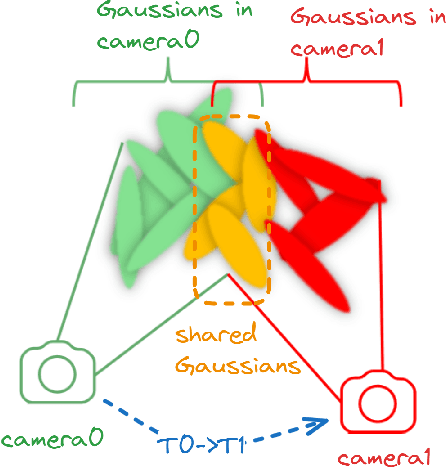
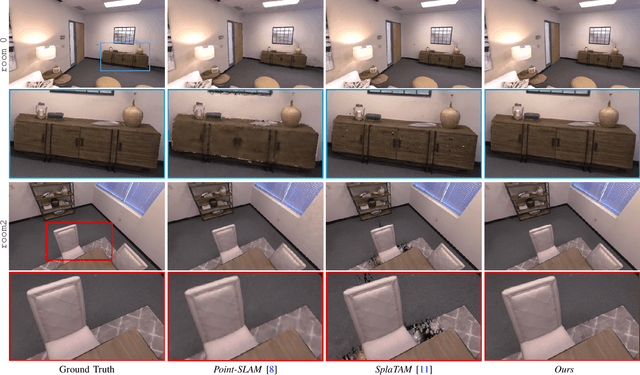
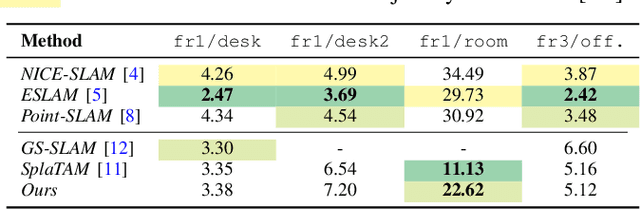
We propose a dense RGBD SLAM system based on 3D Gaussian Splatting that provides metrically accurate pose tracking and visually realistic reconstruction. To this end, we first propose a Gaussian densification strategy based on the rendering loss to map unobserved areas and refine reobserved areas. Second, we introduce extra regularization parameters to alleviate the forgetting problem in the continuous mapping problem, where parameters tend to overfit the latest frame and result in decreasing rendering quality for previous frames. Both mapping and tracking are performed with Gaussian parameters by minimizing re-rendering loss in a differentiable way. Compared to recent neural and concurrently developed gaussian splatting RGBD SLAM baselines, our method achieves state-of-the-art results on the synthetic dataset Replica and competitive results on the real-world dataset TUM.
ThermoNeRF: Multimodal Neural Radiance Fields for Thermal Novel View Synthesis
Mar 18, 2024Thermal scene reconstruction exhibit great potential for applications across a broad spectrum of fields, including building energy consumption analysis and non-destructive testing. However, existing methods typically require dense scene measurements and often rely on RGB images for 3D geometry reconstruction, with thermal information being projected post-reconstruction. This two-step strategy, adopted due to the lack of texture in thermal images, can lead to disparities between the geometry and temperatures of the reconstructed objects and those of the actual scene. To address this challenge, we propose ThermoNeRF, a novel multimodal approach based on Neural Radiance Fields, capable of rendering new RGB and thermal views of a scene jointly. To overcome the lack of texture in thermal images, we use paired RGB and thermal images to learn scene density, while distinct networks estimate color and temperature information. Furthermore, we introduce ThermoScenes, a new dataset to palliate the lack of available RGB+thermal datasets for scene reconstruction. Experimental results validate that ThermoNeRF achieves accurate thermal image synthesis, with an average mean absolute error of 1.5$^\circ$C, an improvement of over 50% compared to using concatenated RGB+thermal data with Nerfacto, a state-of-the-art NeRF method.