 Add to Chrome
 Add to Firefox
 Add to Edge
PixSDS: Why Latent SDS Makes Noisy Pixels
Aug 13, 2026
Score Distillation Sampling (SDS) enables text-to-3D generation by optimizing rendered images with a pretrained diffusion prior, but latent SDS often produces structured color artifacts and high-frequency texture noise. We identify a failure mode of latent SDS caused by VAE-induced pixel drift: the optimized image can move along pixel-space directions that are weakly constrained by the VAE encoder, so its latent representation remains clean and semantically meaningful while the image itself accumulates visible artifacts. We support this diagnosis with controlled 2D SDS experiments, VAE-only optimization, and a simplified analysis showing that encoder-like latent objectives can amplify image-space noise when the inverse mapping to pixels is underconstrained. Motivated by this observation, we propose PixSDS, a lightweight VAE-consistent gradient repair method. PixSDS decodes a latent SDS lookahead step and uses the decoded image as a clean direction for pixel-space optimization, reducing motion in VAE-inconsistent directions without retraining the diffusion model, changing the renderer, or replacing the SDS objective. Experiments in 2D optimization and text-to-3D generation show that PixSDS substantially reduces structured artifacts while preserving semantic content. Code is publicly available at https://sevashasla.github.io/pixsds-webpage/.

Spline-Based Boundary Representations for Sparse View Reconstruction and Simulation Using Isogeometric Analysis
Jul 28, 2026Image-based reconstruction aims to recover three-dimensional geometry from images. Recent advances have enabled the recovery of visually detailed models, yet their representations are not well-suited for numerical simulation. Simulation frameworks typically require explicit, watertight, and smooth geometries to ensure numerical robustness and accuracy, properties that surfaces extracted from image-based reconstructions lack. We propose FORGE-SIM, a method to directly reconstruct a multi-patch B-spline boundary representation from sparse posed RGB images without manual intervention. By optimizing the spline representation itself, our approach produces compact, smooth, and watertight geometries that are natively compatible with both Computer Aided Design and simulation workflows. Additionally, we introduce a strategy to project observation-derived fields, such as a thermal state and semantic information, onto the reconstructed models in the same spline basis, enabling immediate use in simulation. We demonstrate that the obtained models are of sufficiently high quality to enable thermal simulation and modal analysis. By unifying image-based reconstruction and simulation-ready modeling within a single optimization framework, this work removes a long-standing barrier between computer vision and numerical analysis. We anticipate that it will enable new workflows for simulation-driven design, inspection, and digital twin applications.
SEAR: Simple and Efficient Adaptation of Visual Geometric Transformers for RGB+Thermal 3D Reconstruction
Mar 19, 2026Foundational feed-forward visual geometry models enable accurate and efficient camera pose estimation and scene reconstruction by learning strong scene priors from massive RGB datasets. However, their effectiveness drops when applied to mixed sensing modalities, such as RGB-thermal (RGB-T) images. We observe that while a visual geometry grounded transformer pretrained on RGB data generalizes well to thermal-only reconstruction, it struggles to align RGB and thermal modalities when processed jointly. To address this, we propose SEAR, a simple yet efficient fine-tuning strategy that adapts a pretrained geometry transformer to multimodal RGB-T inputs. Despite being trained on a relatively small RGB-T dataset, our approach significantly outperforms state-of-the-art methods for 3D reconstruction and camera pose estimation, achieving significant improvements over all metrics (e.g., over 29\% in AUC@30) and delivering higher detail and consistency between modalities with negligible overhead in inference time compared to the original pretrained model. Notably, SEAR enables reliable multimodal pose estimation and reconstruction even under challenging conditions, such as low lighting and dense smoke. We validate our architecture through extensive ablation studies, demonstrating how the model aligns both modalities. Additionally, we introduce a new dataset featuring RGB and thermal sequences captured at different times, viewpoints, and illumination conditions, providing a robust benchmark for future work in multimodal 3D scene reconstruction. Code and models are publicly available at https://www.github.com/Schindler-EPFL-Lab/SEAR.
D3DR: Lighting-Aware Object Insertion in Gaussian Splatting
Mar 09, 2025Gaussian Splatting has become a popular technique for various 3D Computer Vision tasks, including novel view synthesis, scene reconstruction, and dynamic scene rendering. However, the challenge of natural-looking object insertion, where the object's appearance seamlessly matches the scene, remains unsolved. In this work, we propose a method, dubbed D3DR, for inserting a 3DGS-parametrized object into 3DGS scenes while correcting its lighting, shadows, and other visual artifacts to ensure consistency, a problem that has not been successfully addressed before. We leverage advances in diffusion models, which, trained on real-world data, implicitly understand correct scene lighting. After inserting the object, we optimize a diffusion-based Delta Denoising Score (DDS)-inspired objective to adjust its 3D Gaussian parameters for proper lighting correction. Utilizing diffusion model personalization techniques to improve optimization quality, our approach ensures seamless object insertion and natural appearance. Finally, we demonstrate the method's effectiveness by comparing it to existing approaches, achieving 0.5 PSNR and 0.15 SSIM improvements in relighting quality.
uSF: Learning Neural Semantic Field with Uncertainty
Dec 13, 2023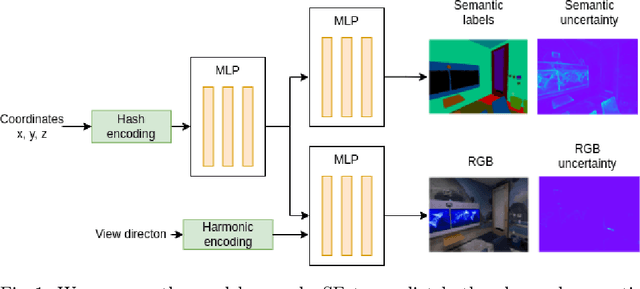
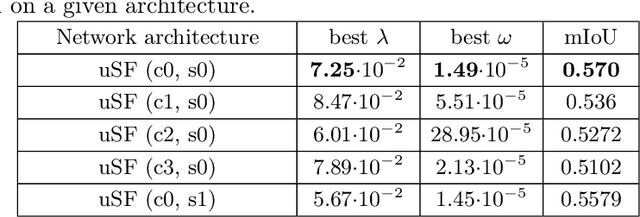
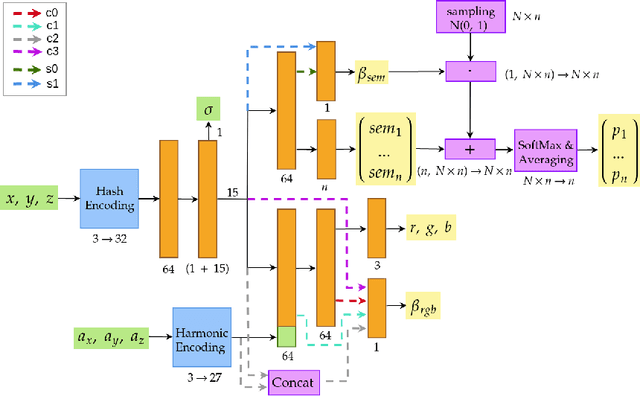
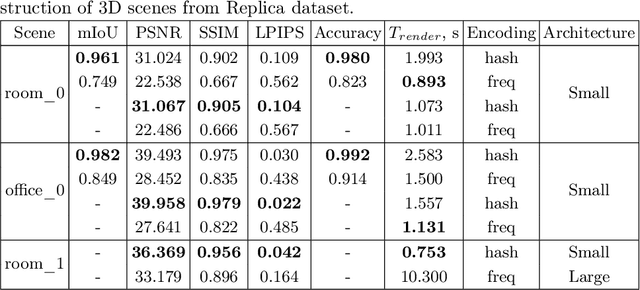
Recently, there has been an increased interest in NeRF methods which reconstruct differentiable representation of three-dimensional scenes. One of the main limitations of such methods is their inability to assess the confidence of the model in its predictions. In this paper, we propose a new neural network model for the formation of extended vector representations, called uSF, which allows the model to predict not only color and semantic label of each point, but also estimate the corresponding values of uncertainty. We show that with a small number of images available for training, a model quantifying uncertainty performs better than a model without such functionality. Code of the uSF approach is publicly available at https://github.com/sevashasla/usf/.