 Add to Chrome
 Add to Firefox
 Add to Edge
How You Move Tells What You'll Do: Trajectory-Conditioned Egocentric Prediction
May 19, 2026
Predicting how a person's first-person view will evolve (what action will follow, what plan completes a task, whether an in-progress shot will score) is fundamentally under-specified: the same context admits many plausible futures, and a model trained to minimize prediction error is forced to hedge or average across them, getting it wrong either way. Two findings shape our approach. First, the future camera trajectory, the path the head carves through space, lets the model commit to one of those futures: it carries the operator's intent in a form fine enough to determine how an action will unfold, substantially outperforming language as a conditioning signal. Second, this same intent makes the trajectory itself partially predictable from the context at hand, enough that trajectory need not be observed at test time to recover most of the gain. We instantiate these findings as TrajPilot, a model that predicts candidate future trajectories from egocentric context and uses them to pilot action prediction in an action-aligned embedding space where language shapes the structure but is never used as a conditioning input. TrajPilot beats VLM and structured-planner baselines on procedural planning across Ego-Exo4D atomic, Ego-Exo4D Keystep, Ego4D GoalStep, and EgoPER, with the trajectory advantage widening with horizon (exactly where prior planners collapse) and holding under RGB-only camera-pose estimation. With the goal masked at inference, the same model performs goal-free anticipation, beating VLM baselines on Ego-Exo4D atomic and extending to EPIC-Kitchens-100 and basketball shot-outcome prediction.

RECIPE: Procedural Planning via Grounding in Instructional Video
May 19, 2026Visual planning asks a model to generate the remaining steps of a procedure in natural language given a partial video context and a goal. Progress on this task is bottlenecked by annotation: clean labeled datasets are small, domain-narrow, and encode a single execution trajectory per example, even though many valid orderings exist. Large-scale instructional video corpora offer orders of magnitude more procedural content, but supervised fine-tuning on pseudo-labels from their noisy ASR narrations propagates segmentation and alignment errors and stays single-trajectory. We identify a key asymmetry: extracting clean step labels from noisy video is hard, but verifying whether a generated step sequence is temporally grounded in ASR transcripts is cheap and scales to millions of videos via precomputed text embeddings. We exploit this asymmetry in RECIPE, which uses grounding quality as a reward for GRPO, turning the noisy corpus into a verifier rather than a label source. The framework applies uniformly to two planner input configurations (Socratic, with a textual history extracted by a frozen VLM, and Video, consuming video tokens directly) and to annotated and weakly supervised regimes. We evaluate on 7 procedural benchmarks using a reference-based LLM-as-judge protocol scoring plans across 6 procedural criteria. RECIPE-RL improves over the base checkpoint at all scales (0.5B, 3B, 7B) and every benchmark, with macro-accuracy gains of +7 to +8 points in-domain and up to +16 points zero-shot. It outperforms supervised fine-tuning on both annotated and pseudo-labeled plans (the latter degrades the base) and remains robust without human annotations. Used as the proposal stage of a prior propose-assess-search planner, it improves over the strongest zero-shot baseline at every horizon on Visual Planning for Assistance, and on COIN it preserves the generation diversity that SFT collapses.
ViterbiPlanNet: Injecting Procedural Knowledge via Differentiable Viterbi for Planning in Instructional Videos
Mar 04, 2026Procedural planning aims to predict a sequence of actions that transforms an initial visual state into a desired goal, a fundamental ability for intelligent agents operating in complex environments. Existing approaches typically rely on large-scale models that learn procedural structures implicitly, resulting in limited sample-efficiency and high computational cost. In this work we introduce ViterbiPlanNet, a principled framework that explicitly integrates procedural knowledge into the learning process through a Differentiable Viterbi Layer (DVL). The DVL embeds a Procedural Knowledge Graph (PKG) directly with the Viterbi decoding algorithm, replacing non-differentiable operations with smooth relaxations that enable end-to-end optimization. This design allows the model to learn through graph-based decoding. Experiments on CrossTask, COIN, and NIV demonstrate that ViterbiPlanNet achieves state-of-the-art performance with an order of magnitude fewer parameters than diffusion- and LLM-based planners. Extensive ablations show that performance gains arise from our differentiable structure-aware training rather than post-hoc refinement, resulting in improved sample efficiency and robustness to shorter unseen horizons. We also address testing inconsistencies establishing a unified testing protocol with consistent splits and evaluation metrics. With this new protocol, we run experiments multiple times and report results using bootstrapping to assess statistical significance.
Task Graph Maximum Likelihood Estimation for Procedural Activity Understanding in Egocentric Videos
Feb 26, 2025We introduce a gradient-based approach for learning task graphs from procedural activities, improving over hand-crafted methods. Our method directly optimizes edge weights via maximum likelihood, enabling integration into neural architectures. We validate our approach on CaptainCook4D, EgoPER, and EgoProceL, achieving +14.5%, +10.2%, and +13.6% F1-score improvements. Our feature-based approach for predicting task graphs from textual/video embeddings demonstrates emerging video understanding abilities. We also achieved top performance on the procedure understanding benchmark on Ego-Exo4D and significantly improved online mistake detection (+19.8% on Assembly101-O, +6.4% on EPIC-Tent-O). Code: https://github.com/fpv-iplab/Differentiable-Task-Graph-Learning.
Differentiable Task Graph Learning: Procedural Activity Representation and Online Mistake Detection from Egocentric Videos
Jun 03, 2024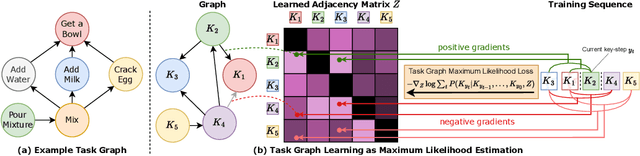
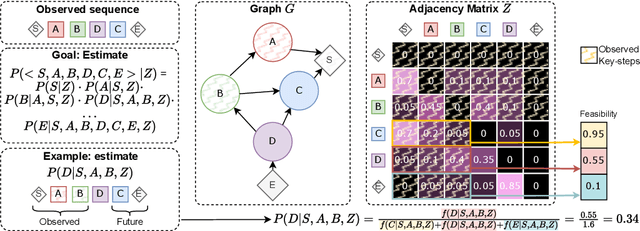
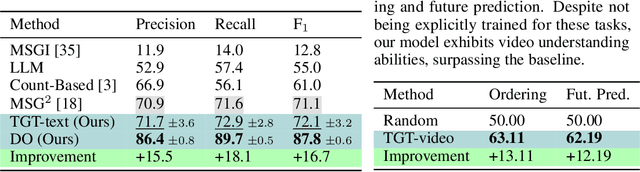
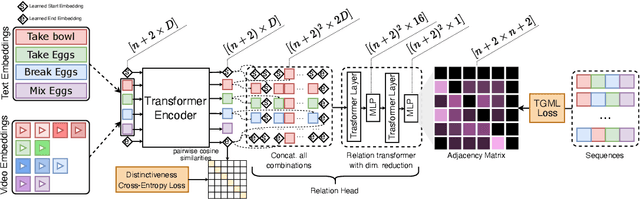
Procedural activities are sequences of key-steps aimed at achieving specific goals. They are crucial to build intelligent agents able to assist users effectively. In this context, task graphs have emerged as a human-understandable representation of procedural activities, encoding a partial ordering over the key-steps. While previous works generally relied on hand-crafted procedures to extract task graphs from videos, in this paper, we propose an approach based on direct maximum likelihood optimization of edges' weights, which allows gradient-based learning of task graphs and can be naturally plugged into neural network architectures. Experiments on the CaptainCook4D dataset demonstrate the ability of our approach to predict accurate task graphs from the observation of action sequences, with an improvement of +16.7% over previous approaches. Owing to the differentiability of the proposed framework, we also introduce a feature-based approach, aiming to predict task graphs from key-step textual or video embeddings, for which we observe emerging video understanding abilities. Task graphs learned with our approach are also shown to significantly enhance online mistake detection in procedural egocentric videos, achieving notable gains of +19.8% and +7.5% on the Assembly101 and EPIC-Tent datasets. Code for replicating experiments is available at https://github.com/fpv-iplab/Differentiable-Task-Graph-Learning.
Ego-Exo4D: Understanding Skilled Human Activity from First- and Third-Person Perspectives
Nov 30, 2023
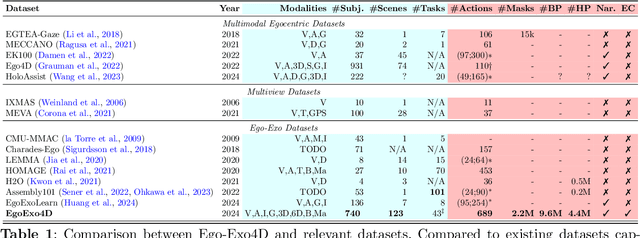

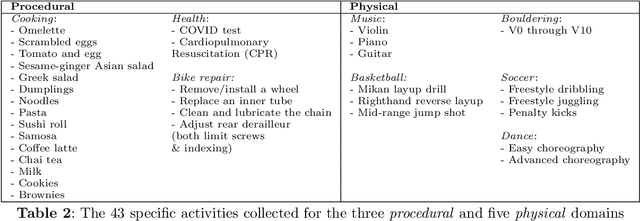
We present Ego-Exo4D, a diverse, large-scale multimodal multiview video dataset and benchmark challenge. Ego-Exo4D centers around simultaneously-captured egocentric and exocentric video of skilled human activities (e.g., sports, music, dance, bike repair). More than 800 participants from 13 cities worldwide performed these activities in 131 different natural scene contexts, yielding long-form captures from 1 to 42 minutes each and 1,422 hours of video combined. The multimodal nature of the dataset is unprecedented: the video is accompanied by multichannel audio, eye gaze, 3D point clouds, camera poses, IMU, and multiple paired language descriptions -- including a novel "expert commentary" done by coaches and teachers and tailored to the skilled-activity domain. To push the frontier of first-person video understanding of skilled human activity, we also present a suite of benchmark tasks and their annotations, including fine-grained activity understanding, proficiency estimation, cross-view translation, and 3D hand/body pose. All resources will be open sourced to fuel new research in the community.