 Add to Chrome
 Add to Firefox
 Add to Edge
FLaRA: Predicting Future Latent Representations for Accident Anticipation
Jun 12, 2026
Anticipating traffic accidents from dashcam videos is a critical challenge in intelligent transportation systems. Existing methods typically map visual context directly to a collision probability without explicitly modeling the future evolution of the driving scene. In this paper we propose FLaRA (Predicting Future Latent Representations for Accident Anticipation), a novel predictive architecture that shifts this paradigm by forecasting future latent representations for accident anticipation. Building upon the Video Joint-Embedding Predictive Architecture (V-JEPA2), our model conditions a predictor network on observed context frames to predict the forthcoming latent features of the scene. A classifier then operates on these predicted future representations rather than only on past observations. To ensure these forecasts remain grounded in realistic future dynamics, we introduce a joint training objective that simultaneously optimizes an auxiliary feature-level reconstruction loss and a cross-entropy classification loss. Extensive evaluations on the Nexar dataset, alongside cross-domain validations on the DAD, DADA-2000, and DoTA benchmarks, demonstrate that our approach achieves state-of-the-art performance while maintaining realistic early warning capabilities.

ARC-RL: A Reinforcement Learning Playground Inspired by ARC Raiders
May 20, 2026Reinforcement learning for legged locomotion has matured into a stack of multi-component reward functions and physics-engine benchmarks whose morphologies are uniformly derived from real commercial hardware. Game NPCs, however, are bound by stylistic constraints absent from sim-to-real robotics and routinely take the form of creatures with no real-robot counterpart. We introduce ARC-RL, a suite of four MuJoCo continuous-control environments featuring robotic morphologies inspired by the bestiary of ARC Raiders: the 18-DoF tall hexapod Queen, the 12-DoF armoured hexapod Bastion, the 18-DoF compact hexapod Tick, and the 12-DoF quadruped Leaper. All four robots share a unified observation template, action convention, simulation cadence, and a single closed-form multi-component reward function whose only per-morphology variation lives in a small set of weights and parameters. The reward fuses a velocity-tracking tent, a healthy survive bonus, a phase-locked gait-compliance bonus/cost pair, action regularisers, three safety penalties, and a posture anchor; no motion-capture data enters the reward at any point. We additionally provide hand-crafted Central Pattern Generator demonstrators per morphology, which serve both as fixed expert references and as sources of prior data for offline-to-online training. On this playground, we conduct a controlled empirical study comparing standard online algorithms (SAC, SPEQ, SOPE-EO) and methods augmented with prior data (SACfD, SPEQ-O2O, SOPE), and characterise how each paradigm copes with the playground's morphological diversity and animation-style stylistic constraints. Source code is available at https://github.com/CarloRomeo427/ARC_RL.git.
SOPE: Stabilizing Off-Policy Evaluation for Online RL with Prior Data
May 07, 2026Incorporating prior data into online reinforcement learning accelerates training but typically forces a difficult trade-off between high computational costs and long, multi-stage training pipelines. While fixed-length stabilization phases are significantly more computationally efficient than static update schedules, they require task-dependent manual tuning, risking either the waste of prior knowledge or severe overfitting. To address this, we propose SOPE, an algorithm that uses an actor-aligned Off-Policy Policy Evaluation (OPE) signal as an automated early-stopping mechanism to dynamically control the length of offline training phases. By evaluating the critic on a held-out validation split under the current policy's action distribution, SOPE halts gradient updates exactly when out-of-distribution benefits saturate, eliminating the need for manual schedule tuning. Evaluated on 25 continuous control tasks from the Minari benchmark suite, SOPE improves baseline performance by up to 45.6% while reducing the required TFLOPs by up to 22x, thus balancing the tradeoff between sample and computational efficiency. These findings demonstrate that adaptive, evaluation-driven update schedules are more effective than relying on static, exhaustive update schedules.
Preventing Latent Rehearsal Decay in Online Continual SSL with SOLAR
Apr 12, 2026This paper explores Online Continual Self-Supervised Learning (OCSSL), a scenario in which models learn from continuous streams of unlabeled, non-stationary data, where methods typically employ replay and fast convergence is a central desideratum. We find that OCSSL requires particular attention to the stability-plasticity trade-off: stable methods (e.g. replay with Reservoir sampling) are able to converge faster compared to plastic ones (e.g. FIFO buffer), but incur in performance drops under certain conditions. We explain this collapse phenomenon with the Latent Rehearsal Decay hypothesis, which attributes it to latent space degradation under excessive stability of replay. We introduce two metrics (Overlap and Deviation) that diagnose latent degradation and correlate with accuracy declines. Building on these insights, we propose SOLAR, which leverages efficient online proxies of Deviation to guide buffer management and incorporates an explicit Overlap loss, allowing SOLAR to adaptively managing plasticity. Experiments demonstrate that SOLAR achieves state-of-the-art performance on OCSSL vision benchmarks, with both high convergence speed and final performance.
Cross-Modal Prototype Alignment and Mixing for Training-Free Few-Shot Classification
Mar 25, 2026Vision-language models (VLMs) like CLIP are trained with the objective of aligning text and image pairs. To improve CLIP-based few-shot image classification, recent works have observed that, along with text embeddings, image embeddings from the training set are an important source of information. In this work we investigate the impact of directly mixing image and text prototypes for few-shot classification and analyze this from a bias-variance perspective. We show that mixing prototypes acts like a shrinkage estimator. Although mixed prototypes improve classification performance, the image prototypes still add some noise in the form of instance-specific background or context information. In order to capture only information from the image space relevant to the given classification task, we propose projecting image prototypes onto the principal directions of the semantic text embedding space to obtain a text-aligned semantic image subspace. These text-aligned image prototypes, when mixed with text embeddings, further improve classification. However, for downstream datasets with poor cross-modal alignment in CLIP, semantic alignment might be suboptimal. We show that the image subspace can still be leveraged by modeling the anisotropy using class covariances. We demonstrate that combining a text-aligned mixed prototype classifier and an image-specific LDA classifier outperforms existing methods across few-shot classification benchmarks.
IsoCLIP: Decomposing CLIP Projectors for Efficient Intra-modal Alignment
Mar 20, 2026Vision-Language Models like CLIP are extensively used for inter-modal tasks which involve both visual and text modalities. However, when the individual modality encoders are applied to inherently intra-modal tasks like image-to-image retrieval, their performance suffers from the intra-modal misalignment. In this paper we study intra-modal misalignment in CLIP with a focus on the role of the projectors that map pre-projection image and text embeddings into the shared embedding space. By analyzing the form of the cosine similarity applied to projected features, and its interaction with the contrastive CLIP loss, we show that there is an inter-modal operator responsible for aligning the two modalities during training, and a second, intra-modal operator that only enforces intra-modal normalization but does nothing to promote intra-modal alignment. Via spectral analysis of the inter-modal operator, we identify an approximately isotropic subspace in which the two modalities are well-aligned, as well as anisotropic directions specific to each modality. We demonstrate that this aligned subspace can be directly obtained from the projector weights and that removing the anisotropic directions improves intra-modal alignment. Our experiments on intra-modal retrieval and classification benchmarks show that our training-free method reduces intra-modal misalignment, greatly lowers latency, and outperforms existing approaches across multiple pre-trained CLIP-like models. The code is publicly available at: https://github.com/simomagi/IsoCLIP.
Modular Memory is the Key to Continual Learning Agents
Mar 02, 2026Foundation models have transformed machine learning through large-scale pretraining and increased test-time compute. Despite surpassing human performance in several domains, these models remain fundamentally limited in continuous operation, experience accumulation, and personalization, capabilities that are central to adaptive intelligence. While continual learning research has long targeted these goals, its historical focus on in-weight learning (IWL), i.e., updating a single model's parameters to absorb new knowledge, has rendered catastrophic forgetting a persistent challenge. Our position is that combining the strengths of In-Weight Learning (IWL) and the newly emerged capabilities of In-Context Learning (ICL) through the design of modular memory is the missing piece for continual adaptation at scale. We outline a conceptual framework for modular memory-centric architectures that leverage ICL for rapid adaptation and knowledge accumulation, and IWL for stable updates to model capabilities, charting a practical roadmap toward continually learning agents.
SpectralGCD: Spectral Concept Selection and Cross-modal Representation Learning for Generalized Category Discovery
Feb 19, 2026Generalized Category Discovery (GCD) aims to identify novel categories in unlabeled data while leveraging a small labeled subset of known classes. Training a parametric classifier solely on image features often leads to overfitting to old classes, and recent multimodal approaches improve performance by incorporating textual information. However, they treat modalities independently and incur high computational cost. We propose SpectralGCD, an efficient and effective multimodal approach to GCD that uses CLIP cross-modal image-concept similarities as a unified cross-modal representation. Each image is expressed as a mixture over semantic concepts from a large task-agnostic dictionary, which anchors learning to explicit semantics and reduces reliance on spurious visual cues. To maintain the semantic quality of representations learned by an efficient student, we introduce Spectral Filtering which exploits a cross-modal covariance matrix over the softmaxed similarities measured by a strong teacher model to automatically retain only relevant concepts from the dictionary. Forward and reverse knowledge distillation from the same teacher ensures that the cross-modal representations of the student remain both semantically sufficient and well-aligned. Across six benchmarks, SpectralGCD delivers accuracy comparable to or significantly superior to state-of-the-art methods at a fraction of the computational cost. The code is publicly available at: https://github.com/miccunifi/SpectralGCD.
No MoCap Needed: Post-Training Motion Diffusion Models with Reinforcement Learning using Only Textual Prompts
Oct 08, 2025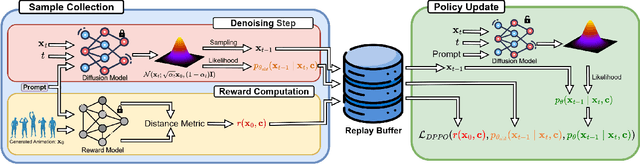
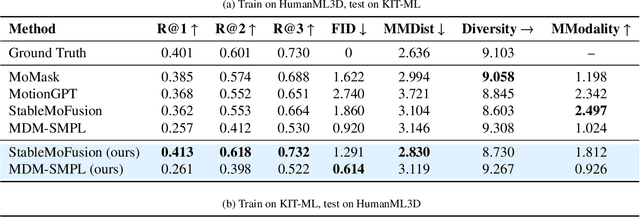
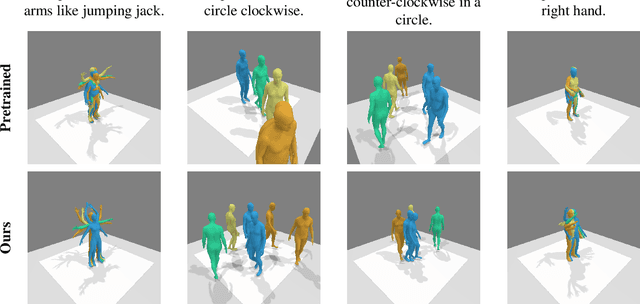
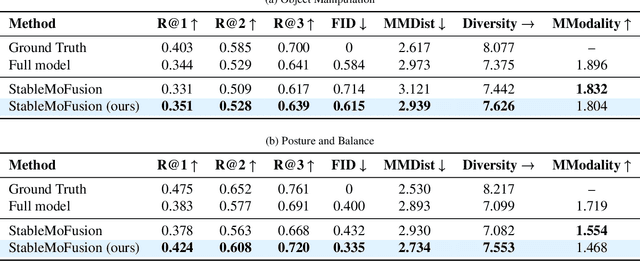
Diffusion models have recently advanced human motion generation, producing realistic and diverse animations from textual prompts. However, adapting these models to unseen actions or styles typically requires additional motion capture data and full retraining, which is costly and difficult to scale. We propose a post-training framework based on Reinforcement Learning that fine-tunes pretrained motion diffusion models using only textual prompts, without requiring any motion ground truth. Our approach employs a pretrained text-motion retrieval network as a reward signal and optimizes the diffusion policy with Denoising Diffusion Policy Optimization, effectively shifting the model's generative distribution toward the target domain without relying on paired motion data. We evaluate our method on cross-dataset adaptation and leave-one-out motion experiments using the HumanML3D and KIT-ML datasets across both latent- and joint-space diffusion architectures. Results from quantitative metrics and user studies show that our approach consistently improves the quality and diversity of generated motions, while preserving performance on the original distribution. Our approach is a flexible, data-efficient, and privacy-preserving solution for motion adaptation.
NTRL: Encounter Generation via Reinforcement Learning for Dynamic Difficulty Adjustment in Dungeons and Dragons
Jun 24, 2025Balancing combat encounters in Dungeons & Dragons (D&D) is a complex task that requires Dungeon Masters (DM) to manually assess party strength, enemy composition, and dynamic player interactions while avoiding interruption of the narrative flow. In this paper, we propose Encounter Generation via Reinforcement Learning (NTRL), a novel approach that automates Dynamic Difficulty Adjustment (DDA) in D&D via combat encounter design. By framing the problem as a contextual bandit, NTRL generates encounters based on real-time party members attributes. In comparison with classic DM heuristics, NTRL iteratively optimizes encounters to extend combat longevity (+200%), increases damage dealt to party members, reducing post-combat hit points (-16.67%), and raises the number of player deaths while maintaining low total party kills (TPK). The intensification of combat forces players to act wisely and engage in tactical maneuvers, even though the generated encounters guarantee high win rates (70%). Even in comparison with encounters designed by human Dungeon Masters, NTRL demonstrates superior performance by enhancing the strategic depth of combat while increasing difficulty in a manner that preserves overall game fairness.