 Add to Chrome
 Add to Firefox
 Add to Edge
Multi-sensory Anti-collision Design for Autonomous Nano-swarm Exploration
Dec 20, 2023
This work presents a multi-sensory anti-collision system design to achieve robust autonomous exploration capabilities for a swarm of 10 cm-side nano-drones operating on object detection missions. We combine lightweight single-beam laser ranging to avoid proximity collisions with a long-range vision-based obstacle avoidance deep learning model (i.e., PULP-Dronet) and an ultra-wide-band (UWB) based ranging module to prevent intra-swarm collisions. An in-field study shows that our multisensory approach can prevent collisions with static obstacles, improving the mission success rate from 20% to 80% in cluttered environments w.r.t. a State-of-the-Art (SoA) baseline. At the same time, the UWB-based sub-system shows a 92.8% success rate in preventing collisions between drones of a four-agent fleet within a safety distance of 65 cm. On a SoA robotic platform extended by a GAP8 multi-core processor, the PULP-Dronet runs interleaved with an objected detection task, which constraints its execution at 1.6 frame/s. This throughput is sufficient for avoiding obstacles with a probability of about 40% but shows a need for more capable processors for the next-generation nano-drone swarms.

TCNCA: Temporal Convolution Network with Chunked Attention for Scalable Sequence Processing
Dec 09, 2023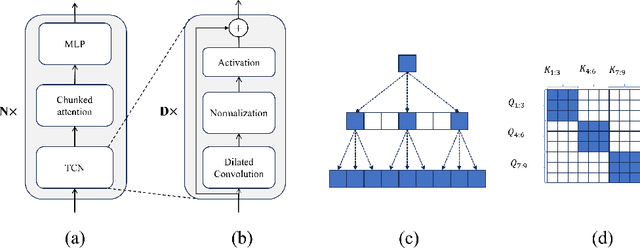

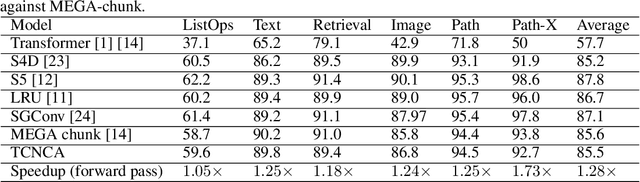

MEGA is a recent transformer-based architecture, which utilizes a linear recurrent operator whose parallel computation, based on the FFT, scales as $O(LlogL)$, with $L$ being the sequence length. We build upon their approach by replacing the linear recurrence with a special temporal convolutional network which permits larger receptive field size with shallower networks, and reduces the computational complexity to $O(L)$. The resulting model is called TCNCA, a Temporal Convolutional Network with Chunked Attention. We evaluate TCNCA on EnWik8 language modeling, long-range-arena (LRA) sequence classification, as well as a synthetic reasoning benchmark associative recall. On EnWik8, TCNCA outperforms MEGA, reaching a lower loss with $1.37\times$/$1.24\times$ faster forward/backward pass during training. The dilated convolutions used in TCNCA are consistently and significantly faster operations than the FFT-based parallelized recurrence in GPUs, making them a scalable candidate for handling very large sequence lengths: they are up to $7.07\times$/$2.86\times$ faster in the forward/backward pass for sequences up to 131k. Further on LRA, TCNCA achieves, on average, $1.28\times$ speed-up during inference with similar accuracy to what MEGA achieves. On associative recall, we find that even a simplified version of TCNCA, without excessive multiplicative and additive interactions, remains superior or competitive to MEGA on a range of sequence lengths and vocabulary sizes.
MIMONets: Multiple-Input-Multiple-Output Neural Networks Exploiting Computation in Superposition
Dec 05, 2023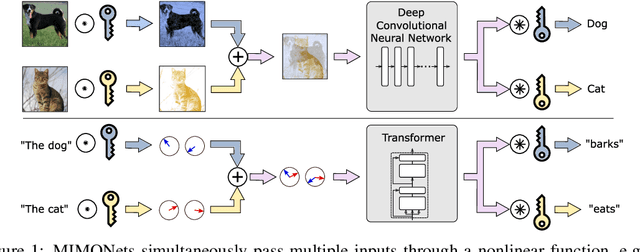
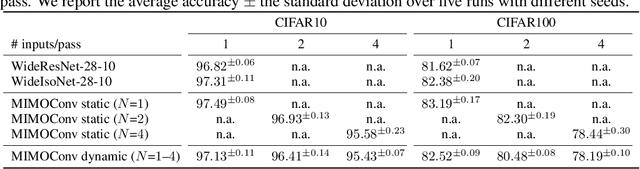
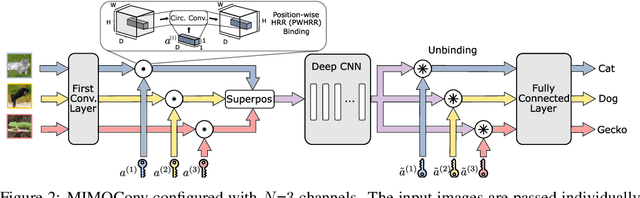
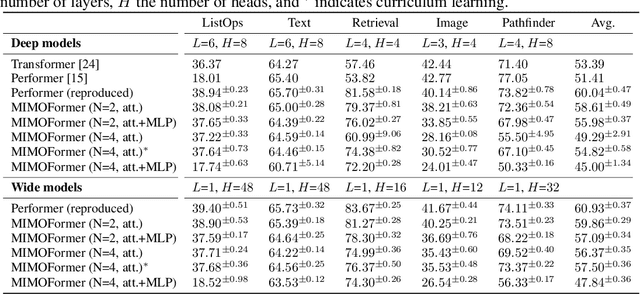
With the advent of deep learning, progressively larger neural networks have been designed to solve complex tasks. We take advantage of these capacity-rich models to lower the cost of inference by exploiting computation in superposition. To reduce the computational burden per input, we propose Multiple-Input-Multiple-Output Neural Networks (MIMONets) capable of handling many inputs at once. MIMONets augment various deep neural network architectures with variable binding mechanisms to represent an arbitrary number of inputs in a compositional data structure via fixed-width distributed representations. Accordingly, MIMONets adapt nonlinear neural transformations to process the data structure holistically, leading to a speedup nearly proportional to the number of superposed input items in the data structure. After processing in superposition, an unbinding mechanism recovers each transformed input of interest. MIMONets also provide a dynamic trade-off between accuracy and throughput by an instantaneous on-demand switching between a set of accuracy-throughput operating points, yet within a single set of fixed parameters. We apply the concept of MIMONets to both CNN and Transformer architectures resulting in MIMOConv and MIMOFormer, respectively. Empirical evaluations show that MIMOConv achieves about 2-4 x speedup at an accuracy delta within [+0.68, -3.18]% compared to WideResNet CNNs on CIFAR10 and CIFAR100. Similarly, MIMOFormer can handle 2-4 inputs at once while maintaining a high average accuracy within a [-1.07, -3.43]% delta on the long range arena benchmark. Finally, we provide mathematical bounds on the interference between superposition channels in MIMOFormer. Our code is available at https://github.com/IBM/multiple-input-multiple-output-nets.
A Survey on Design Methodologies for Accelerating Deep Learning on Heterogeneous Architectures
Nov 29, 2023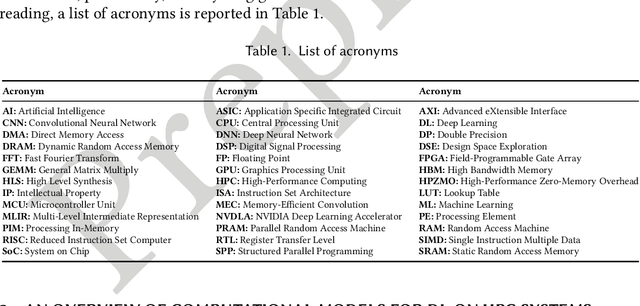
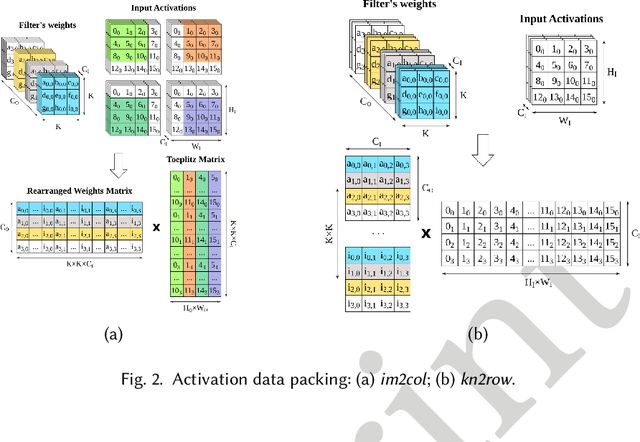
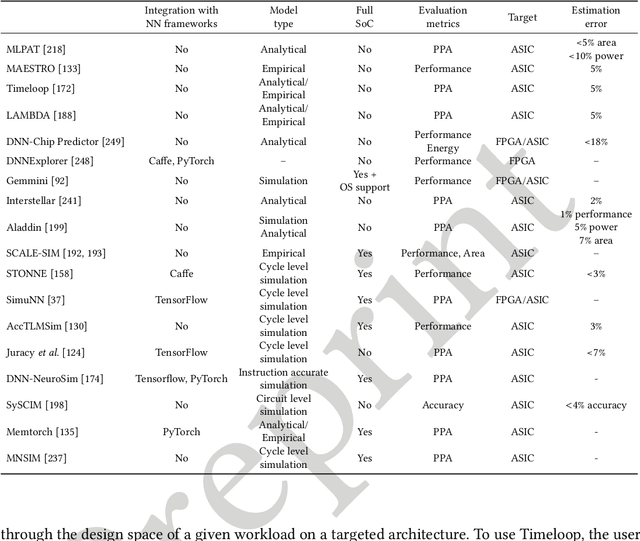
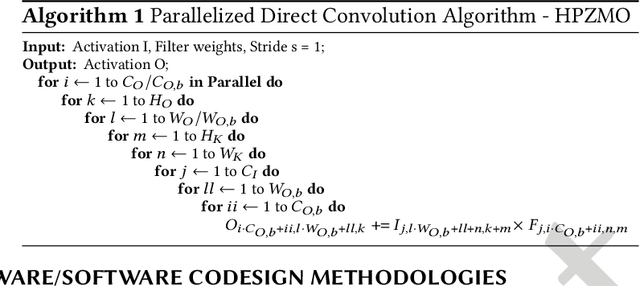
In recent years, the field of Deep Learning has seen many disruptive and impactful advancements. Given the increasing complexity of deep neural networks, the need for efficient hardware accelerators has become more and more pressing to design heterogeneous HPC platforms. The design of Deep Learning accelerators requires a multidisciplinary approach, combining expertise from several areas, spanning from computer architecture to approximate computing, computational models, and machine learning algorithms. Several methodologies and tools have been proposed to design accelerators for Deep Learning, including hardware-software co-design approaches, high-level synthesis methods, specific customized compilers, and methodologies for design space exploration, modeling, and simulation. These methodologies aim to maximize the exploitable parallelism and minimize data movement to achieve high performance and energy efficiency. This survey provides a holistic review of the most influential design methodologies and EDA tools proposed in recent years to implement Deep Learning accelerators, offering the reader a wide perspective in this rapidly evolving field. In particular, this work complements the previous survey proposed by the same authors in [203], which focuses on Deep Learning hardware accelerators for heterogeneous HPC platforms.
Stella Nera: Achieving 161 TOp/s/W with Multiplier-free DNN Acceleration based on Approximate Matrix Multiplication
Nov 16, 2023From classical HPC to deep learning, MatMul is at the heart of today's computing. The recent Maddness method approximates MatMul without the need for multiplication by using a hash-based version of product quantization (PQ) indexing into a look-up table (LUT). Stella Nera is the first Maddness accelerator and it achieves 15x higher area efficiency (GMAC/s/mm^2) and more than 25x higher energy efficiency (TMAC/s/W) than direct MatMul accelerators implemented in the same technology. The hash function is a decision tree, which allows for an efficient hardware implementation as the multiply-accumulate operations are replaced by decision tree passes and LUT lookups. The entire Maddness MatMul can be broken down into parts that allow an effective implementation with small computing units and memories, allowing it to reach extreme efficiency while remaining generically applicable for MatMul tasks. In a commercial 14nm technology and scaled to 3nm, we achieve an energy efficiency of 161 TOp/s/W@0.55V with a Top-1 accuracy on CIFAR-10 of more than 92.5% using ResNet9.
Ultra-Efficient On-Device Object Detection on AI-Integrated Smart Glasses with TinyissimoYOLO
Nov 03, 2023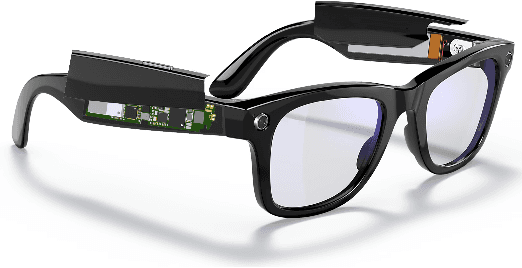
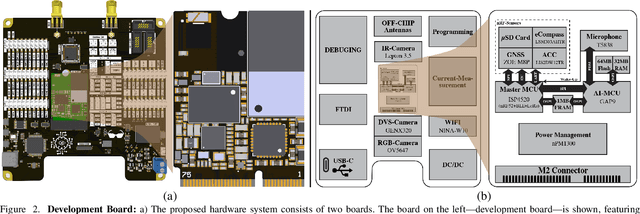
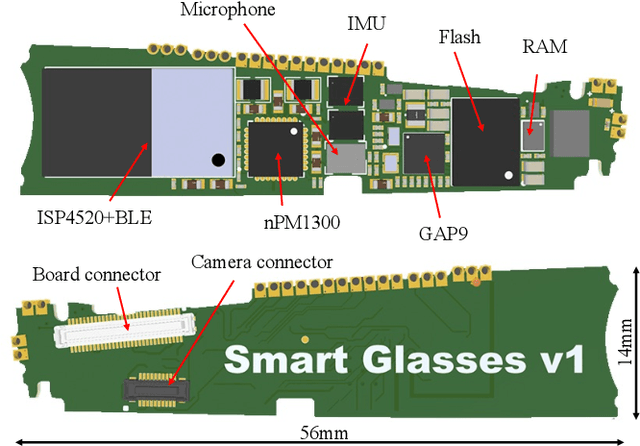

Smart glasses are rapidly gaining advanced functionality thanks to cutting-edge computing technologies, accelerated hardware architectures, and tiny AI algorithms. Integrating AI into smart glasses featuring a small form factor and limited battery capacity is still challenging when targeting full-day usage for a satisfactory user experience. This paper illustrates the design and implementation of tiny machine-learning algorithms exploiting novel low-power processors to enable prolonged continuous operation in smart glasses. We explore the energy- and latency-efficient of smart glasses in the case of real-time object detection. To this goal, we designed a smart glasses prototype as a research platform featuring two microcontrollers, including a novel milliwatt-power RISC-V parallel processor with a hardware accelerator for visual AI, and a Bluetooth low-power module for communication. The smart glasses integrate power cycling mechanisms, including image and audio sensing interfaces. Furthermore, we developed a family of novel tiny deep-learning models based on YOLO with sub-million parameters customized for microcontroller-based inference dubbed TinyissimoYOLO v1.3, v5, and v8, aiming at benchmarking object detection with smart glasses for energy and latency. Evaluations on the prototype of the smart glasses demonstrate TinyissimoYOLO's 17ms inference latency and 1.59mJ energy consumption per inference while ensuring acceptable detection accuracy. Further evaluation reveals an end-to-end latency from image capturing to the algorithm's prediction of 56ms or equivalently 18 fps, with a total power consumption of 62.9mW, equivalent to a 9.3 hours of continuous run time on a 154mAh battery. These results outperform MCUNet (TinyNAS+TinyEngine), which runs a simpler task (image classification) at just 7.3 fps per second.
Quantitative Evaluation of a Multi-Modal Camera Setup for Fusing Event Data with RGB Images
Nov 03, 2023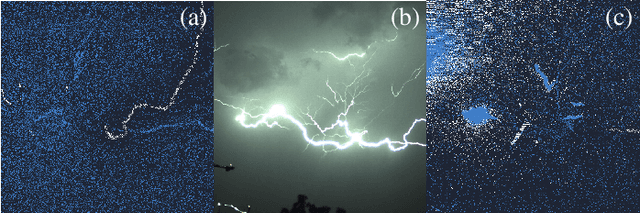
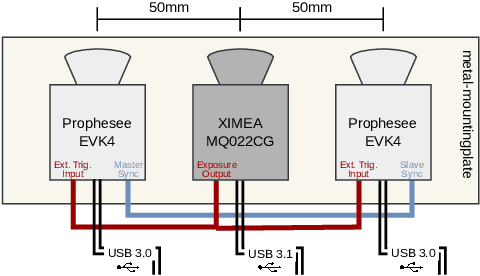
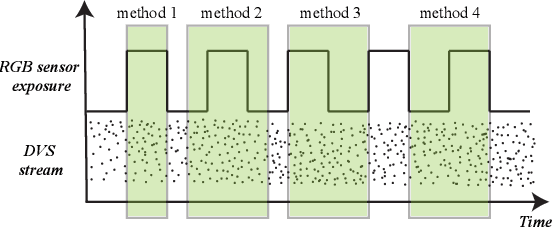
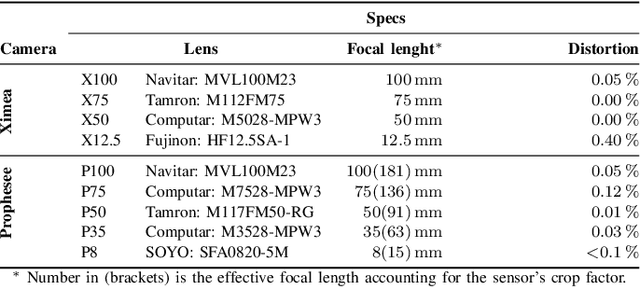
Event-based cameras, also called silicon retinas, potentially revolutionize computer vision by detecting and reporting significant changes in intensity asynchronous events, offering extended dynamic range, low latency, and low power consumption, enabling a wide range of applications from autonomous driving to longtime surveillance. As an emerging technology, there is a notable scarcity of publicly available datasets for event-based systems that also feature frame-based cameras, in order to exploit the benefits of both technologies. This work quantitatively evaluates a multi-modal camera setup for fusing high-resolution DVS data with RGB image data by static camera alignment. The proposed setup, which is intended for semi-automatic DVS data labeling, combines two recently released Prophesee EVK4 DVS cameras and one global shutter XIMEA MQ022CG-CM RGB camera. After alignment, state-of-the-art object detection or segmentation networks label the image data by mapping boundary boxes or labeled pixels directly to the aligned events. To facilitate this process, various time-based synchronization methods for DVS data are analyzed, and calibration accuracy, camera alignment, and lens impact are evaluated. Experimental results demonstrate the benefits of the proposed system: the best synchronization method yields an image calibration error of less than 0.90px and a pixel cross-correlation deviation of1.6px, while a lens with 8mm focal length enables detection of objects with size 30cm at a distance of 350m against homogeneous background.
Fully Onboard Low-Power Localization with Semantic Sensor Fusion on a Nano-UAV using Floor Plans
Oct 19, 2023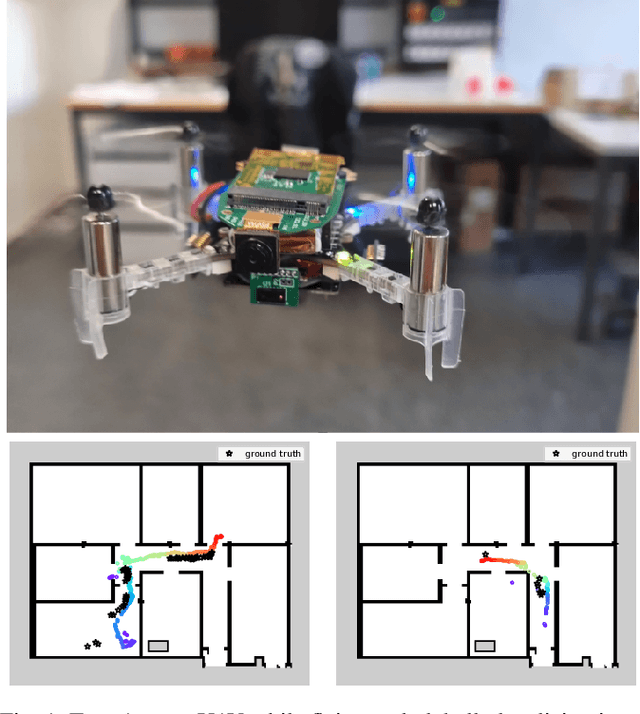
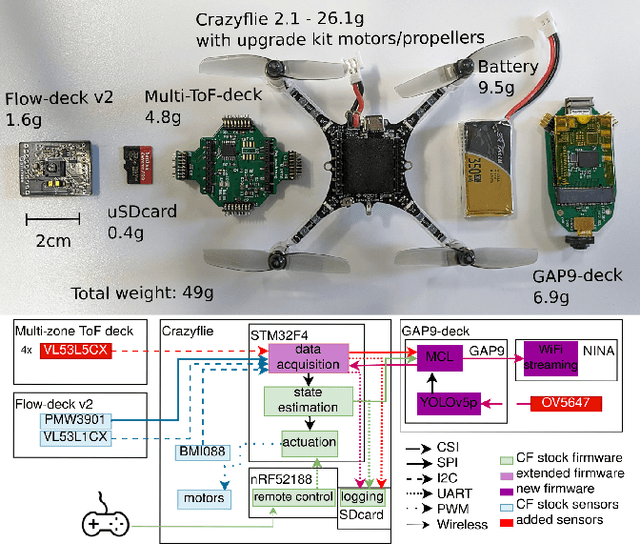
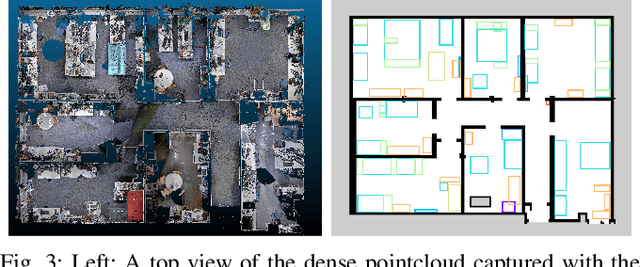
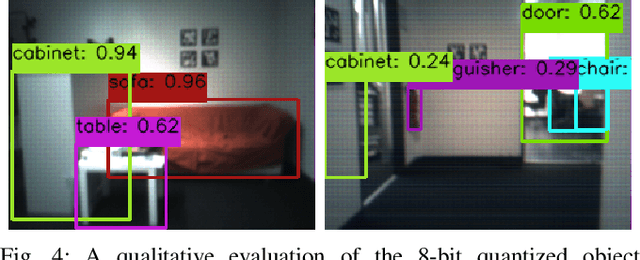
Nano-sized unmanned aerial vehicles (UAVs) are well-fit for indoor applications and for close proximity to humans. To enable autonomy, the nano-UAV must be able to self-localize in its operating environment. This is a particularly-challenging task due to the limited sensing and compute resources on board. This work presents an online and onboard approach for localization in floor plans annotated with semantic information. Unlike sensor-based maps, floor plans are readily-available, and do not increase the cost and time of deployment. To overcome the difficulty of localizing in sparse maps, the proposed approach fuses geometric information from miniaturized time-of-flight sensors and semantic cues. The semantic information is extracted from images by deploying a state-of-the-art object detection model on a high-performance multi-core microcontroller onboard the drone, consuming only 2.5mJ per frame and executing in 38ms. In our evaluation, we globally localize in a real-world office environment, achieving 90% success rate. We also release an open-source implementation of our work.
Enhancing Neural Architecture Search with Multiple Hardware Constraints for Deep Learning Model Deployment on Tiny IoT Devices
Oct 11, 2023The rapid proliferation of computing domains relying on Internet of Things (IoT) devices has created a pressing need for efficient and accurate deep-learning (DL) models that can run on low-power devices. However, traditional DL models tend to be too complex and computationally intensive for typical IoT end-nodes. To address this challenge, Neural Architecture Search (NAS) has emerged as a popular design automation technique for co-optimizing the accuracy and complexity of deep neural networks. Nevertheless, existing NAS techniques require many iterations to produce a network that adheres to specific hardware constraints, such as the maximum memory available on the hardware or the maximum latency allowed by the target application. In this work, we propose a novel approach to incorporate multiple constraints into so-called Differentiable NAS optimization methods, which allows the generation, in a single shot, of a model that respects user-defined constraints on both memory and latency in a time comparable to a single standard training. The proposed approach is evaluated on five IoT-relevant benchmarks, including the MLPerf Tiny suite and Tiny ImageNet, demonstrating that, with a single search, it is possible to reduce memory and latency by 87.4% and 54.2%, respectively (as defined by our targets), while ensuring non-inferior accuracy on state-of-the-art hand-tuned deep neural networks for TinyML.
Towards a Novel Ultrasound System Based on Low-Frequency Feature Extraction From a Fully-Printed Flexible Transducer
Sep 25, 2023Ultrasound is a key technology in healthcare, and it is being explored for non-invasive, wearable, continuous monitoring of vital signs. However, its widespread adoption in this scenario is still hindered by the size, complexity, and power consumption of current devices. Moreover, such an application demands adaptability to human anatomy, which is hard to achieve with current transducer technology. This paper presents a novel ultrasound system prototype based on a fully printed, lead-free, and flexible polymer ultrasound transducer, whose bending radius promises good adaptability to the human anatomy. Our application scenario focuses on continuous blood flow monitoring. We implemented a hardware envelope filter to efficiently transpose high-frequency ultrasound signals to a lower-frequency spectrum. This reduces computational and power demands with little to no degradation in the task proposed for this work. We validated our method on a setup that mimics human blood flow by using a flow phantom and a peristaltic pump simulating 3 different heartbeat rhythms: 60, 90 and 120 beats per minute. Our ultrasound setup reconstructs peristaltic pump frequencies with errors of less than 0.05 Hz (3 bpm) from the set pump frequency, both for the raw echo and the enveloped echo. The analog pre-processing showed a promising reduction of signal bandwidth of more than 6x: pulse-echo signals of transducers excited at 12.5 MHz were reduced to about 2 MHz. Thus, allowing consumer MCUs to acquire and elaborate signals within mW-power range in an inexpensive fashion.