 Add to Chrome
 Add to Firefox
 Add to Edge
OpenGlass: Ultra-Low-Power On-Device AI Eyewear with Event-based Vision
Jun 08, 2026
Smart eyewear enables unobtrusive, context-aware interaction through multimodal sensors and on-device intelligence, but is severely limited by power, memory, and compute constraints in a compact form factor. Open-hardware platforms supporting event-based vision and embedded ML at this scale are rare. This work introduces an open-source smart glasses platform for rapid prototyping of novel sensors and algorithms. Its modular design uses a flexible FPC interposer to support both event-based and frame-based cameras without full PCB redesign. A hardware-software co-designed power management system combines a configurable PMIC with event-driven wake-up via an nRF5340 coordinator, keeping the GAP9 RISC-V SoC powered down between inferences. The prototype achieves up to 11.5 hours of continuous on-device ML from a 200 mAh battery. As a demonstration, an egocentric hand gesture recognition pipeline was evaluated on the LynX dataset using polarity-separated event histograms from a Prophesee GENX320 camera. R(2+1)D achieved the best cross-subject accuracy of 83.94\% (macro F1 = 0.781) under leave-two-subjects-out validation, with 78.3 ms end-to-end inference latency on the GAP9. Temporal augmentation and removal of ambiguous classes provided the largest gains (+8.9 pp). All hardware designs, firmware, and models are released open source.

OpenGlass: Open-Source Smart Glasses for On-Device Event-Based Gesture Recognition
Jun 05, 2026Smart eyewear enables unobtrusive, context-aware interaction through multimodal sensors and on-device intelligence, but is severely limited by power, memory, and compute constraints in a compact form factor. Open-hardware platforms supporting event-based vision and embedded ML at this scale are rare. This work introduces an open-source smart glasses platform for rapid prototyping of novel sensors and algorithms. Its modular design uses a flexible FPC interposer to support both event-based and frame-based cameras without full PCB redesign. A hardware-software co-designed power management system combines a configurable PMIC with event-driven wake-up via an nRF5340 coordinator, keeping the GAP9 RISC-V SoC powered down between inferences. The prototype achieves up to 11.8 hours of continuous on-device ML from a 200 mAh battery. As a demonstration, an egocentric hand gesture recognition pipeline was evaluated on the LynX dataset using polarity-separated event histograms from a Prophesee GENX320 camera. R(2+1)D achieved the best cross-subject accuracy of 83.94\% (macro F1 = 0.781) under leave-two-subjects-out validation, with 33.9 ms end-to-end latency on the GAP9. Temporal augmentation and removal of ambiguous classes provided the largest gains (+8.9 pp). All hardware designs, firmware, and models are released open source.
Exploiting In-Sensor Computing for Energy-Efficient Earth Observation
May 31, 2026The rapid growth of the satellite industry has driven a significant increase in geospatial data acquisition, highlighting a critical bottleneck: the severe disparity between the volume of collected sensor data and the limited downlink bandwidth available to ground stations. While On-Board Computing (OBC) has helped address this by pre-processing data in orbit, this article further advances the paradigm by introducing an in-sensor computing framework. We present an optimized end-to-end Earth Observation (EO) pipeline tailored for strict computational constraints by integrating TinyML techniques with the Sony IMX500 Intelligent Vision Sensor. Specifically, our approach shifts processing directly to the sensor level, offloading the computation from the primary embedded device, and effectively mitigating the downlink transmission of noisy or irrelevant data. We evaluated several efficient Convolutional Neural Networks (ConvNets), i.e., SqueezeNet, ShuffleNetV2, and MCUNetV1, on the EuroSAT dataset. Experimental results show that, despite the optimizations required for deployment on the IMX500 platform, our models maintain a competitive 96.68% accuracy while operating within its 8 MB constraints. Specifically, the models reach an average processing throughput of 17.40 FPS with a latency of 27.43 ms. Furthermore, our system profile exhibits high energy efficiency, with a low energy footprint of 14.19 mJ per inference and an efficiency rating of 42.26 GMAC/J, demonstrating its viability for in-sensor deployment.
Event-Based Vision in Space: Applications, Trends, and Future Directions
May 31, 2026Earth Observation (EO) is undergoing a significant transformation driven by the deployment of novel sensing technologies. Traditional frame-based optical sensors often struggle with motion blur, high power consumption, and extreme data redundancy in challenging orbital environments. In contrast, event-based sensors, also known as neuromorphic cameras, offer a bio-inspired asynchronous approach. By capturing only local illumination changes, they provide microsecond temporal resolution, an extremely high dynamic range, and exceptional energy efficiency. Although the use of these sensors is rapidly expanding from terrestrial systems to orbital platforms, the scientific literature surrounding their space-based applications remains heavily fragmented. To bridge this gap, this article presents a comprehensive review of the state-of-the-art in event-based vision in the space domain. Based on the retrieved literature, we introduce a taxonomy structured around four primary domains: 1) atmospheric and high-speed observation; 2) environmental monitoring and change detection; 3) operational support and onboard processing; and 4) geospatial modeling and predictive analysis. As a result, this survey highlights that neuromorphic engineering is far more than a supplementary imaging technique; it is a paradigm shift that can be used to directly address critical bottlenecks in modern remote sensing and sustainable space exploration.
FTerViT: Fully Ternary Vision Transformer
May 20, 2026Ternary Vision Transformers offer substantial model compression, however state-of-the-art methods only ternarize the encoder layers, leaving patch embeddings, LayerNorm parameters, and classifier heads in full precision. In compact models targeting resource-constrained processors, such as microcontrollers, these remaining full-precision components determine the total memory footprint, severely limiting deployment efficiency and on-device feasibility. In this work, we introduce a fully ternarized Vision Transformer in which \emph{all} weight matrices and normalization parameters are ternarized (FTerViT). To this end, we introduce two novel operators : TernaryBitConv2d with per-channel scaling for patch embedding and TernaryLayerNorm. FTerViT is trained using knowledge distillation, followed by a lightweight quantization-aware recovery phase. Our ternary W2A8 DeiT-III-S at 384$\times$384 resolution achieves 82.43\% ImageNet-1K top-1 at 6.09\,MB (${\sim}$15$\times$ compression, $-$2.42\,pp vs.\ FP32), outperforming prior ternary ViTs methods up to 8 pp. Finally, we demonstrate the first implementation of ternary vision transformers on a dual cores XTensa LX7 microcontroller inside the ESP32-S3 system-on-chip. By deploying FTerViT-Small (based on DeiT-III-Small at 224$\times$224 resolution, 5.81\,MB), we achieve 79.64\% ImageNet-1K top-1 accuracy.
TinyGLASS: Real-Time Self-Supervised In-Sensor Anomaly Detection
Mar 17, 2026Anomaly detection plays a key role in industrial quality control, where defects must be identified despite the scarcity of labeled faulty samples. Recent self-supervised approaches, such as GLASS, learn normal visual patterns using only defect-free data and have shown strong performance on industrial benchmarks. However, their computational requirements limit deployment on resource-constrained edge platforms. This work introduces TinyGLASS, a lightweight adaptation of the GLASS framework designed for real-time in-sensor anomaly detection on the Sony IMX500 intelligent vision sensor. The proposed architecture replaces the original WideResNet-50 backbone with a compact ResNet-18 and introduces deployment-oriented modifications that enable static graph tracing and INT8 quantization using Sony's Model Compression Toolkit. In addition to evaluating performance on the MVTec-AD benchmark, we investigate robustness to contaminated training data and introduce a custom industrial dataset, named MMS Dataset, for cross-device evaluation. Experimental results show that TinyGLASS achieves 8.7x parameter compression while maintaining competitive detection performance, reaching 94.2% image-level AUROC on MVTec-AD and operating at 20 FPS within the 8 MB memory constraints of the IMX500 platform. System profiling demonstrates low power consumption (4.0 mJ per inference), real-time end-to-end latency (20 FPS), and high energy efficiency (470 GMAC/J). Furthermore, the model maintains stable performance under moderate levels of training data contamination.
PicoSAM3: Real-Time In-Sensor Region-of-Interest Segmentation
Mar 12, 2026Real-time, on-device segmentation is critical for latency-sensitive and privacy-aware applications such as smart glasses and Internet-of-Things devices. We introduce PicoSAM3, a lightweight promptable visual segmentation model optimized for edge and in-sensor execution, including deployment on the Sony IMX500 vision sensor. PicoSAM3 has 1.3 M parameters and combines a dense CNN architecture with region of interest prompt encoding, Efficient Channel Attention, and knowledge distillation from SAM2 and SAM3. On COCO and LVIS, PicoSAM3 achieves 65.45% and 64.01% mIoU, respectively, outperforming existing SAM-based and edge-oriented baselines at similar or lower complexity. The INT8 quantized model preserves accuracy with negligible degradation while enabling real-time in-sensor inference at 11.82 ms latency on the IMX500, fully complying with its memory and operator constraints. Ablation studies show that distillation from large SAM models yields up to +14.5% mIoU improvement over supervised training and demonstrate that high-quality, spatially flexible promptable segmentation is feasible directly at the sensor level.
PicoSAM2: Low-Latency Segmentation In-Sensor for Edge Vision Applications
Jun 24, 2025Real-time, on-device segmentation is critical for latency-sensitive and privacy-aware applications like smart glasses and IoT devices. We introduce PicoSAM2, a lightweight (1.3M parameters, 336M MACs) promptable segmentation model optimized for edge and in-sensor execution, including the Sony IMX500. It builds on a depthwise separable U-Net, with knowledge distillation and fixed-point prompt encoding to learn from the Segment Anything Model 2 (SAM2). On COCO and LVIS, it achieves 51.9% and 44.9% mIoU, respectively. The quantized model (1.22MB) runs at 14.3 ms on the IMX500-achieving 86 MACs/cycle, making it the only model meeting both memory and compute constraints for in-sensor deployment. Distillation boosts LVIS performance by +3.5% mIoU and +5.1% mAP. These results demonstrate that efficient, promptable segmentation is feasible directly on-camera, enabling privacy-preserving vision without cloud or host processing.
RGB-Event Fusion with Self-Attention for Collision Prediction
May 07, 2025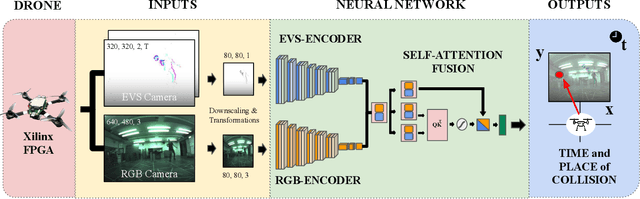
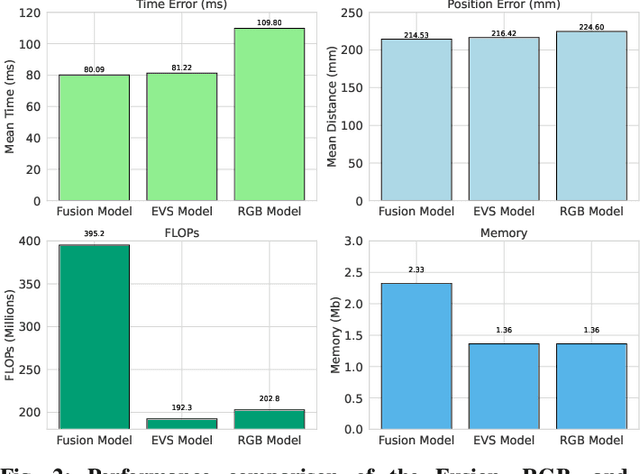
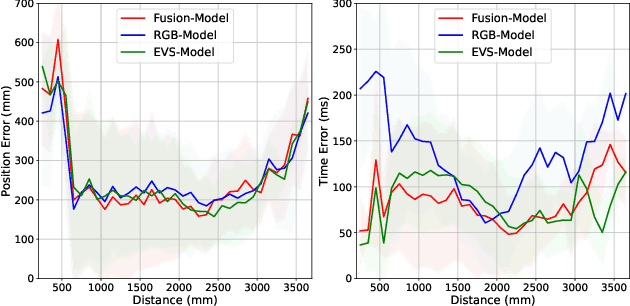
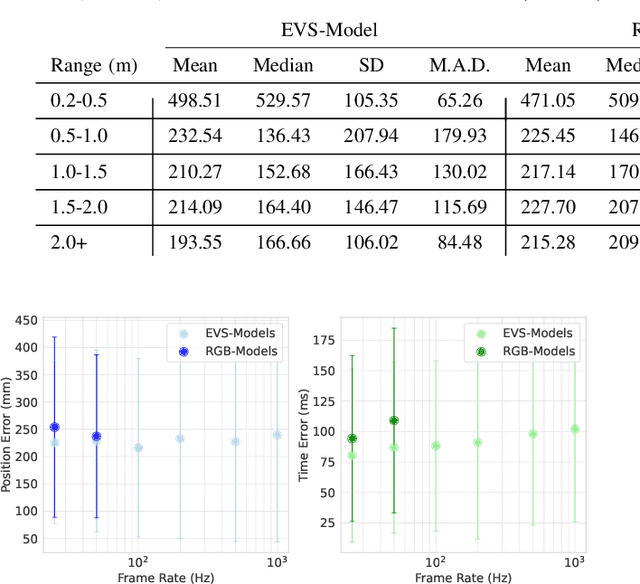
Ensuring robust and real-time obstacle avoidance is critical for the safe operation of autonomous robots in dynamic, real-world environments. This paper proposes a neural network framework for predicting the time and collision position of an unmanned aerial vehicle with a dynamic object, using RGB and event-based vision sensors. The proposed architecture consists of two separate encoder branches, one for each modality, followed by fusion by self-attention to improve prediction accuracy. To facilitate benchmarking, we leverage the ABCD [8] dataset collected that enables detailed comparisons of single-modality and fusion-based approaches. At the same prediction throughput of 50Hz, the experimental results show that the fusion-based model offers an improvement in prediction accuracy over single-modality approaches of 1% on average and 10% for distances beyond 0.5m, but comes at the cost of +71% in memory and + 105% in FLOPs. Notably, the event-based model outperforms the RGB model by 4% for position and 26% for time error at a similar computational cost, making it a competitive alternative. Additionally, we evaluate quantized versions of the event-based models, applying 1- to 8-bit quantization to assess the trade-offs between predictive performance and computational efficiency. These findings highlight the trade-offs of multi-modal perception using RGB and event-based cameras in robotic applications.
Towards Low-Latency Event-based Obstacle Avoidance on a FPGA-Drone
Apr 14, 2025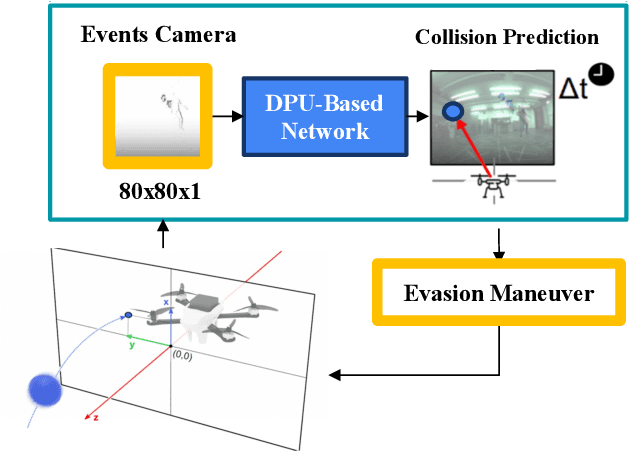
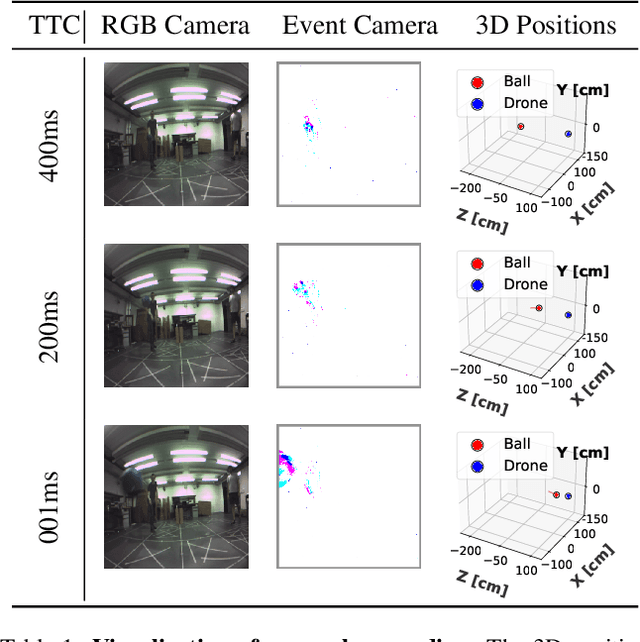
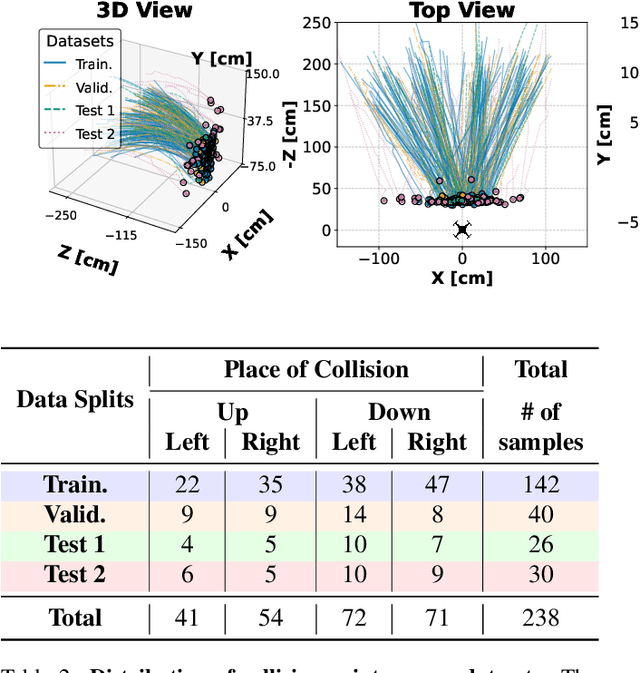
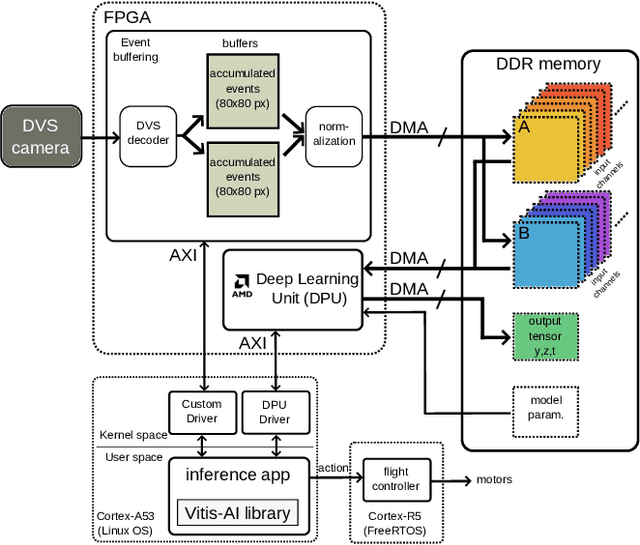
This work quantitatively evaluates the performance of event-based vision systems (EVS) against conventional RGB-based models for action prediction in collision avoidance on an FPGA accelerator. Our experiments demonstrate that the EVS model achieves a significantly higher effective frame rate (1 kHz) and lower temporal (-20 ms) and spatial prediction errors (-20 mm) compared to the RGB-based model, particularly when tested on out-of-distribution data. The EVS model also exhibits superior robustness in selecting optimal evasion maneuvers. In particular, in distinguishing between movement and stationary states, it achieves a 59 percentage point advantage in precision (78% vs. 19%) and a substantially higher F1 score (0.73 vs. 0.06), highlighting the susceptibility of the RGB model to overfitting. Further analysis in different combinations of spatial classes confirms the consistent performance of the EVS model in both test data sets. Finally, we evaluated the system end-to-end and achieved a latency of approximately 2.14 ms, with event aggregation (1 ms) and inference on the processing unit (0.94 ms) accounting for the largest components. These results underscore the advantages of event-based vision for real-time collision avoidance and demonstrate its potential for deployment in resource-constrained environments.