 Add to Chrome
 Add to Firefox
 Add to Edge
MATCH: Model-Aware TVM-based Compilation for Heterogeneous Edge Devices
Oct 11, 2024

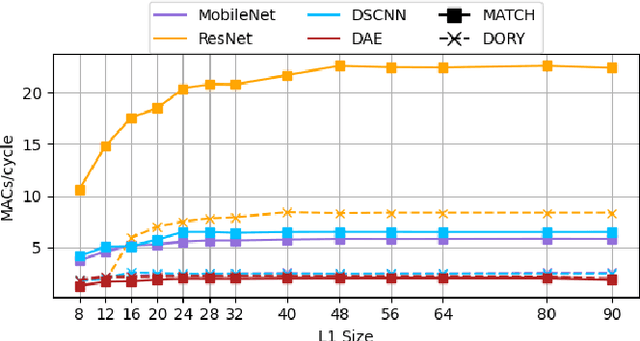
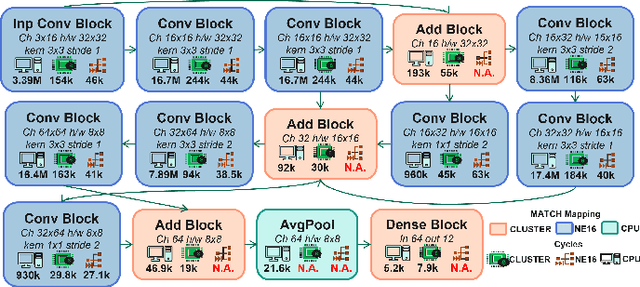
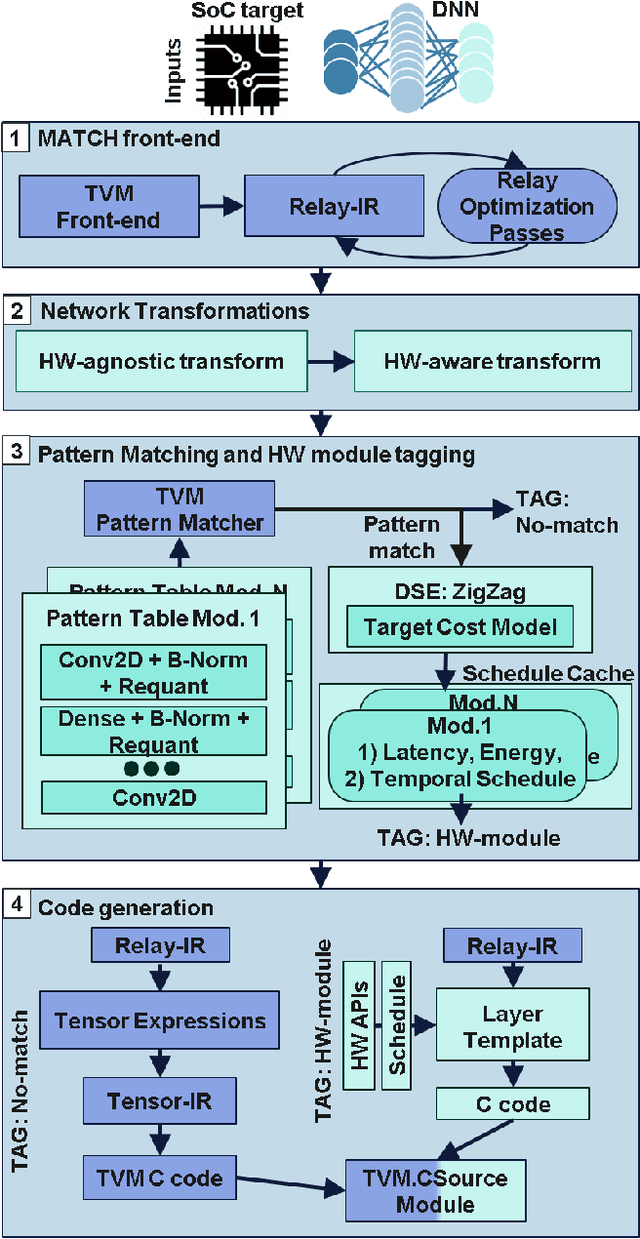
Streamlining the deployment of Deep Neural Networks (DNNs) on heterogeneous edge platforms, coupling within the same micro-controller unit (MCU) instruction processors and hardware accelerators for tensor computations, is becoming one of the crucial challenges of the TinyML field. The best-performing DNN compilation toolchains are usually deeply customized for a single MCU family, and porting to a different heterogeneous MCU family implies labor-intensive re-development of almost the entire compiler. On the opposite side, retargetable toolchains, such as TVM, fail to exploit the capabilities of custom accelerators, resulting in the generation of general but unoptimized code. To overcome this duality, we introduce MATCH, a novel TVM-based DNN deployment framework designed for easy agile retargeting across different MCU processors and accelerators, thanks to a customizable model-based hardware abstraction. We show that a general and retargetable mapping framework enhanced with hardware cost models can compete with and even outperform custom toolchains on diverse targets while only needing the definition of an abstract hardware model and a SoC-specific API. We tested MATCH on two state-of-the-art heterogeneous MCUs, GAP9 and DIANA. On the four DNN models of the MLPerf Tiny suite MATCH reduces inference latency by up to 60.88 times on DIANA, compared to using the plain TVM, thanks to the exploitation of the on-board HW accelerator. Compared to HTVM, a fully customized toolchain for DIANA, we still reduce the latency by 16.94%. On GAP9, using the same benchmarks, we improve the latency by 2.15 times compared to the dedicated DORY compiler, thanks to our heterogeneous DNN mapping approach that synergically exploits the DNN accelerator and the eight-cores cluster available on board.

When SAM2 Meets Video Camouflaged Object Segmentation: A Comprehensive Evaluation and Adaptation
Sep 27, 2024
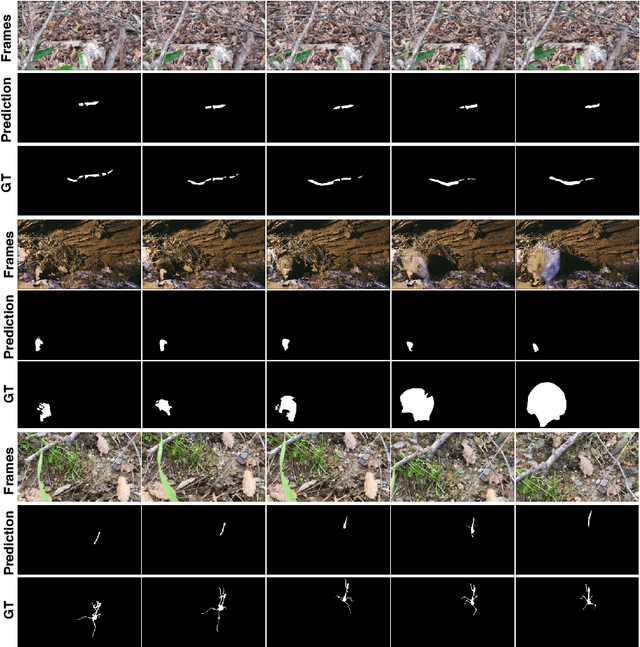
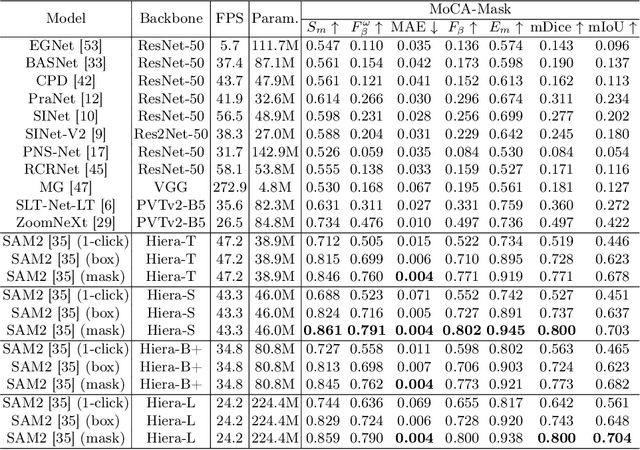

This study investigates the application and performance of the Segment Anything Model 2 (SAM2) in the challenging task of video camouflaged object segmentation (VCOS). VCOS involves detecting objects that blend seamlessly in the surroundings for videos, due to similar colors and textures, poor light conditions, etc. Compared to the objects in normal scenes, camouflaged objects are much more difficult to detect. SAM2, a video foundation model, has shown potential in various tasks. But its effectiveness in dynamic camouflaged scenarios remains under-explored. This study presents a comprehensive study on SAM2's ability in VCOS. First, we assess SAM2's performance on camouflaged video datasets using different models and prompts (click, box, and mask). Second, we explore the integration of SAM2 with existing multimodal large language models (MLLMs) and VCOS methods. Third, we specifically adapt SAM2 by fine-tuning it on the video camouflaged dataset. Our comprehensive experiments demonstrate that SAM2 has excellent zero-shot ability of detecting camouflaged objects in videos. We also show that this ability could be further improved by specifically adjusting SAM2's parameters for VCOS. The code will be available at https://github.com/zhoustan/SAM2-VCOS
An Ultra-Low Power Wearable BMI System with Continual Learning Capabilities
Sep 16, 2024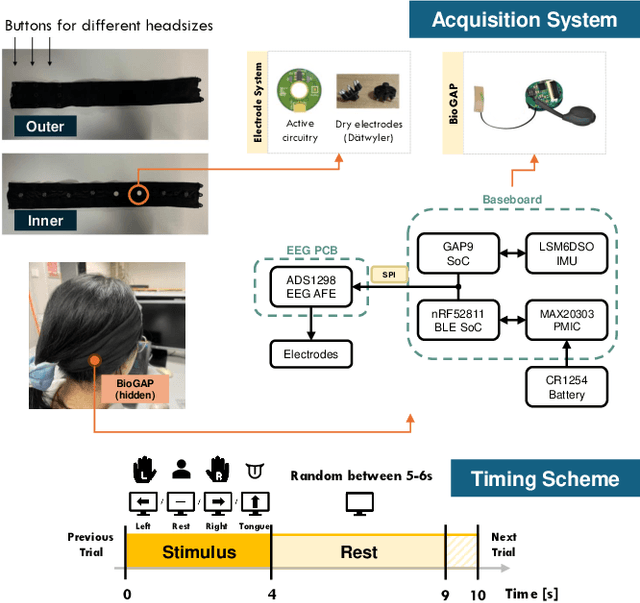
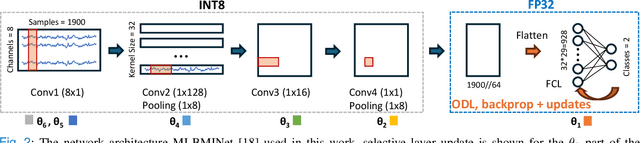
Driven by the progress in efficient embedded processing, there is an accelerating trend toward running machine learning models directly on wearable Brain-Machine Interfaces (BMIs) to improve portability and privacy and maximize battery life. However, achieving low latency and high classification performance remains challenging due to the inherent variability of electroencephalographic (EEG) signals across sessions and the limited onboard resources. This work proposes a comprehensive BMI workflow based on a CNN-based Continual Learning (CL) framework, allowing the system to adapt to inter-session changes. The workflow is deployed on a wearable, parallel ultra-low power BMI platform (BioGAP). Our results based on two in-house datasets, Dataset A and Dataset B, show that the CL workflow improves average accuracy by up to 30.36% and 10.17%, respectively. Furthermore, when implementing the continual learning on a Parallel Ultra-Low Power (PULP) microcontroller (GAP9), it achieves an energy consumption as low as 0.45mJ per inference and an adaptation time of only 21.5ms, yielding around 25h of battery life with a small 100mAh, 3.7V battery on BioGAP. Our setup, coupled with the compact CNN model and on-device CL capabilities, meets users' needs for improved privacy, reduced latency, and enhanced inter-session performance, offering good promise for smart embedded real-world BMIs.
Train-On-Request: An On-Device Continual Learning Workflow for Adaptive Real-World Brain Machine Interfaces
Sep 13, 2024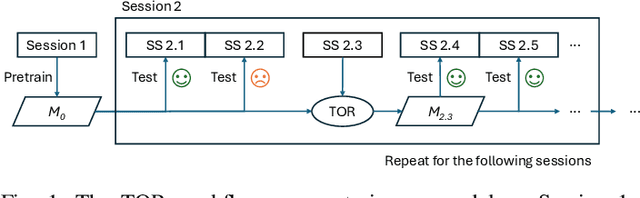
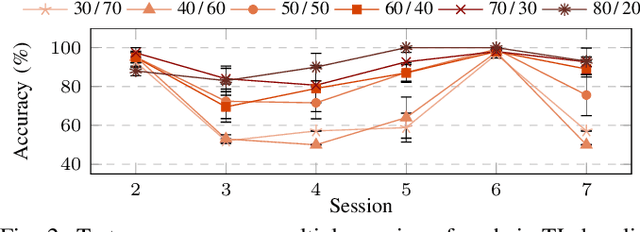
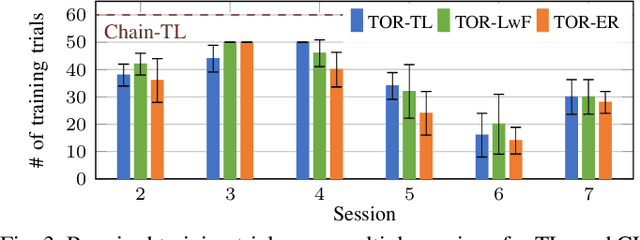
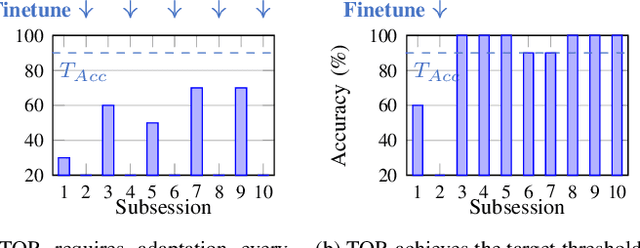
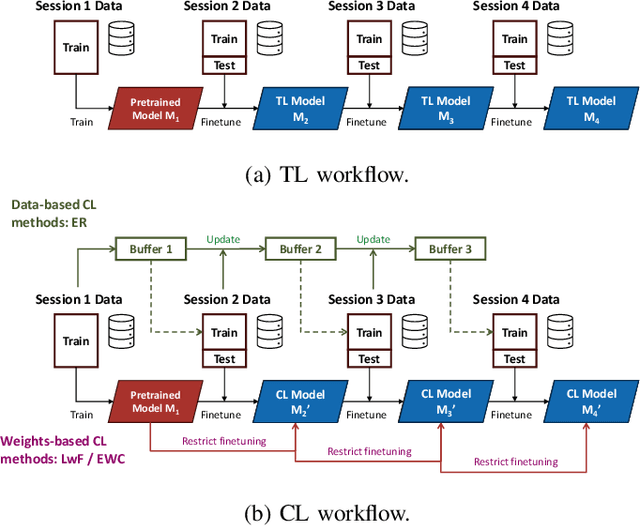
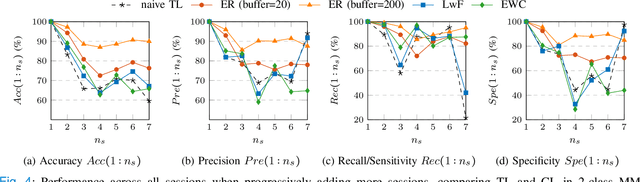
Brain-machine interfaces (BMIs) are expanding beyond clinical settings thanks to advances in hardware and algorithms. However, they still face challenges in user-friendliness and signal variability. Classification models need periodic adaptation for real-life use, making an optimal re-training strategy essential to maximize user acceptance and maintain high performance. We propose TOR, a train-on-request workflow that enables user-specific model adaptation to novel conditions, addressing signal variability over time. Using continual learning, TOR preserves knowledge across sessions and mitigates inter-session variability. With TOR, users can refine, on demand, the model through on-device learning (ODL) to enhance accuracy adapting to changing conditions. We evaluate the proposed methodology on a motor-movement dataset recorded with a non-stigmatizing wearable BMI headband, achieving up to 92% accuracy and a re-calibration time as low as 1.6 minutes, a 46% reduction compared to a naive transfer learning workflow. We additionally demonstrate that TOR is suitable for ODL in extreme edge settings by deploying the training procedure on a RISC-V ultra-low-power SoC (GAP9), resulting in 21.6 ms of latency and 1 mJ of energy consumption per training step. To the best of our knowledge, this work is the first demonstration of an online, energy-efficient, dynamic adaptation of a BMI model to the intrinsic variability of EEG signals in real-time settings.
Accelerating Image-based Pest Detection on a Heterogeneous Multi-core Microcontroller
Aug 29, 2024The codling moth pest poses a significant threat to global crop production, with potential losses of up to 80% in apple orchards. Special camera-based sensor nodes are deployed in the field to record and transmit images of trapped insects to monitor the presence of the pest. This paper investigates the embedding of computer vision algorithms in the sensor node using a novel State-of-the-Art Microcontroller Unit (MCU), the GreenWaves Technologies' GAP9 System-on-Chip, which combines 10 RISC-V general purposes cores with a convolution hardware accelerator. We compare the performance of a lightweight Viola-Jones detector algorithm with a Convolutional Neural Network (CNN), MobileNetV3-SSDLite, trained for the pest detection task. On two datasets that differentiate for the distance between the camera sensor and the pest targets, the CNN generalizes better than the other method and achieves a detection accuracy between 83% and 72%. Thanks to the GAP9's CNN accelerator, the CNN inference task takes only 147 ms to process a 320$\times$240 image. Compared to the GAP8 MCU, which only relies on general-purpose cores for processing, we achieved 9.5$\times$ faster inference speed. When running on a 1000 mAh battery at 3.7 V, the estimated lifetime is approximately 199 days, processing an image every 30 seconds. Our study demonstrates that the novel heterogeneous MCU can perform end-to-end CNN inference with an energy consumption of just 4.85 mJ, matching the efficiency of the simpler Viola-Jones algorithm and offering power consumption up to 15$\times$ lower than previous methods. Code at: https://github.com/Bomps4/TAFE_Pest_Detection
Deeploy: Enabling Energy-Efficient Deployment of Small Language Models On Heterogeneous Microcontrollers
Aug 08, 2024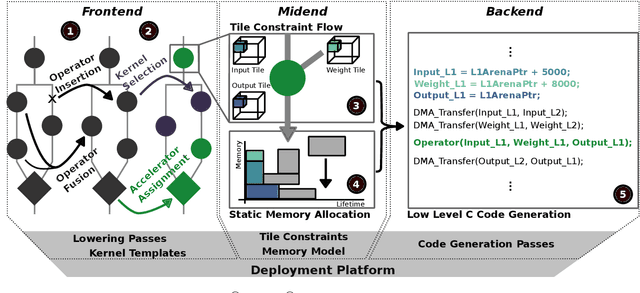


With the rise of Embodied Foundation Models (EFMs), most notably Small Language Models (SLMs), adapting Transformers for edge applications has become a very active field of research. However, achieving end-to-end deployment of SLMs on microcontroller (MCU)-class chips without high-bandwidth off-chip main memory access is still an open challenge. In this paper, we demonstrate high-efficiency end-to-end SLM deployment on a multicore RISC-V (RV32) MCU augmented with ML instruction extensions and a hardware neural processing unit (NPU). To automate the exploration of the constrained, multi-dimensional memory vs. computation tradeoffs involved in aggressive SLM deployment on heterogeneous (multicore+NPU) resources, we introduce Deeploy, a novel Deep Neural Network (DNN) compiler, which generates highly-optimized C code requiring minimal runtime support. We demonstrate that Deeploy generates end-to-end code for executing SLMs, fully exploiting the RV32 cores' instruction extensions and the NPU: We achieve leading-edge energy and throughput of \SI{490}{\micro\joule \per Token}, at \SI{340}{Token \per \second} for an SLM trained on the TinyStories dataset, running for the first time on an MCU-class device without external memory.
Toward Attention-based TinyML: A Heterogeneous Accelerated Architecture and Automated Deployment Flow
Aug 05, 2024One of the challenges for Tiny Machine Learning (tinyML) is keeping up with the evolution of Machine Learning models from Convolutional Neural Networks to Transformers. We address this by leveraging a heterogeneous architectural template coupling RISC-V processors with hardwired accelerators supported by an automated deployment flow. We demonstrate an Attention-based model in a tinyML power envelope with an octa-core cluster coupled with an accelerator for quantized Attention. Our deployment flow enables an end-to-end 8-bit MobileBERT, achieving leading-edge energy efficiency and throughput of 2960 GOp/J and 154 GOp/s at 32.5 Inf/s consuming 52.0 mW (0.65 V, 22 nm FD-SOI technology).
Distilling Tiny and Ultra-fast Deep Neural Networks for Autonomous Navigation on Nano-UAVs
Jul 17, 2024Nano-sized unmanned aerial vehicles (UAVs) are ideal candidates for flying Internet-of-Things smart sensors to collect information in narrow spaces. This requires ultra-fast navigation under very tight memory/computation constraints. The PULP-Dronet convolutional neural network (CNN) enables autonomous navigation running aboard a nano-UAV at 19 frame/s, at the cost of a large memory footprint of 320 kB -- and with drone control in complex scenarios hindered by the disjoint training of collision avoidance and steering capabilities. In this work, we distill a novel family of CNNs with better capabilities than PULP-Dronet, but memory footprint reduced by up to 168x (down to 2.9 kB), achieving an inference rate of up to 139 frame/s; we collect a new open-source unified collision/steering 66 k images dataset for more robust navigation; and we perform a thorough in-field analysis of both PULP-Dronet and our tiny CNNs running on a commercially available nano-UAV. Our tiniest CNN, called Tiny-PULP-Dronet v3, navigates with a 100% success rate a challenging and never-seen-before path, composed of a narrow obstacle-populated corridor and a 180{\deg} turn, at a maximum target speed of 0.5 m/s. In the same scenario, the SoA PULP-Dronet consistently fails despite having 168x more parameters.
Ultra-Lightweight Collaborative Mapping for Robot Swarms
Jul 03, 2024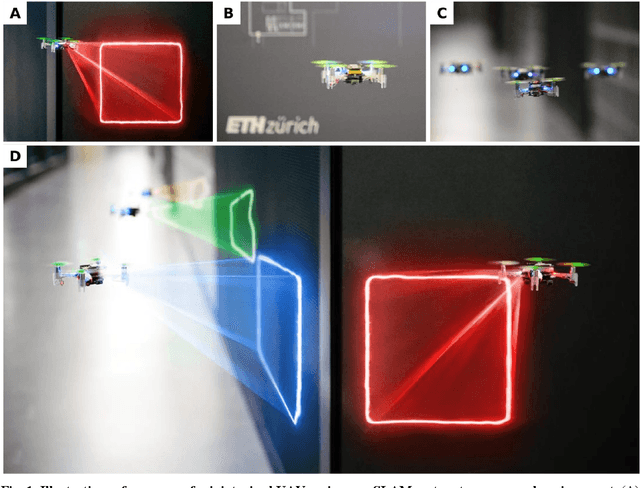
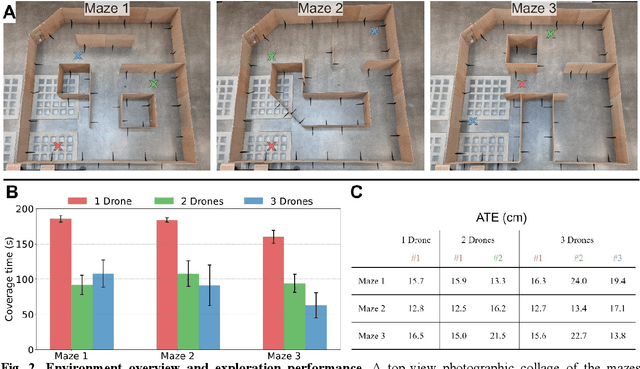
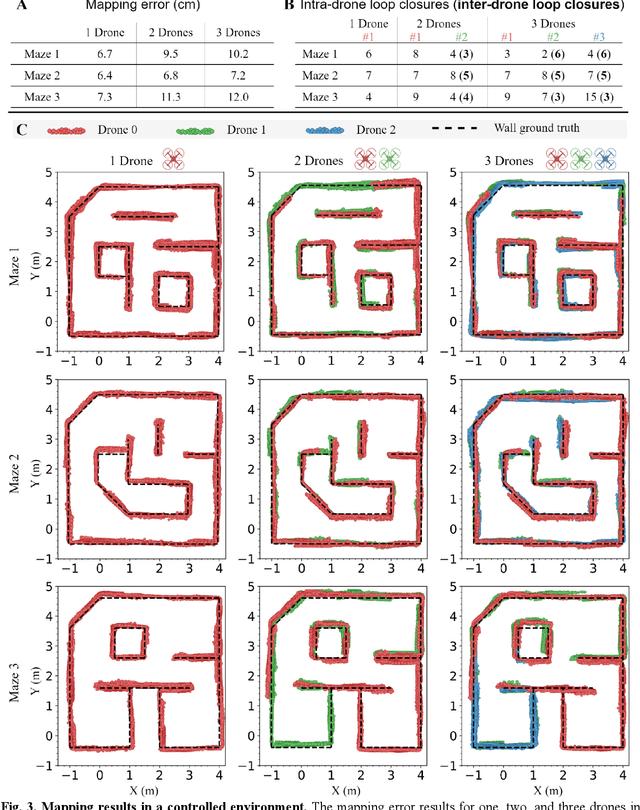
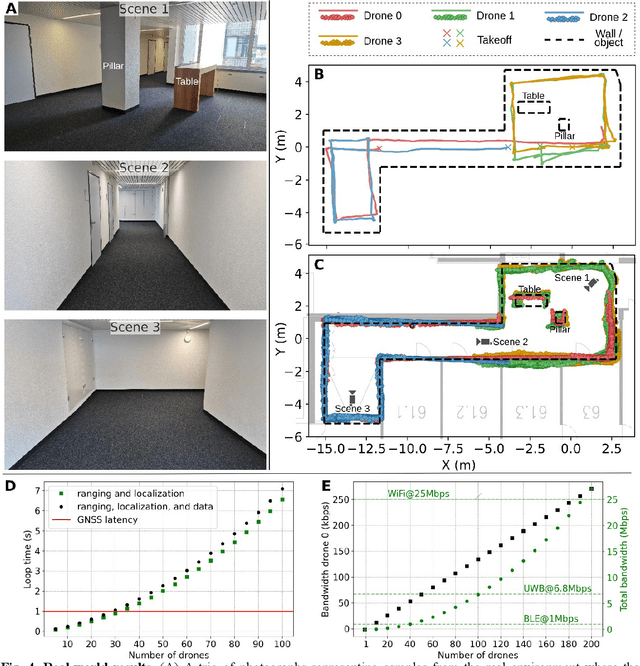
A key requirement in robotics is the ability to simultaneously self-localize and map a previously unknown environment, relying primarily on onboard sensing and computation. Achieving fully onboard accurate simultaneous localization and mapping (SLAM) is feasible for high-end robotic platforms, whereas small and inexpensive robots face challenges due to constrained hardware, therefore frequently resorting to external infrastructure for sensing and computation. The challenge is further exacerbated in swarms of robots, where coordination, scalability, and latency are crucial concerns. This work introduces a decentralized and lightweight collaborative SLAM approach that enables mapping on virtually any robot, even those equipped with low-cost hardware, including miniaturized insect-size devices. Moreover, the proposed solution supports large swarm formations with the capability to coordinate hundreds of agents. To substantiate our claims, we have successfully implemented collaborative SLAM on centimeter-size drones weighing only 46 grams. Remarkably, we achieve results comparable to high-end state-of-the-art solutions while reducing the cost, memory, and computation requirements by two orders of magnitude. Our approach is innovative in three main aspects. First, it enables onboard infrastructure-less collaborative mapping with a lightweight and cost-effective solution in terms of sensing and computation. Second, we optimize the data traffic within the swarm to support hundreds of cooperative agents using standard wireless protocols such as ultra-wideband (UWB), Bluetooth, or WiFi. Last, we implement a distributed swarm coordination policy to decrease mapping latency and enhance accuracy.
Tiny-PULP-Dronets: Squeezing Neural Networks for Faster and Lighter Inference on Multi-Tasking Autonomous Nano-Drones
Jul 02, 2024Pocket-sized autonomous nano-drones can revolutionize many robotic use cases, such as visual inspection in narrow, constrained spaces, and ensure safer human-robot interaction due to their tiny form factor and weight -- i.e., tens of grams. This compelling vision is challenged by the high level of intelligence needed aboard, which clashes against the limited computational and storage resources available on PULP (parallel-ultra-low-power) MCU class navigation and mission controllers that can be hosted aboard. This work moves from PULP-Dronet, a State-of-the-Art convolutional neural network for autonomous navigation on nano-drones. We introduce Tiny-PULP-Dronet: a novel methodology to squeeze by more than one order of magnitude model size (50x fewer parameters), and number of operations (27x less multiply-and-accumulate) required to run inference with similar flight performance as PULP-Dronet. This massive reduction paves the way towards affordable multi-tasking on nano-drones, a fundamental requirement for achieving high-level intelligence.