 Add to Chrome
 Add to Firefox
 Add to Edge
ConsistRM: Improving Generative Reward Models via Consistency-Aware Self-Training
Apr 08, 2026
Generative reward models (GRMs) have emerged as a promising approach for aligning Large Language Models (LLMs) with human preferences by offering greater representational capacity and flexibility than traditional scalar reward models. However, GRMs face two major challenges: reliance on costly human-annotated data restricts scalability, and self-training approaches often suffer from instability and vulnerability to reward hacking. To address these issues, we propose ConsistRM, a self-training framework that enables effective and stable GRM training without human annotations. ConsistRM incorporates the Consistency-Aware Answer Reward, which produces reliable pseudo-labels with temporal consistency, thereby providing more stable model optimization. Moreover, the Consistency-Aware Critique Reward is introduced to assess semantic consistency across multiple critiques and allocates fine-grained and differentiated rewards. Experiments on five benchmark datasets across four base models demonstrate that ConsistRM outperforms vanilla Reinforcement Fine-Tuning (RFT) by an average of 1.5%. Further analysis shows that ConsistRM enhances output consistency and mitigates position bias caused by input order, highlighting the effectiveness of consistency-aware rewards in improving GRMs.

ReflectRM: Boosting Generative Reward Models via Self-Reflection within a Unified Judgment Framework
Apr 08, 2026Reward Models (RMs) are critical components in the Reinforcement Learning from Human Feedback (RLHF) pipeline, directly determining the alignment quality of Large Language Models (LLMs). Recently, Generative Reward Models (GRMs) have emerged as a superior paradigm, offering higher interpretability and stronger generalization than traditional scalar RMs. However, existing methods for GRMs focus primarily on outcome-level supervision, neglecting analytical process quality, which constrains their potential. To address this, we propose ReflectRM, a novel GRM that leverages self-reflection to assess analytical quality and enhance preference modeling. ReflectRM is trained under a unified generative framework for joint modeling of response preference and analysis preference. During inference, we use its self-reflection capability to identify the most reliable analysis, from which the final preference prediction is derived. Experiments across four benchmarks show that ReflectRM consistently improves performance, achieving an average accuracy gain of +3.7 on Qwen3-4B. Further experiments confirm that response preference and analysis preference are mutually reinforcing. Notably, ReflectRM substantially mitigates positional bias, yielding +10.2 improvement compared with leading GRMs and establishing itself as a more stable evaluator.
Advancing General-Purpose Reasoning Models with Modular Gradient Surgery
Feb 02, 2026Reinforcement learning (RL) has played a central role in recent advances in large reasoning models (LRMs), yielding strong gains in verifiable and open-ended reasoning. However, training a single general-purpose LRM across diverse domains remains challenging due to pronounced domain heterogeneity. Through a systematic study of two widely used strategies, Sequential RL and Mixed RL, we find that both incur substantial cross-domain interference at the behavioral and gradient levels, resulting in limited overall gains. To address these challenges, we introduce **M**odular **G**radient **S**urgery (**MGS**), which resolves gradient conflicts at the module level within the transformer. When applied to Llama and Qwen models, MGS achieves average improvements of 4.3 (16.6\%) and 4.5 (11.1\%) points, respectively, over standard multi-task RL across three representative domains (math, general chat, and instruction following). Further analysis demonstrates that MGS remains effective under prolonged training. Overall, our study clarifies the sources of interference in multi-domain RL and presents an effective solution for training general-purpose LRMs.
MMIDR: Teaching Large Language Model to Interpret Multimodal Misinformation via Knowledge Distillation
Mar 21, 2024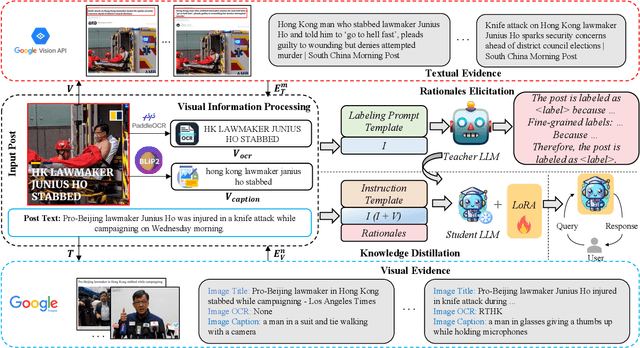
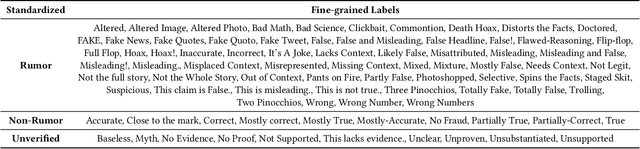

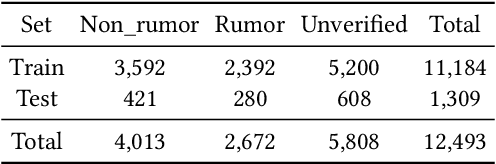
Automatic detection of multimodal misinformation has gained a widespread attention recently. However, the potential of powerful Large Language Models (LLMs) for multimodal misinformation detection remains underexplored. Besides, how to teach LLMs to interpret multimodal misinformation in cost-effective and accessible way is still an open question. To address that, we propose MMIDR, a framework designed to teach LLMs in providing fluent and high-quality textual explanations for their decision-making process of multimodal misinformation. To convert multimodal misinformation into an appropriate instruction-following format, we present a data augmentation perspective and pipeline. This pipeline consists of a visual information processing module and an evidence retrieval module. Subsequently, we prompt the proprietary LLMs with processed contents to extract rationales for interpreting the authenticity of multimodal misinformation. Furthermore, we design an efficient knowledge distillation approach to distill the capability of proprietary LLMs in explaining multimodal misinformation into open-source LLMs. To explore several research questions regarding the performance of LLMs in multimodal misinformation detection tasks, we construct an instruction-following multimodal misinformation dataset and conduct comprehensive experiments. The experimental findings reveal that our MMIDR exhibits sufficient detection performance and possesses the capacity to provide compelling rationales to support its assessments.
Cross-modal Contrastive Learning for Multimodal Fake News Detection
Feb 25, 2023
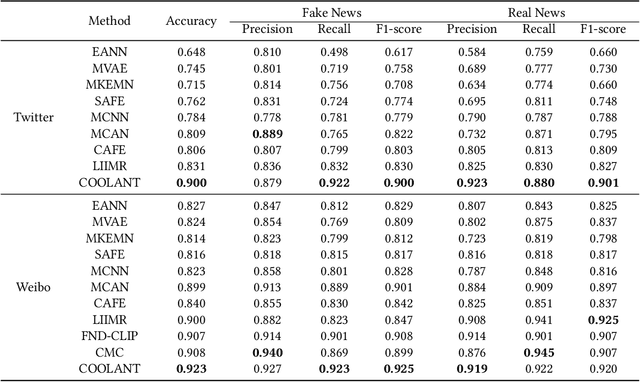
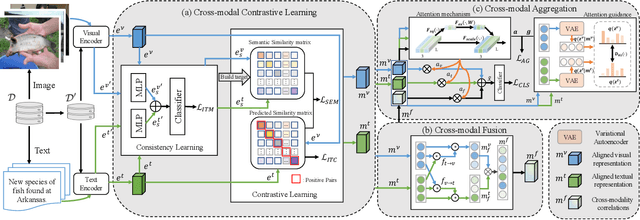
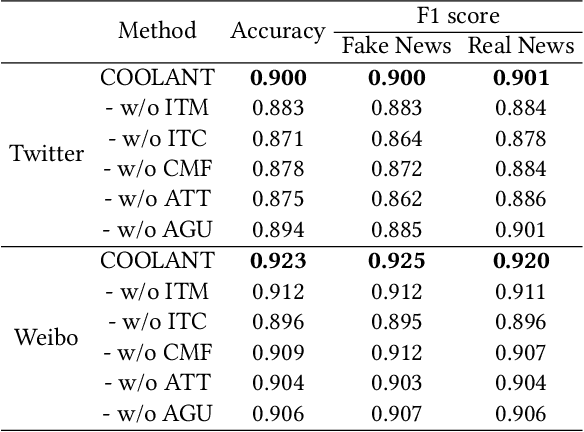
Automatic detection of multimodal fake news has gained a widespread attention recently. Many existing approaches seek to fuse unimodal features to produce multimodal news representations. However, the potential of powerful cross-modal contrastive learning methods for fake news detection has not been well exploited. Besides, how to aggregate features from different modalities to boost the performance of the decision-making process is still an open question. To address that, we propose COOLANT, a cross-modal contrastive learning framework for multimodal fake news detection, aiming to achieve more accurate image-text alignment. To further improve the alignment precision, we leverage an auxiliary task to soften the loss term of negative samples during the contrast process. A cross-modal fusion module is developed to learn the cross-modality correlations. An attention mechanism with an attention guidance module is implemented to help effectively and interpretably aggregate the aligned unimodal representations and the cross-modality correlations. Finally, we evaluate the COOLANT and conduct a comparative study on two widely used datasets, Twitter and Weibo. The experimental results demonstrate that our COOLANT outperforms previous approaches by a large margin and achieves new state-of-the-art results on the two datasets.