 Add to Chrome
 Add to Firefox
 Add to Edge
Near-Field Channel Estimation for mmWave/THz Communications with Extremely Large-Scale UPAs
Mar 15, 2026
Extremely large antenna arrays (ELAAs) are widely adopted in mmWave/THz communications to compensate for the severe path loss, wherein the channel estimation remains a significant challenge since the Rayleigh distance of ELAAs stretches to tens or even hundreds of meters and the near-field channel model should be considered. Existing polar-domain based methods and block-sparse based methods are originally devised for Uniform Linear Arrays (ULAs) near-field channel estimation. The polar-domain based method can be applied to Uniform Planar Arrays (UPAs), but it behaves plain since it ignores the specific sparsity structure of the UPA near-field channels. Meanwhile, the block-sparse based method cannot be extended to the UPA scenarios directly. To address these issues, we first reformulate the original UPA near-field channel as an outer product of two ULA near-field channels and we construct a modified two-dimensional DFT (2D-DFT) dictionary for it. With the proposed dictionary, we further prove that the UPA near-field channel admits a 2D block-sparse structure. Leveraging this specific sparse structure, we solve the channel estimation problem with the 2D Pattern-Coupled Sparse Bayesian Learning (2D-PCSBL) algorithm. Simulation results show that the proposed approach outperforms conventional existing methods while maintaining a comparable computational complexity.

Compressive Near-Field Wideband Channel Estimation for THz Extremely Large-scale MIMO Systems
Jul 30, 2025We consider the channel acquisition problem for a wideband terahertz (THz) communication system, where an extremely large-scale array is deployed to mitigate severe path attenuation. In channel modeling, we account for both the near-field spherical wavefront and the wideband beam-splitting phenomena, resulting in a wideband near-field channel. We propose a frequency-independent orthogonal dictionary that generalizes the standard discrete Fourier transform (DFT) matrix by introducing an additional parameter to capture the near-field property. This dictionary enables the wideband near-field channel to be efficiently represented with a two-dimensional (2D) block-sparse structure. Leveraging this specific sparse structure, the wideband near-field channel estimation problem can be effectively addressed within a customized compressive sensing framework. Numerical results demonstrate the significant advantages of our proposed 2D block-sparsity-aware method over conventional polar-domain-based approaches for near-field wideband channel estimation.
Advancing THz Radio Map Construction and Obstacle Sensing: An Integrated Generative Framework in ISAC
Mar 29, 2025Integrated sensing and communication (ISAC) in the terahertz (THz) band enables obstacle detection, which in turn facilitates efficient beam management to mitigate THz signal blockage. Simultaneously, a THz radio map, which captures signal propagation characteristics through the distribution of received signal strength (RSS), is well-suited for sensing, as it inherently contains obstacle-related information and reflects the unique properties of the THz channel. This means that communication-assisted sensing in ISAC can be effectively achieved using a THz radio map. However, constructing a radio map presents significant challenges due to the sparse deployment of THz sensors and their limited ability to accurately measure the RSS distribution, which directly affects obstacle sensing. In this paper, we formulate an integrated problem for the first time, leveraging the mutual enhancement between sensed obstacles and the constructed THz radio maps. To address this challenge while improving generalization, we propose an integration framework based on a conditional generative adversarial network (CGAN), which uncovers the manifold structure of THz radio maps embedded with obstacle information. Furthermore, recognizing the shared environmental semantics across THz radio maps from different beam directions, we introduce a novel voting-based sensing scheme, where obstacles are detected by aggregating votes from THz radio maps generated by the CGAN. Simulation results demonstrate that the proposed framework outperforms non-integrated baselines in both radio map construction and obstacle sensing, achieving up to 44.3% and 90.6% reductions in mean squared error (MSE), respectively, in a real-world scenario. These results validate the effectiveness of the proposed voting-based scheme.
Towards THz-based Obstacle Sensing: A Generative Radio Environment Awareness Framework
Feb 11, 2025Obstacle sensing is essential for terahertz (THz) communication since the subsequent beam management can avoid THz signals blocked by the obstacles. In parallel, radio environment, which can be manifested by channel knowledge such as the distribution of received signal strength (RSS), reveals signal propagation situation and the corresponding obstacle information. However, the awareness of the radio environment for obstacle sensing is challenging in practice, as the sparsely deployed THz sensors can acquire only little a priori knowledge with their RSS measurements. Therefore, we formulate in this paper a radio environment awareness problem, which for the first time considers a probability distribution of obstacle attributes. To solve such a problem, we propose a THz-based generative radio environment awareness framework, in which obstacle information is obtained directly from the aware radio environment. We also propose a novel generative model based on conditional generative adversarial network (CGAN), where U-net and the objective function of the problem are introduced to enable accurate awareness of RSS distribution. Simulation results show that the proposed framework can improve the awareness of the radio environment, and thus achieve superior sensing performance in terms of average precision regarding obstacles' shape and location.
An Analytical Range-Angle Dependent Beam Focusing Model for Terahertz Linear Antenna Array
May 22, 2022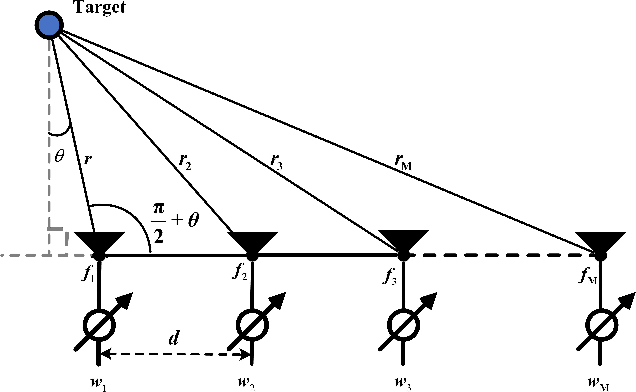
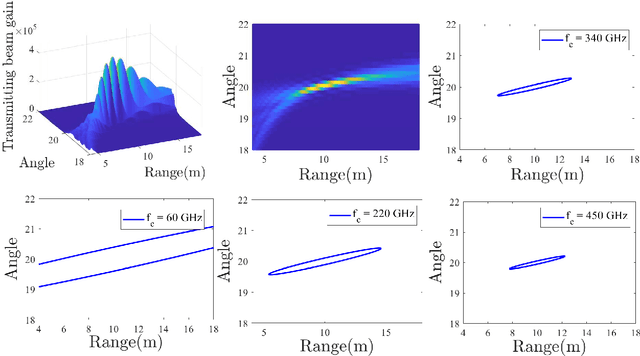
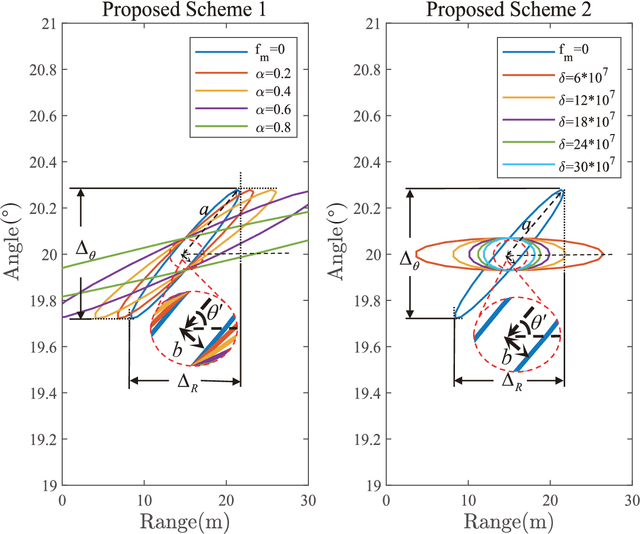
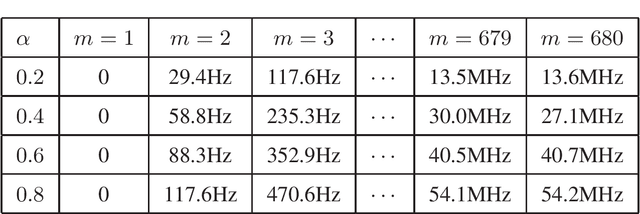
This paper considers a scenario in which the Terahertz (THz) transmitter equipped with a linear antenna array wishes to focus its beam to a desired spatial region in the array near-field. The goal is to compute the achievable spatial region and determine how the system parameters such as the carrier frequency, the array dimension and the user's location affect its beam focusing performance. First, based on a theorem from analytic geometry, we show that the achievable focusing spatial region constitutes a rotated ellipse, with the x and y coordinates denoting the range and angle, respectively. In this way, the determination of the spatial region is reduced to a problem of deriving the coverage of an ellipse. The achievable coverage is then obtained in closed form, and the construction of carrier frequency offsets that can analytically control the beam focusing performance is provided. Numerical results validate the theoretical findings and demonstrate the performance of the proposed method.
Improving THz Coverage for 6G URLLC Services via Exploiting Mobile Computing
May 25, 2021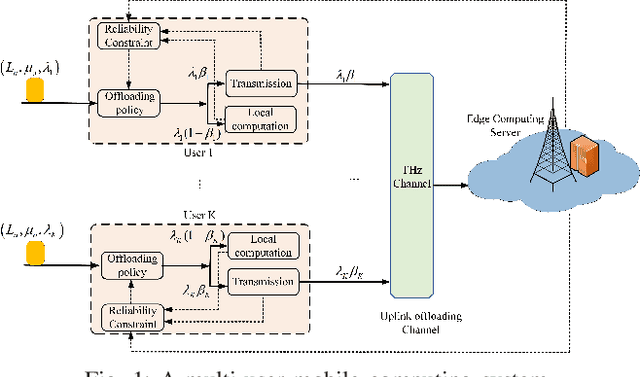
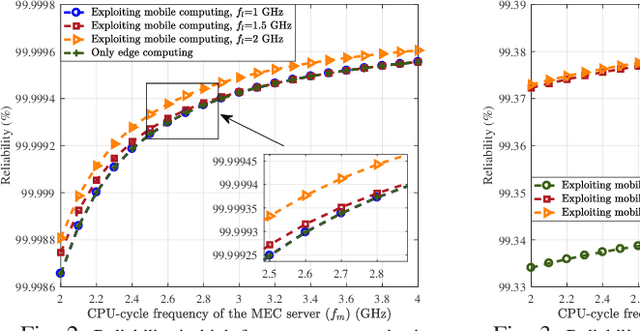
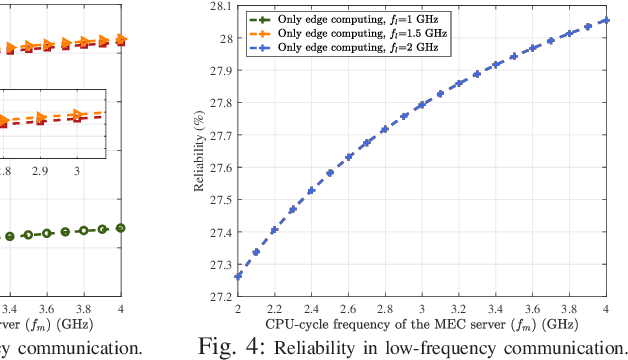
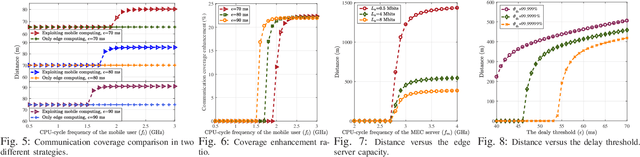
Terahertz (THz) communication (0.1-10 THz) is regarded as a promising technology, which provides rich available bandwidth and high data rate of terahertz bit per second (Tbps). However, THz signals suffer from high path loss, which profoundly decreases the transmission distance. To improve THz coverage, we consider the aid of mobile computing. Specifically, job offloading decision in mobile computing and frequency allocation in communication are co-designed to maximize distance and concurrently support ultra-reliable low-latency communications (URLLC) services for the sixth-generation (6G) mobile communication. Further, the above optimization problem is non-convex, then an effective and low-complexity method is proposed via exploiting the special structure of this problem. Finally, numerical results verify the effectiveness of our work.