 Add to Chrome
 Add to Firefox
 Add to Edge
Extended-Target Classification and Localization for Near-Field ISAC
Mar 24, 2026
Near-field integrated sensing and communication (ISAC) enables object-level sensing from distance-dependent array responses, yet most existing near-field methods still rely on point-target models and realistic extended targets remain largely unexplored. In this paper, joint target classification and range-azimuth localization are studied from channel responses of realistic extended targets. A dual-branch inference framework is proposed. Semantic and geometric branches are used for classification and localization, respectively. Cross-task attention is introduced after task-specific encoding so that complementary cues can be exchanged without forcing full feature sharing from the input stage. To improve localization on the same backbone, uncertainty-aware regression and a physics-guided structured objective are adopted, including planar consistency, peak-response regularization, and geometry-coupling constraints. Training and evaluation data are generated from full-wave electromagnetic scattering simulations of voxelized vehicle targets with randomized heading angles, material contrasts, and placements. The compared variants show that cross-task attention mainly benefits classification, while uncertainty-aware and structured supervision are needed to recover strong localization performance on the same backbone. Under the adopted shared-OFDM benchmark, the proposed framework reaches the best joint operating point with fewer sensing tones for the same target performance region.

A Spatio-Temporal-Frequency Transformer Framework for Near-Field Target Recognition
Mar 16, 2026A target recognition framework relying on near-field integrated sensing and communication (ISAC) systems is proposed. By exploiting the distance-dependent spatial signatures provided by the near-field spherical wavefront, high-accuracy sensing is realized in a bandwidth-efficient manner. A spatio--temporal--frequency (STF) transformer framework is introduced for target recognition using electromagnetic features found in the wireless channel response. In particular, a lightweight spatial encoder is employed to extract features from the antenna array for each frame and subcarrier. These features are then fused by a time-frequency transformer head with positional embeddings to model temporal dynamics and cross-subcarrier correlations. Simulation results demonstrate that strong target recognition performance can be achieved even with limited bandwidth resources.
Multistatic Integrated Sensing and Communication System in Cellular Networks
May 22, 2023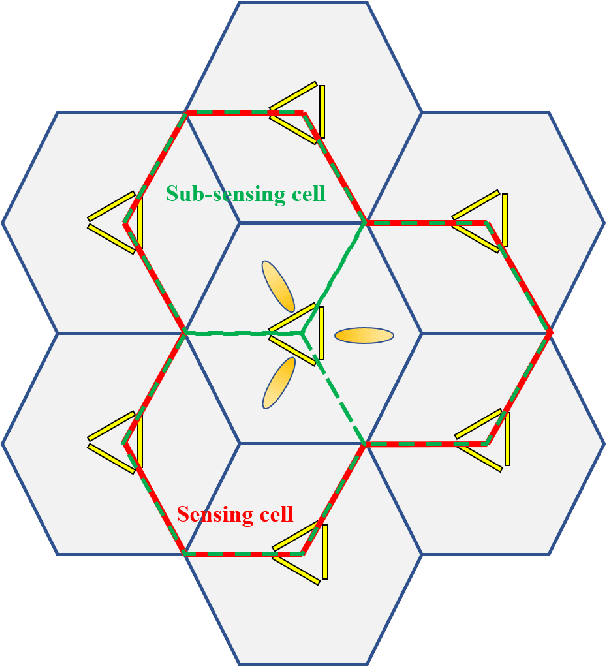

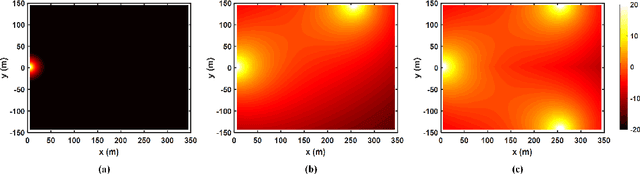
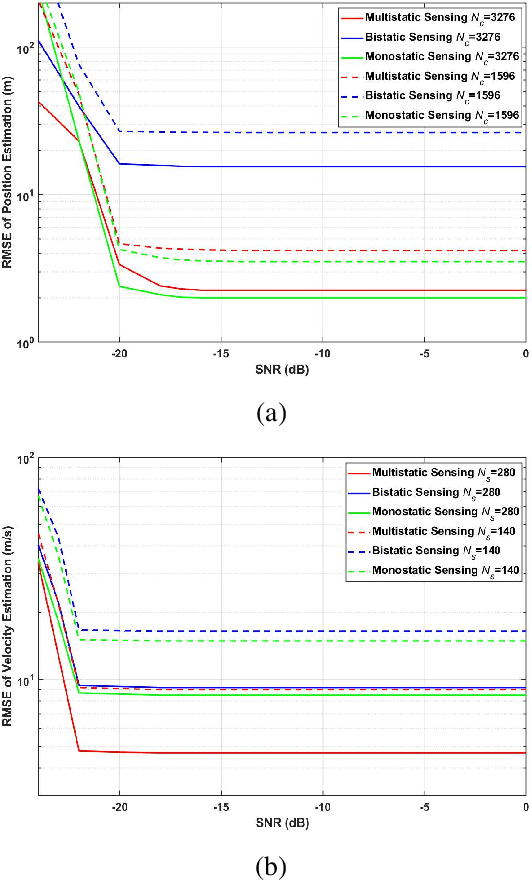
A novel multistatic multiple-input multiple-output (MIMO) integrated sensing and communication (ISAC) system in cellular networks is proposed. It can make use of widespread base stations (BSs) to perform cooperative sensing in wide area. This system is important since the deployment of sensing function can be achieved based on the existing mobile communication networks at a low cost. In this system, orthogonal frequency division multiplexing (OFDM) signals transmitted from the central BS are received and processed by each of the neighboring BSs to estimate sensing object parameters. A joint data processing method is then introduced to derive the closed-form solution of objects position and velocity. Numerical simulation shows that the proposed multistatic system can improve the position and velocity estimation accuracy compared with monostatic and bistatic system, demonstrating the effectiveness and promise of implementing ISAC in the upcoming fifth generation advanced (5G-A) and sixth generation (6G) mobile networks.