 Add to Chrome
 Add to Firefox
 Add to Edge
The Horizon Gap: Planning, Memory, Execution, Training, and Evaluation for Long-Horizon LLM Agents
Aug 07, 2026
Frontier language models solve reasoning problems in a single forward pass that would have been research contributions years ago, yet fail at multi-hour tasks: losing track of earlier decisions, declaring half-finished work done, or drifting from goals. We call this the horizon gap and survey 1,547 arXiv papers (2024-2026) collected via systematic seed harvest with a disclosed 26.8% bleed filter, extended by targeted supplementation. We disambiguate three routinely conflated properties: long-horizon (task property: required steps), long-context (model property: token capacity), and long-term memory (system property: persistence across steps/sessions). We organize the corpus into six categories tracking a long-horizon task's lifecycle -- planning, memory, execution, training, evaluation, and foundations/safety -- crossed with an axis capturing where horizons are carried (within-context, within-task-beyond-context, or cross-task-persistent). Across all categories, we find the same pattern: outcome-only signals grow uninformative as horizons lengthen, and the field's response -- whether process reward models, credit assignment, or trajectory-level diagnostics -- manufactures denser step-level signals. We treat critical and diagnostic literature as first-class threads throughout, arguing that segregating critique from method would routinely split single papers across chapters. We close by naming open measurement problems: decomposing model versus harness capability, managing correlated bias in process-level signals used for both training and evaluation, and whether long-horizon reliability admits general predictive theory.

The Calibration Floor: Format Repair Can Masquerade as Self-Correction at Small-to-Mid Scale
Aug 05, 2026Accuracy changes after language-model self-revision are usually interpreted as changes in reasoning. We show this can fail at the answer-extraction boundary, and test the failure causally rather than only observationally. Across Qwen3.5 (0.8B-9B), Gemma-4-12B, and two frontier models via API (Tencent Hy3, Nvidia Nemotron-3-Ultra-550B) in 29 primary cells plus a frontier arm, we decompose the always-revise accuracy shift into a content margin (both answers parseable) and format-recovery/loss margins (parseability changes). On 12 cells with meaningful unparseable-answer rates, format effects exceed content effects (Wilcoxon p=1.7e-3). To test this causally, we force already-generated reasoning through grammar-constrained decoding so every answer is parseable by construction: across 14 cells this closes a median 71% of the gap between the naive total effect and the content-margin estimate, with two cells converging exactly and a residual on the two largest-effect cells reported rather than dismissed. A clustered model confirms floor-scale (0.8B/2B) models have far higher odds of content-level change and harm than capable-scale models (p<1e-7). Replicating a cited confidence-gating protocol verbatim on Qwen3.5 does not reproduce its reported gain and shows the same near-zero content margin. A frontier check on much larger models shows format-dominance intensifying with scale: content margin is exactly zero in all 5 cells despite total effects up to +0.275, though this arm is lower-powered. The calibration-floor criterion on the content margin reveals a squeeze: floor-scale cells have headroom but insufficient signal, capable-scale cells have signal but little headroom; only one cell is marginally viable, with negligible sealed-holdout gain. Content is a minority share of what the field has measured as self-correction. We release the instrument, code, and derived results.
Recursive Self-Improvement in AI: From Bounded Self-Refinement to Autonomous Research Loops
Jul 08, 2026AI systems increasingly participate in their own improvement: revising their outputs, adapting their own harnesses during deployment, training on data they generate, and, increasingly, conducting AI research itself. This literature is described under a vocabulary ("self-refine," "self-reward," "self-play," "self-evolve") that conflates fundamentally different ambitions. We survey 1,250 arXiv papers (2024-2026) along two axes: what the system improves -- its behavior in deployment, its policy through training, its evaluator, or the research process itself -- and the degree of loop closure (human-in-the-loop to fully closed). The taxonomy separates bounded self-refinement -- convergent, evaluable, and already industrial practice -- from open-ended recursive self-improvement (RSI), which remains bounded by grounding requirements, collapse dynamics, and compute constraints on every measured axis. Its distinctive feature is a dedicated category for self-evaluation: every improvement loop is a claim that some signal can substitute for human judgment. We survey the evaluator design space -- judges, process reward models, verifiers, rubrics, meta-evaluation -- order the signals into a verification hierarchy from formal verifiers (strongest) to intrinsic self-assessment (weakest), and observe that demonstrated self-improvement strength tracks this hierarchy, that its failure modes (self-confirming loops, model collapse, diversity collapse) follow from its violations, and that the "research direction-setting" bottleneck keeping humans in the loop sits at the top of that hierarchy. We connect the technical literature to the theory of RSI limits and to the safety and governance questions raised by frontier-lab accounts of closing the loop, and identify governance-grade measurement of self-improvement as the field's most underpopulated niche.
EGAM: Extended Graph Attention Model for Solving Routing Problems
Jan 29, 2026Neural combinatorial optimization (NCO) solvers, implemented with graph neural networks (GNNs), have introduced new approaches for solving routing problems. Trained with reinforcement learning (RL), the state-of-the-art graph attention model (GAM) achieves near-optimal solutions without requiring expert knowledge or labeled data. In this work, we generalize the existing graph attention mechanism and propose the extended graph attention model (EGAM). Our model utilizes multi-head dot-product attention to update both node and edge embeddings, addressing the limitations of the conventional GAM, which considers only node features. We employ an autoregressive encoder-decoder architecture and train it with policy gradient algorithms that incorporate a specially designed baseline. Experiments show that EGAM matches or outperforms existing methods across various routing problems. Notably, the proposed model demonstrates exceptional performance on highly constrained problems, highlighting its efficiency in handling complex graph structures.
Multimodal Pre-training Based on Graph Attention Network for Document Understanding
Mar 25, 2022
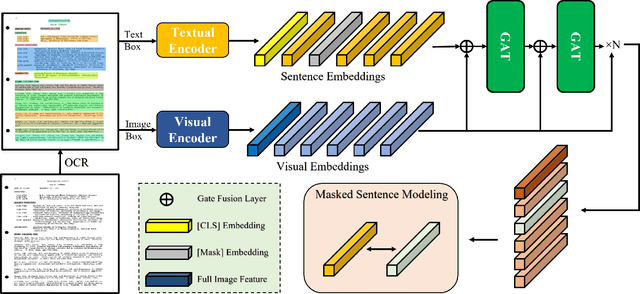
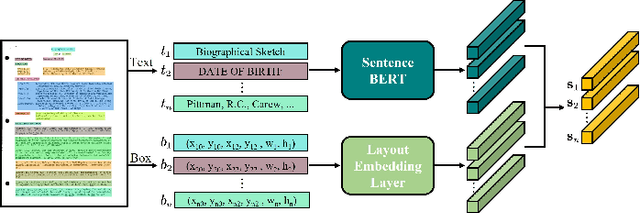
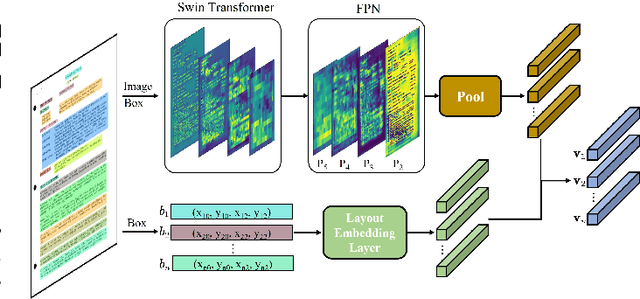
Document intelligence as a relatively new research topic supports many business applications. Its main task is to automatically read, understand, and analyze documents. However, due to the diversity of formats (invoices, reports, forms, etc.) and layouts in documents, it is difficult to make machines understand documents. In this paper, we present the GraphDoc, a multimodal graph attention-based model for various document understanding tasks. GraphDoc is pre-trained in a multimodal framework by utilizing text, layout, and image information simultaneously. In a document, a text block relies heavily on its surrounding contexts, so we inject the graph structure into the attention mechanism to form a graph attention layer so that each input node can only attend to its neighborhoods. The input nodes of each graph attention layer are composed of textual, visual, and positional features from semantically meaningful regions in a document image. We do the multimodal feature fusion of each node by the gate fusion layer. The contextualization between each node is modeled by the graph attention layer. GraphDoc learns a generic representation from only 320k unlabeled documents via the Masked Sentence Modeling task. Extensive experimental results on the publicly available datasets show that GraphDoc achieves state-of-the-art performance, which demonstrates the effectiveness of our proposed method.
SecureGBM: Secure Multi-Party Gradient Boosting
Nov 27, 2019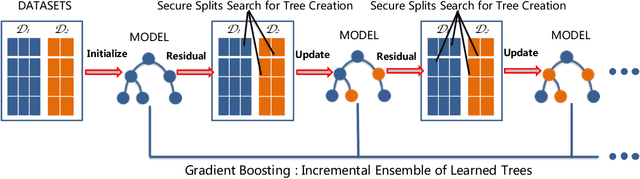
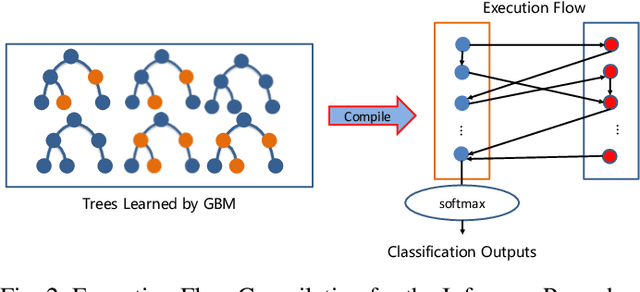
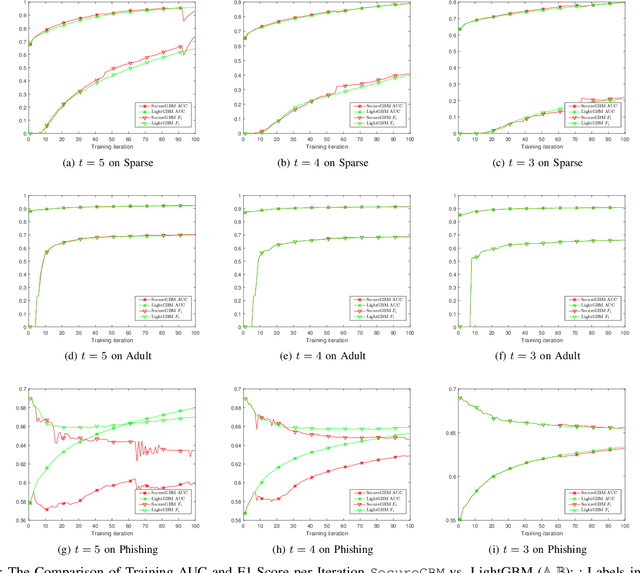
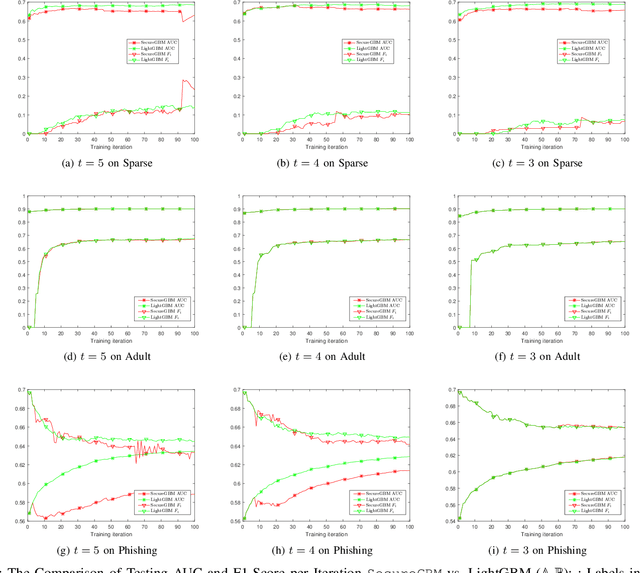
Federated machine learning systems have been widely used to facilitate the joint data analytics across the distributed datasets owned by the different parties that do not trust each others. In this paper, we proposed a novel Gradient Boosting Machines (GBM) framework SecureGBM built-up with a multi-party computation model based on semi-homomorphic encryption, where every involved party can jointly obtain a shared Gradient Boosting machines model while protecting their own data from the potential privacy leakage and inferential identification. More specific, our work focused on a specific "dual--party" secure learning scenario based on two parties -- both party own an unique view (i.e., attributes or features) to the sample group of samples while only one party owns the labels. In such scenario, feature and label data are not allowed to share with others. To achieve the above goal, we firstly extent -- LightGBM -- a well known implementation of tree-based GBM through covering its key operations for training and inference with SEAL homomorphic encryption schemes. However, the performance of such re-implementation is significantly bottle-necked by the explosive inflation of the communication payloads, based on ciphertexts subject to the increasing length of plaintexts. In this way, we then proposed to use stochastic approximation techniques to reduced the communication payloads while accelerating the overall training procedure in a statistical manner. Our experiments using the real-world data showed that SecureGBM can well secure the communication and computation of LightGBM training and inference procedures for the both parties while only losing less than 3% AUC, using the same number of iterations for gradient boosting, on a wide range of benchmark datasets.