 Add to Chrome
 Add to Firefox
 Add to Edge
The Horizon Gap: Planning, Memory, Execution, Training, and Evaluation for Long-Horizon LLM Agents
Aug 07, 2026
Frontier language models solve reasoning problems in a single forward pass that would have been research contributions years ago, yet fail at multi-hour tasks: losing track of earlier decisions, declaring half-finished work done, or drifting from goals. We call this the horizon gap and survey 1,547 arXiv papers (2024-2026) collected via systematic seed harvest with a disclosed 26.8% bleed filter, extended by targeted supplementation. We disambiguate three routinely conflated properties: long-horizon (task property: required steps), long-context (model property: token capacity), and long-term memory (system property: persistence across steps/sessions). We organize the corpus into six categories tracking a long-horizon task's lifecycle -- planning, memory, execution, training, evaluation, and foundations/safety -- crossed with an axis capturing where horizons are carried (within-context, within-task-beyond-context, or cross-task-persistent). Across all categories, we find the same pattern: outcome-only signals grow uninformative as horizons lengthen, and the field's response -- whether process reward models, credit assignment, or trajectory-level diagnostics -- manufactures denser step-level signals. We treat critical and diagnostic literature as first-class threads throughout, arguing that segregating critique from method would routinely split single papers across chapters. We close by naming open measurement problems: decomposing model versus harness capability, managing correlated bias in process-level signals used for both training and evaluation, and whether long-horizon reliability admits general predictive theory.

The Calibration Floor: Format Repair Can Masquerade as Self-Correction at Small-to-Mid Scale
Aug 05, 2026Accuracy changes after language-model self-revision are usually interpreted as changes in reasoning. We show this can fail at the answer-extraction boundary, and test the failure causally rather than only observationally. Across Qwen3.5 (0.8B-9B), Gemma-4-12B, and two frontier models via API (Tencent Hy3, Nvidia Nemotron-3-Ultra-550B) in 29 primary cells plus a frontier arm, we decompose the always-revise accuracy shift into a content margin (both answers parseable) and format-recovery/loss margins (parseability changes). On 12 cells with meaningful unparseable-answer rates, format effects exceed content effects (Wilcoxon p=1.7e-3). To test this causally, we force already-generated reasoning through grammar-constrained decoding so every answer is parseable by construction: across 14 cells this closes a median 71% of the gap between the naive total effect and the content-margin estimate, with two cells converging exactly and a residual on the two largest-effect cells reported rather than dismissed. A clustered model confirms floor-scale (0.8B/2B) models have far higher odds of content-level change and harm than capable-scale models (p<1e-7). Replicating a cited confidence-gating protocol verbatim on Qwen3.5 does not reproduce its reported gain and shows the same near-zero content margin. A frontier check on much larger models shows format-dominance intensifying with scale: content margin is exactly zero in all 5 cells despite total effects up to +0.275, though this arm is lower-powered. The calibration-floor criterion on the content margin reveals a squeeze: floor-scale cells have headroom but insufficient signal, capable-scale cells have signal but little headroom; only one cell is marginally viable, with negligible sealed-holdout gain. Content is a minority share of what the field has measured as self-correction. We release the instrument, code, and derived results.
Recursive Self-Improvement in AI: From Bounded Self-Refinement to Autonomous Research Loops
Jul 08, 2026AI systems increasingly participate in their own improvement: revising their outputs, adapting their own harnesses during deployment, training on data they generate, and, increasingly, conducting AI research itself. This literature is described under a vocabulary ("self-refine," "self-reward," "self-play," "self-evolve") that conflates fundamentally different ambitions. We survey 1,250 arXiv papers (2024-2026) along two axes: what the system improves -- its behavior in deployment, its policy through training, its evaluator, or the research process itself -- and the degree of loop closure (human-in-the-loop to fully closed). The taxonomy separates bounded self-refinement -- convergent, evaluable, and already industrial practice -- from open-ended recursive self-improvement (RSI), which remains bounded by grounding requirements, collapse dynamics, and compute constraints on every measured axis. Its distinctive feature is a dedicated category for self-evaluation: every improvement loop is a claim that some signal can substitute for human judgment. We survey the evaluator design space -- judges, process reward models, verifiers, rubrics, meta-evaluation -- order the signals into a verification hierarchy from formal verifiers (strongest) to intrinsic self-assessment (weakest), and observe that demonstrated self-improvement strength tracks this hierarchy, that its failure modes (self-confirming loops, model collapse, diversity collapse) follow from its violations, and that the "research direction-setting" bottleneck keeping humans in the loop sits at the top of that hierarchy. We connect the technical literature to the theory of RSI limits and to the safety and governance questions raised by frontier-lab accounts of closing the loop, and identify governance-grade measurement of self-improvement as the field's most underpopulated niche.
CLQT: A Closed-Loop, Cost-Aware, Strategy-Consistent Benchmark for Diagnostic Evaluation of LLM Portfolio-Management Agents
Jun 29, 2026LLM agents are increasingly cast as autonomous portfolio managers, and benchmarks have moved from financial question-answering to sequential trading. Yet most still rank agents by returns over a fixed window -- a weak proxy, since a period's return is dominated by the market path and apparent alpha can dissolve once look-ahead leakage is controlled. Such a ranking certifies neither sound reasoning, nor a consistent strategy, nor a durable edge. We introduce CLQT, which reframes closed-loop trading evaluation as diagnosis rather than ranking: an instrument that localizes where and why an agent's process succeeds or fails. CLQT is a fully closed-loop, cost-aware, strategy-consistent, temporally-gated environment whose agents run a five-stage cycle: gather, synthesize, allocate, execute, reflect. Each round emits a complete DecisionRound sealed into a recompute-verifiable hash chain, so every metric is reconstructable from the trail. Six pillars form the substrate: a hard TimeGate, institutional transaction- and financing-cost modeling, strategy-consistency scoring, three-tier memory, a Model-Context-Protocol tool layer, and mandate-aware synthesis. The same agent runs as a constrained committee of specialized roles or a single full-autonomy orchestrator, making process scaffolding an experimental variable. From the audit trail we compute a five-axis capability scorecard (APM-CS: Coherence, Acuity, Composure, Discipline, Reliability), with Coherence judged partly by a held-out, out-of-cohort LLM to curb self-preference bias. We validate it on a contamination-controlled multi-model backtest with an ablation grid and a live broker track on unseen, post-cutoff data, against a repeated-run noise floor. CLQT separates outcome from capability, yielding not a model ranking but a durable, extensible map of agent competencies and limitations.
InvestPhilBench: A Multi-Layer Dynamic Benchmark for Evaluating Large Language Model Procedural Reasoning in Expert Investment Philosophy
Jun 24, 2026Large language models are increasingly deployed as investment research assistants, yet no benchmark tests whether they can accurately reconstruct and apply the specific procedural decision frameworks of expert investors. We introduce InvestPhilBench, a multi-layer dynamic benchmark spanning eight cognitive tiers, from principle identification (L1) to novel framework extrapolation (L8). The v0.6 release comprises 118 primary-source-verified investment principle cards, 25 decision framework cards with explicit topology metadata, and 243 QA questions (197 dev / 46 held-out test). For reproducible scoring at scale we introduce the Benchmark Automated Scoring Pipeline (BASP) -- five algorithmic metrics (OGRS, KCCS, SAP@k, IVP, CKCA) -- the Failure Mode Detection Protocol (FMDP) with computable rules for six failure modes, and Gate Reconstruction Accuracy (GRA), a per-gate metric for questions with gold reasoning programs. In this release, InvestPhilBench is primarily a benchmark-and-methodology contribution. A four-model sanity wave on the 188-question development split shows a sharp provider-tier split (BASP 0.906 vs. 0.438); these mixed-judge numbers are confounded upper bounds. The central finding: the BASP composite saturates at the frontier (Claude L4 = 0.932) while GRA still exposes a procedural deficit (frontier L4 GRA approx. 0.77, L7 GRA 0.57-0.62) -- composite scoring rewards fluent prose and hides the procedural gap. v0.6 implements a unified judge and true model-in-the-loop retrieval/oracle conditions; the de-confounded multi-model leaderboard and full three-condition run are v1.0 deliverables. On a 100-item expert-annotated gold set the automated BASP composite tracks the human reference at Pearson r = 0.72 (MAE = 0.10), with attribution (SAP@3) the weakest sub-metric and the failure-mode detector running sensitive-but-over-flagging.
EDFFDNet: Towards Accurate and Efficient Unsupervised Multi-Grid Image Registration
Sep 09, 2025Previous deep image registration methods that employ single homography, multi-grid homography, or thin-plate spline often struggle with real scenes containing depth disparities due to their inherent limitations. To address this, we propose an Exponential-Decay Free-Form Deformation Network (EDFFDNet), which employs free-form deformation with an exponential-decay basis function. This design achieves higher efficiency and performs well in scenes with depth disparities, benefiting from its inherent locality. We also introduce an Adaptive Sparse Motion Aggregator (ASMA), which replaces the MLP motion aggregator used in previous methods. By transforming dense interactions into sparse ones, ASMA reduces parameters and improves accuracy. Additionally, we propose a progressive correlation refinement strategy that leverages global-local correlation patterns for coarse-to-fine motion estimation, further enhancing efficiency and accuracy. Experiments demonstrate that EDFFDNet reduces parameters, memory, and total runtime by 70.5%, 32.6%, and 33.7%, respectively, while achieving a 0.5 dB PSNR gain over the state-of-the-art method. With an additional local refinement stage,EDFFDNet-2 further improves PSNR by 1.06 dB while maintaining lower computational costs. Our method also demonstrates strong generalization ability across datasets, outperforming previous deep learning methods.
Multi-task CNN Behavioral Embedding Model For Transaction Fraud Detection
Nov 29, 2024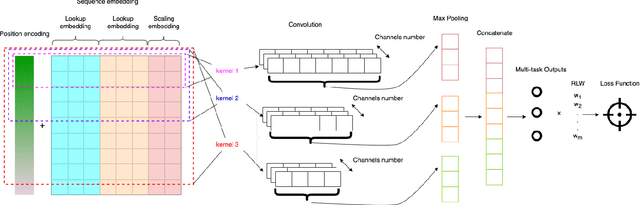
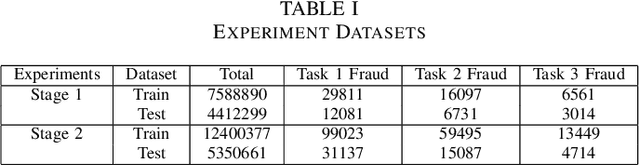
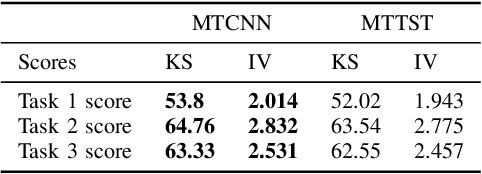
The burgeoning e-Commerce sector requires advanced solutions for the detection of transaction fraud. With an increasing risk of financial information theft and account takeovers, deep learning methods have become integral to the embedding of behavior sequence data in fraud detection. However, these methods often struggle to balance modeling capabilities and efficiency and incorporate domain knowledge. To address these issues, we introduce the multitask CNN behavioral Embedding Model for Transaction Fraud Detection. Our contributions include 1) introducing a single-layer CNN design featuring multirange kernels which outperform LSTM and Transformer models in terms of scalability and domain-focused inductive bias, and 2) the integration of positional encoding with CNN to introduce sequence-order signals enhancing overall performance, and 3) implementing multitask learning with randomly assigned label weights, thus removing the need for manual tuning. Testing on real-world data reveals our model's enhanced performance of downstream transaction models and comparable competitiveness with the Transformer Time Series (TST) model.
MuVAM: A Multi-View Attention-based Model for Medical Visual Question Answering
Jul 07, 2021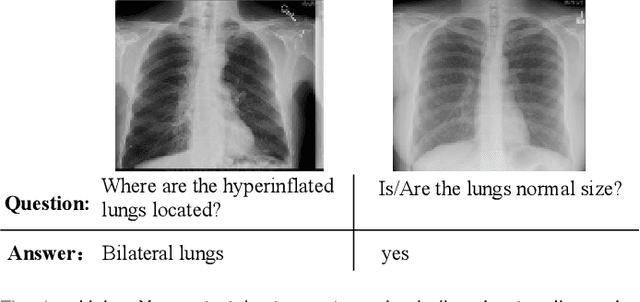
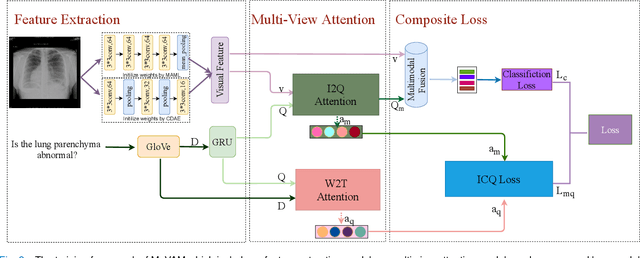
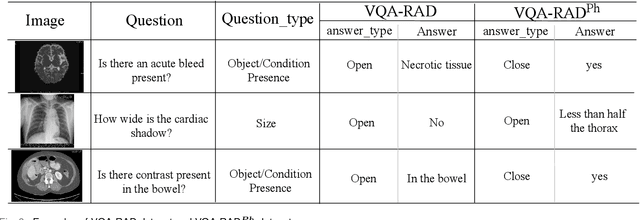
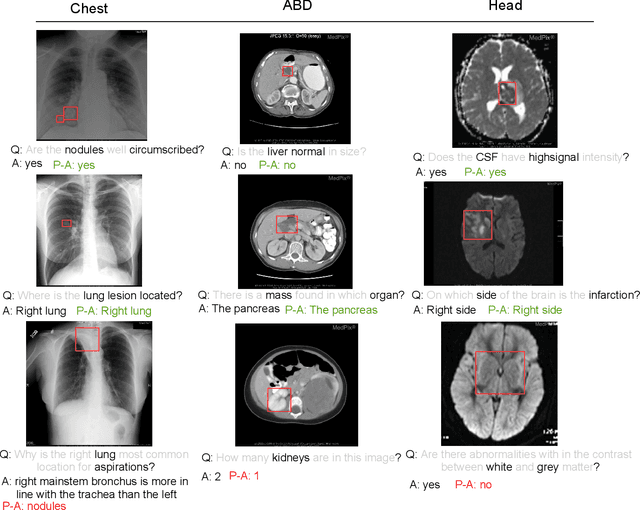
Medical Visual Question Answering (VQA) is a multi-modal challenging task widely considered by research communities of the computer vision and natural language processing. Since most current medical VQA models focus on visual content, ignoring the importance of text, this paper proposes a multi-view attention-based model(MuVAM) for medical visual question answering which integrates the high-level semantics of medical images on the basis of text description. Firstly, different methods are utilized to extract the features of the image and the question for the two modalities of vision and text. Secondly, this paper proposes a multi-view attention mechanism that include Image-to-Question (I2Q) attention and Word-to-Text (W2T) attention. Multi-view attention can correlate the question with image and word in order to better analyze the question and get an accurate answer. Thirdly, a composite loss is presented to predict the answer accurately after multi-modal feature fusion and improve the similarity between visual and textual cross-modal features. It consists of classification loss and image-question complementary (IQC) loss. Finally, for data errors and missing labels in the VQA-RAD dataset, we collaborate with medical experts to correct and complete this dataset and then construct an enhanced dataset, VQA-RADPh. The experiments on these two datasets show that the effectiveness of MuVAM surpasses the state-of-the-art method.
Deep Attributed Network Representation Learning via Attribute Enhanced Neighborhood
Apr 12, 2021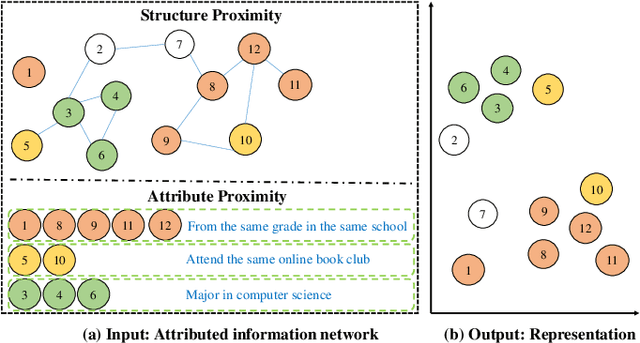
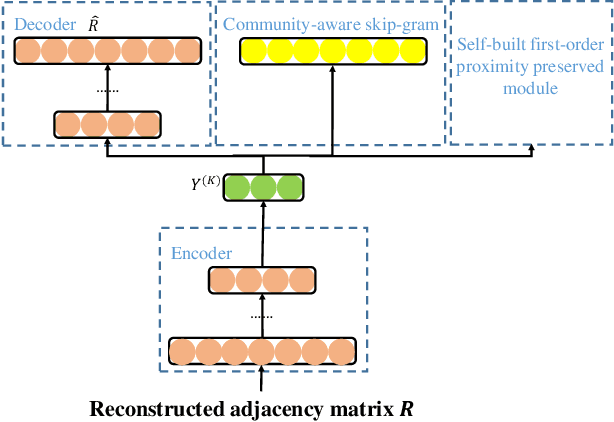
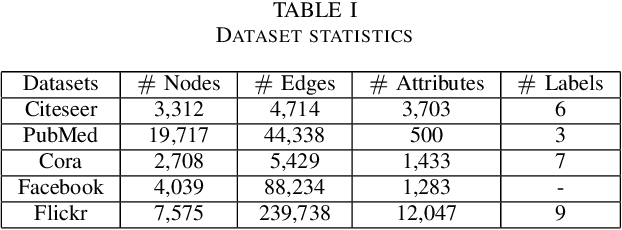
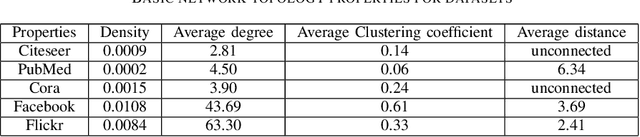
Attributed network representation learning aims at learning node embeddings by integrating network structure and attribute information. It is a challenge to fully capture the microscopic structure and the attribute semantics simultaneously, where the microscopic structure includes the one-step, two-step and multi-step relations, indicating the first-order, second-order and high-order proximity of nodes, respectively. In this paper, we propose a deep attributed network representation learning via attribute enhanced neighborhood (DANRL-ANE) model to improve the robustness and effectiveness of node representations. The DANRL-ANE model adopts the idea of the autoencoder, and expands the decoder component to three branches to capture different order proximity. We linearly combine the adjacency matrix with the attribute similarity matrix as the input of our model, where the attribute similarity matrix is calculated by the cosine similarity between the attributes based on the social homophily. In this way, we preserve the second-order proximity to enhance the robustness of DANRL-ANE model on sparse networks, and deal with the topological and attribute information simultaneously. Moreover, the sigmoid cross-entropy loss function is extended to capture the neighborhood character, so that the first-order proximity is better preserved. We compare our model with the state-of-the-art models on five real-world datasets and two network analysis tasks, i.e., link prediction and node classification. The DANRL-ANE model performs well on various networks, even on sparse networks or networks with isolated nodes given the attribute information is sufficient.