 Add to Chrome
 Add to Firefox
 Add to Edge
Warp-free Cross-view Geo-localization via Feature-space Consensus Mining
Aug 10, 2026
Cross-view geo-localization is challenging due to drastic viewpoint changes and large appearance discrepancies between street-level and satellite imagery. Although existing methods often use geometric warping to expose co-visible cues, such transformations rely on restrictive spatial assumptions and inevitably introduce severe visual distortions under view-dependent visibility, yielding noisy supervision and fragile correspondences. To overcome this, we propose a novel joint-view consensus-guided learning framework that entirely bypasses explicit geometric warping. Instead of forcing rigid spatial alignment, we dynamically mine and adaptively strengthen a semantic consensus directly within the feature space. Specifically, an auxiliary joint-view pathway during training enables direct cross-view interaction, allowing each view to selectively aggregate corroborative evidence into a unified consensus representation. To resolve feature heterogeneity among the single- and joint-view streams, we introduce global pattern probes acting as a semantic dictionary to project divergent modalities into a strictly aligned metric space. Guided by a consensus-mediated contrastive objective, single-view embeddings are explicitly pulled toward the joint-view anchor during training, distilling this consensus-mining capability into the single-view encoders for robust retrieval at inference. Extensive experiments demonstrate that our method achieves state-of-the-art performance across four standard benchmarks, underscoring the importance of discovering cross-view semantic consensus for reliable geo-localization.

Learning Structured Visual Compositional Representations for Weakly Supervised Referring Expression Comprehension
Jul 06, 2026Referring expression comprehension (REC) aims to localize the object in an image described by natural language. In Weakly supervised REC (WREC), existing approaches primarily operate on anchor-level visual representations. Even when enriched with auxiliary cues, relational interactions remain implicitly encoded within individual anchor features. The resulting visual representation remains flat and unary-only, limiting its ability to align with the structured nature of language. In this work, we propose a Structured Visual Compositional Representation (SVCR) learning framework for WREC. Rather than implicitly encoding relations within unary anchors, the proposed SVCR explicitly models both unary object embeddings and pairwise relational embeddings, forming a structured visual representation space. We further introduce a compositional alignment mechanism that matches unary and pairwise visual representations with their corresponding textual embeddings in a unified manner, enabling compositional visual-textual matching under weak supervision. Extensive experiments on RefCOCO, RefCOCO+, and RefCOCOg show that the proposed SVCR achieves state-of-the-art performance. These results demonstrate the effectiveness of explicit structured visual representations and visual-textual alignment for WREC.
ScalePredictor: Instance-aware Scale Learning for Accurate Quantization of Vision Transformers
Jun 20, 2026Vision Transformers have achieved remarkable success in many fields, yet their deployment on edge devices remains challenging due to their substantial computational demands. Post-Training Quantization (PTQ) offers an attractive solution by compressing models using a small calibration set with minimal training overhead. However, most existing PTQ works adopt a static quantization paradigm that is uniformly applied to all instances. Given the substantial diversity of natural images, the activation distributions vary significantly across samples, making these methods inherently suboptimal. In this paper, we propose ScalePredictor, a dynamic quantization framework for accurate and efficient quantization scale learning of ViTs. We first reveal a hidden correlation between the distribution range of shallow-layer activations and the optimal scales of deeper layers. Based on this, we develop a scale learning mechanism that integrates an efficient range extraction approach to capture robust range statistics at the shallow stage, which are then fed into a Taylor-motivated polynomial scale projection module to generate all quantization scales simultaneously. With the efficiency of polynomial approximation, ScalePredictor introduces insignificant computational overhead while avoiding costly just-in-time calibration. Extensive experiments on ImageNet demonstrate that ScalePredictor consistently outperforms prior PTQ methods, achieving a more favorable accuracy-efficiency trade-off. Code and additional results are shown in the supplementary materials.
TS-Fault: Benchmarking Time Series Forecasters Against Structural Faults
Jun 16, 2026Time series forecasting (TSF) underpins consequential decisions in energy, transportation, finance, and healthcare, yet TSF models are almost universally ranked by a single number (e.g., average error) on clean held-out data, under the implicit assumption that it predicts deployed reliability. However, real faults are not i.i.d noise but structured events with temporal shape, broken cross-variable dependencies, regime change coupled with missingness, and causal propagation across a sensing pipeline. Treating TSF robustness as a data-quality problem, we present TS-Fault, a benchmark that evaluates forecasting models under explicit, parameterized fault scenarios with controllable semantic difficulty. TS-Fault organizes recurring failures into four modes along two orthogonal axes (observation- vs mechanism-level; univariate vs multivariate) and injects each fault into the most prediction-critical window via a unified importance score. This design enables robustness to be tested against the structures models actually rely on, rather than reduced to generic noise sensitivity. We evaluate 21 models across 6 datasets, 4 modes, and 5 difficulty levels under a paired clean/corrupt protocol. The results reveal three findings that contradict common leaderboard intuition: (i) clean-data accuracy anti-correlates with robustness; (ii) clean rankings are preserved under observation-level faults but reshuffled under mechanism-level faults; and (iii) all catastrophic failures occur under mechanism-level faults, with foundation models achieving the highest clean-data accuracy yet exhibiting the greatest fragility. The code is publicly available at https://github.com/Ray-zyy/TS-Fault.
Fact or Fake? Assessing the Role of Deepfake Detectors in Multimodal Misinformation Detection
Feb 02, 2026In multimodal misinformation, deception usually arises not just from pixel-level manipulations in an image, but from the semantic and contextual claim jointly expressed by the image-text pair. Yet most deepfake detectors, engineered to detect pixel-level forgeries, do not account for claim-level meaning, despite their growing integration in automated fact-checking (AFC) pipelines. This raises a central scientific and practical question: Do pixel-level detectors contribute useful signal for verifying image-text claims, or do they instead introduce misleading authenticity priors that undermine evidence-based reasoning? We provide the first systematic analysis of deepfake detectors in the context of multimodal misinformation detection. Using two complementary benchmarks, MMFakeBench and DGM4, we evaluate: (1) state-of-the-art image-only deepfake detectors, (2) an evidence-driven fact-checking system that performs tool-guided retrieval via Monte Carlo Tree Search (MCTS) and engages in deliberative inference through Multi-Agent Debate (MAD), and (3) a hybrid fact-checking system that injects detector outputs as auxiliary evidence. Results across both benchmark datasets show that deepfake detectors offer limited standalone value, achieving F1 scores in the range of 0.26-0.53 on MMFakeBench and 0.33-0.49 on DGM4, and that incorporating their predictions into fact-checking pipelines consistently reduces performance by 0.04-0.08 F1 due to non-causal authenticity assumptions. In contrast, the evidence-centric fact-checking system achieves the highest performance, reaching F1 scores of approximately 0.81 on MMFakeBench and 0.55 on DGM4. Overall, our findings demonstrate that multimodal claim verification is driven primarily by semantic understanding and external evidence, and that pixel-level artifact signals do not reliably enhance reasoning over real-world image-text misinformation.
Hybrid Transformer-Mamba Architecture for Weakly Supervised Volumetric Medical Segmentation
Dec 11, 2025Weakly supervised semantic segmentation offers a label-efficient solution to train segmentation models for volumetric medical imaging. However, existing approaches often rely on 2D encoders that neglect the inherent volumetric nature of the data. We propose TranSamba, a hybrid Transformer-Mamba architecture designed to capture 3D context for weakly supervised volumetric medical segmentation. TranSamba augments a standard Vision Transformer backbone with Cross-Plane Mamba blocks, which leverage the linear complexity of state space models for efficient information exchange across neighboring slices. The information exchange enhances the pairwise self-attention within slices computed by the Transformer blocks, directly contributing to the attention maps for object localization. TranSamba achieves effective volumetric modeling with time complexity that scales linearly with the input volume depth and maintains constant memory usage for batch processing. Extensive experiments on three datasets demonstrate that TranSamba establishes new state-of-the-art performance, consistently outperforming existing methods across diverse modalities and pathologies. Our source code and trained models are openly accessible at: https://github.com/YihengLyu/TranSamba.
Auxiliary Tasks Enhanced Dual-affinity Learning for Weakly Supervised Semantic Segmentation
Mar 02, 2024
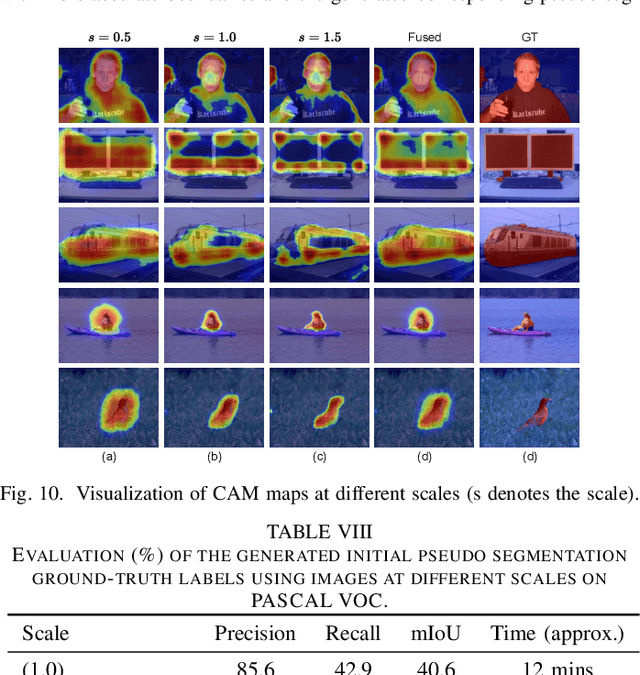
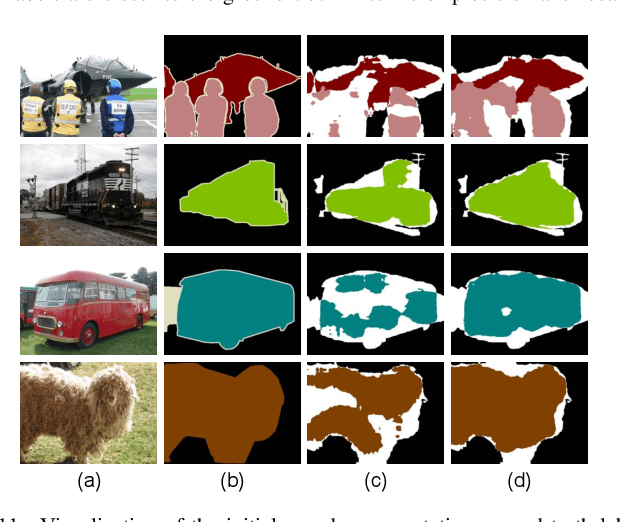

Most existing weakly supervised semantic segmentation (WSSS) methods rely on Class Activation Mapping (CAM) to extract coarse class-specific localization maps using image-level labels. Prior works have commonly used an off-line heuristic thresholding process that combines the CAM maps with off-the-shelf saliency maps produced by a general pre-trained saliency model to produce more accurate pseudo-segmentation labels. We propose AuxSegNet+, a weakly supervised auxiliary learning framework to explore the rich information from these saliency maps and the significant inter-task correlation between saliency detection and semantic segmentation. In the proposed AuxSegNet+, saliency detection and multi-label image classification are used as auxiliary tasks to improve the primary task of semantic segmentation with only image-level ground-truth labels. We also propose a cross-task affinity learning mechanism to learn pixel-level affinities from the saliency and segmentation feature maps. In particular, we propose a cross-task dual-affinity learning module to learn both pairwise and unary affinities, which are used to enhance the task-specific features and predictions by aggregating both query-dependent and query-independent global context for both saliency detection and semantic segmentation. The learned cross-task pairwise affinity can also be used to refine and propagate CAM maps to provide better pseudo labels for both tasks. Iterative improvement of segmentation performance is enabled by cross-task affinity learning and pseudo-label updating. Extensive experiments demonstrate the effectiveness of the proposed approach with new state-of-the-art WSSS results on the challenging PASCAL VOC and MS COCO benchmarks.
MCTformer+: Multi-Class Token Transformer for Weakly Supervised Semantic Segmentation
Aug 06, 2023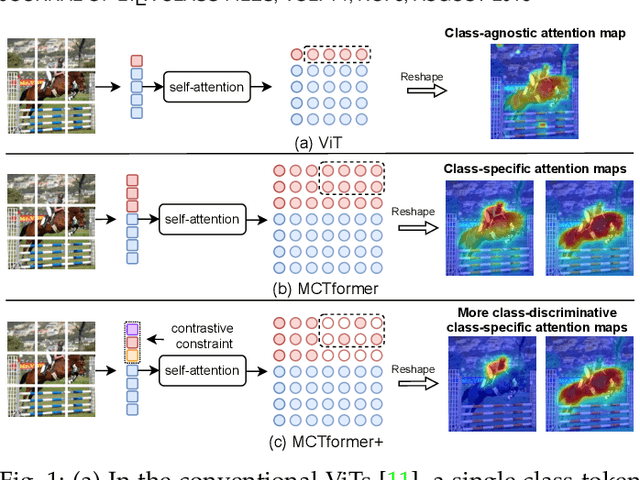
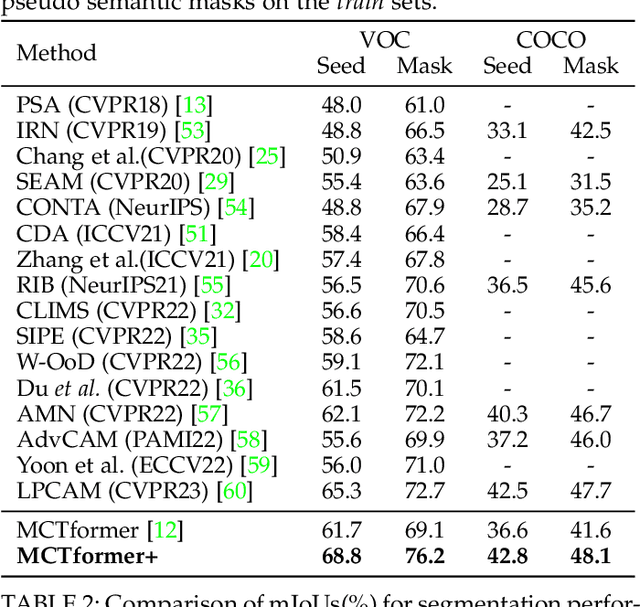
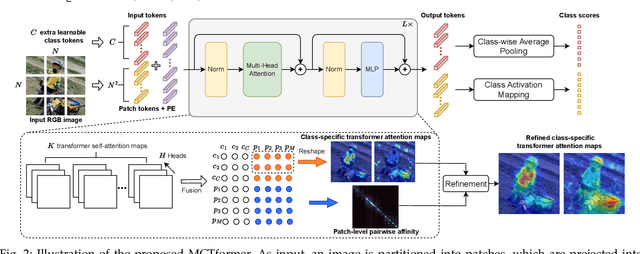
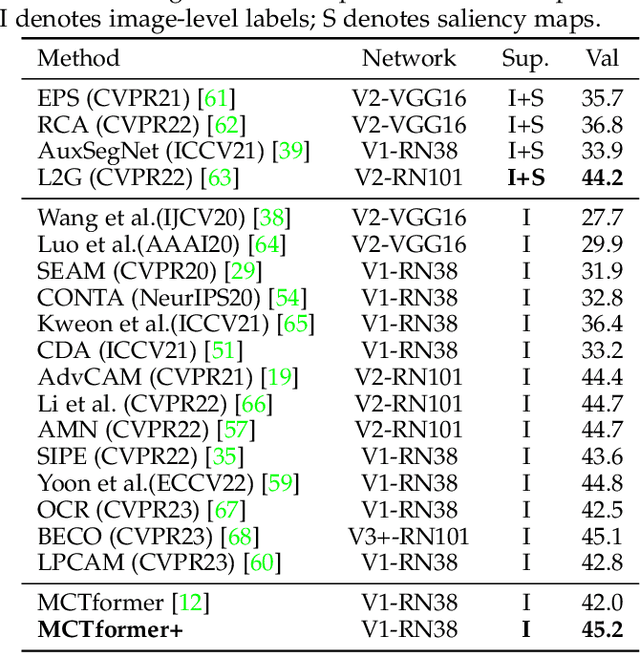
This paper proposes a novel transformer-based framework that aims to enhance weakly supervised semantic segmentation (WSSS) by generating accurate class-specific object localization maps as pseudo labels. Building upon the observation that the attended regions of the one-class token in the standard vision transformer can contribute to a class-agnostic localization map, we explore the potential of the transformer model to capture class-specific attention for class-discriminative object localization by learning multiple class tokens. We introduce a Multi-Class Token transformer, which incorporates multiple class tokens to enable class-aware interactions with the patch tokens. To achieve this, we devise a class-aware training strategy that establishes a one-to-one correspondence between the output class tokens and the ground-truth class labels. Moreover, a Contrastive-Class-Token (CCT) module is proposed to enhance the learning of discriminative class tokens, enabling the model to better capture the unique characteristics and properties of each class. As a result, class-discriminative object localization maps can be effectively generated by leveraging the class-to-patch attentions associated with different class tokens. To further refine these localization maps, we propose the utilization of patch-level pairwise affinity derived from the patch-to-patch transformer attention. Furthermore, the proposed framework seamlessly complements the Class Activation Mapping (CAM) method, resulting in significantly improved WSSS performance on the PASCAL VOC 2012 and MS COCO 2014 datasets. These results underline the importance of the class token for WSSS.
Active-Passive SimStereo -- Benchmarking the Cross-Generalization Capabilities of Deep Learning-based Stereo Methods
Sep 17, 2022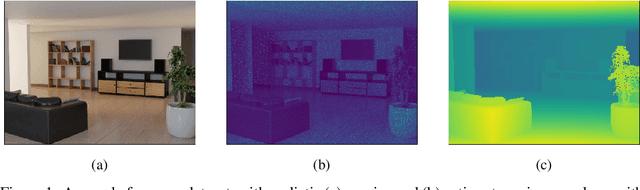

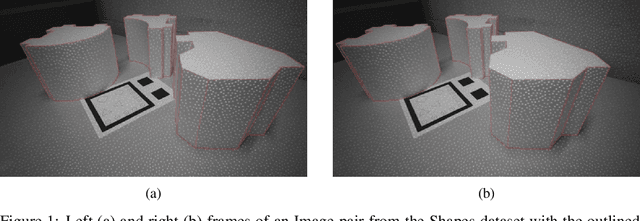
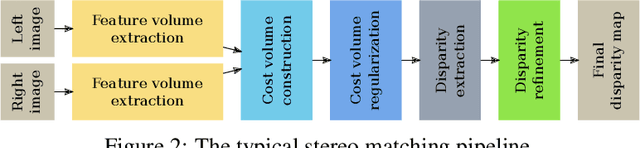
In stereo vision, self-similar or bland regions can make it difficult to match patches between two images. Active stereo-based methods mitigate this problem by projecting a pseudo-random pattern on the scene so that each patch of an image pair can be identified without ambiguity. However, the projected pattern significantly alters the appearance of the image. If this pattern acts as a form of adversarial noise, it could negatively impact the performance of deep learning-based methods, which are now the de-facto standard for dense stereo vision. In this paper, we propose the Active-Passive SimStereo dataset and a corresponding benchmark to evaluate the performance gap between passive and active stereo images for stereo matching algorithms. Using the proposed benchmark and an additional ablation study, we show that the feature extraction and matching modules of a selection of twenty selected deep learning-based stereo matching methods generalize to active stereo without a problem. However, the disparity refinement modules of three of the twenty architectures (ACVNet, CascadeStereo, and StereoNet) are negatively affected by the active stereo patterns due to their reliance on the appearance of the input images.
A Guide to Image and Video based Small Object Detection using Deep Learning : Case Study of Maritime Surveillance
Jul 26, 2022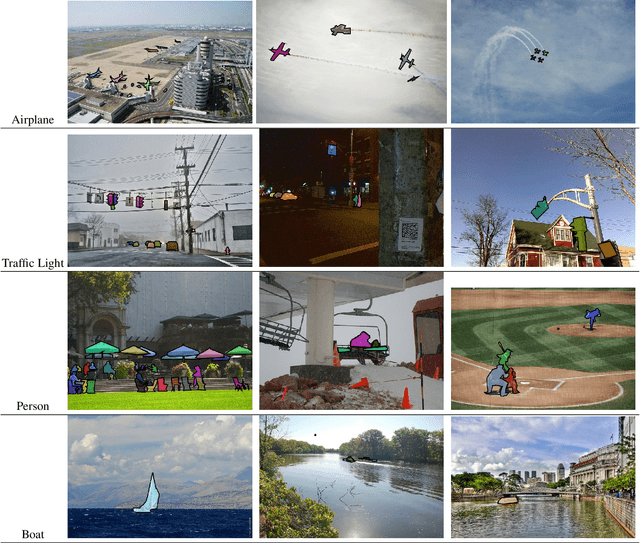
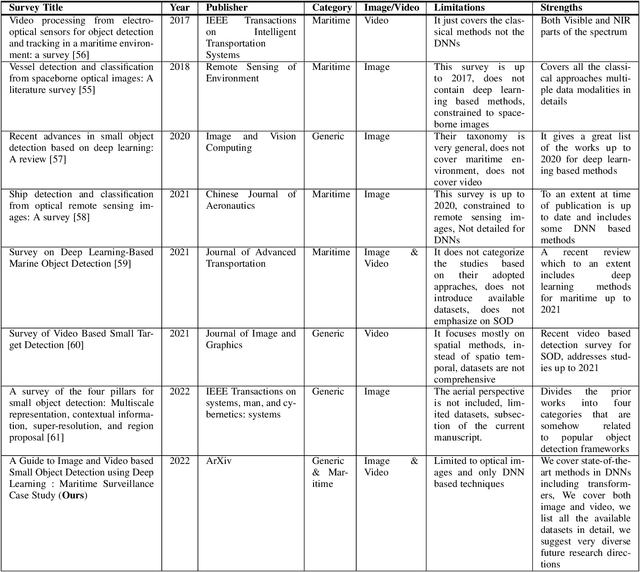
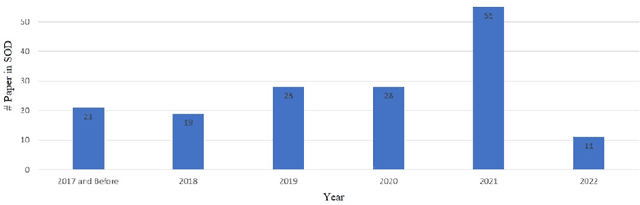
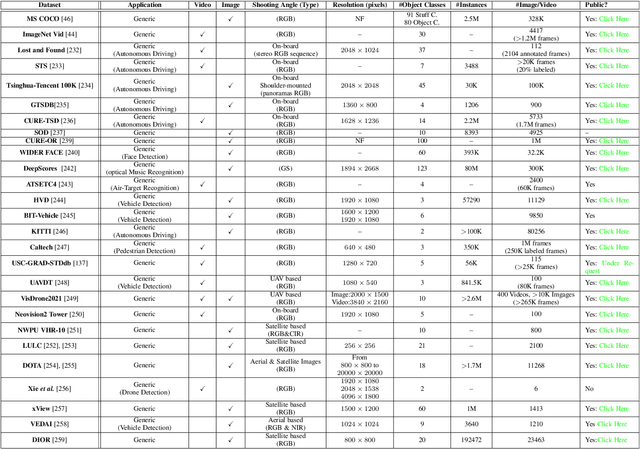
Small object detection (SOD) in optical images and videos is a challenging problem that even state-of-the-art generic object detection methods fail to accurately localize and identify such objects. Typically, small objects appear in real-world due to large camera-object distance. Because small objects occupy only a small area in the input image (e.g., less than 10%), the information extracted from such a small area is not always rich enough to support decision making. Multidisciplinary strategies are being developed by researchers working at the interface of deep learning and computer vision to enhance the performance of SOD deep learning based methods. In this paper, we provide a comprehensive review of over 160 research papers published between 2017 and 2022 in order to survey this growing subject. This paper summarizes the existing literature and provide a taxonomy that illustrates the broad picture of current research. We investigate how to improve the performance of small object detection in maritime environments, where increasing performance is critical. By establishing a connection between generic and maritime SOD research, future directions have been identified. In addition, the popular datasets that have been used for SOD for generic and maritime applications are discussed, and also well-known evaluation metrics for the state-of-the-art methods on some of the datasets are provided.